Friday, April 9, 2010

The Crystal Ballroom, 1332 W. Burnside, Portland, OR Performance List January-June 1968 (Oregon III)

(The poster from the February 2-3, 1968 performance by The Grateful Dead and Quicksilver Messenger Service at Portland's Crystal Ballroom)

This post is the third and last part of a series listing the rock performances at the Crystal Ballroom in Portland, Oregon in 1967 and 1968. Also see
Portland, Oregon
Portland, Oregon was a regular stop on the touring circuit for all kinds of entertainment, but in the late 1960s it was not a major or important market. As a result of Portland’s then modest status and a tolerant attitude befitting its status as port city on the West Coast, it became a sort of satellite of the San Francisco scene. 

The Crystal Ballroom, 1332 West Burnside at N.W. 14th Avenue, Portland, OR, 97209
The Crystal Ballroom at 1332 West Burnside (at NW 14th) was built in 1914 as the Cotillion Dancehall.  It was constructed with a mechanical “Floating Dance Floor” (on ball bearings), a concept that was thought to be unique on the West Coast at the time. The building was used for dances, parties and musical performances throughout its history. The complete history of the Crystal, and in effect the entertainment history of downtown Portland, can be found in Tim Hills' book The Many Lives Of The Crystal Ballroom (1997: McMenamins Pubs & Breweries). This book is the principal source of almost all the information currently available on the web about the Crystal, and I have relied on it heavily here for background and facts about both the Crystal and the Portland scene in general.

In the early 1960s, the Crystal became an important stop on the Rhythm and Blues circuit, and many famous R&B acts like James Brown and Ike & Tina Turner had memorable performances at the hall. These shows were booked by one Charles Sullivan, who booked many R&B acts up and down the West Coast. Sullivan controlled the lease on San Francisco’s Fillmore Auditorium (Bill Graham took over the lease when Sullivan retired in 1966), and booked shows not only at the Fillmore and the Crystal but at a string of venues in the Northwest (including the University of Oregon at Eugene, the Salem Armory, the Evergreen Ballroom in Lacey [WA], the Crescent Ballroom in Tacoma and the Encore Ballroom in Seattle). Hills has excellent and detailed recollections of the various soul and R&B shows at the Crystal in the early 60s.

Hills also documents the city of Portland’s uneasiness with the popular shows in the local African American community. When the city put a freeway through the middle of downtown (now Interstate 405), many businesses near the Crystal were demolished. Although the Crystal itself was spared, many of the patrons of the Ballroom had lived in nearby residence hotels that disappeared. With Sullivan on the verge of retirement and the Crystals’ neighborhood crippled, management gave up their lease on the Crystal at the end of 1965, and the building was dormant for all of 1966.

As the “underground” rock market became bigger in the wake of the Fillmore, Whitey Davis, manager of the Caffe Espresso (previously The Folksinger), needed a bigger venue to accommodate larger crowds for bigger bands. Davis had worked at the Avalon Ballroom in San Francisco, so he was both well connected and had some idea of how to proceed. He formed a partnership with friend and Los Angeles club manager Michael Magaurn, and on January 1, 1967 they took over the lease on the then-vacant Crystal Ballroom.

Starting on Friday, January 20, 1967, Davis and Magaurn took over the Crystal Ballroom for weekend dances. Most of the initial acts were local, but by the end of 1967 the Crystal became a regular stop on the West Coast for bands touring the “ballroom circuit” that had developed from San Francisco’s Fillmore and Avalon. There may have been dances on other nights of the week as well, but our information so far has come from surviving posters and handbills, and weeknight shows seem to have been limited to when major acts were passing through Portland.

According to Hills, while the Ballroom was immediately popular with the local counterculture, Davis and Magaurn had trouble making ends meet. As a result, bands were apparently not paid well (compared to other venues), and some of them appear to have had a sour taste about the Crystal.In early 1967, however, the hippie counterculture scene was still exciting and early shows were well attended. This post is the third of a three part history of performances at the Crystal Ballroom in its brief flowering as a psychedelic rock ballroom, from January 1967 through June 1968.

I have taken the best available information from posters, books and reminiscences (cited above and throughout).   This performance list only covers the period from when Whitey Davis took over the booking in 1967 to when the city of Portland forced the closure of the ballroom in July 1968. As our research is mostly from posters, there are substantial gaps in the chronology. We do not know if the Crystal skipped a lot of weekends, or (more likely) whether we simply have not uncovered the dates.

As this remains a work in progress, anyone with corrections, insights, new informations or recovered memories (real or imagined), please Email me or post them in the Comment section. I have made some comments on some of the bands, but for more detailed information, see the fantastic Pacific Northwest Bands site (which includes an alphabetical list of Crystal performers, but not by date). For a sharper picture of the Portland scene, and particularly the move from  based acoustic folk music to electric rock music, see Valerie Brown's exceptional article in the Summer 2007 Oregon Historical Quarterly (From Folk To Acid Rock In Portland Coffeehouses, 1967-70).

This post covers Crystal Ballroom rock performances from January to June 1968 (for January to June 1967, see here; for July to December 1967, see here; for additional Oregon rock history see here and here).

February 2-3, 1968 Grateful Dead/Quicksilver Messenger Service/PH Phactor Jug Band
There were likely other rock shows at the Crystal Ballroom in January 1968, but this show was the first known Crystal event in 1968, by far its most successful event, and the only one memorialized by a recording that was actually released.

In January and February 1968, the Grateful Dead and Quicksilver Messenger Service had a particularly legendary tour of the Pacific Northwest, dubbed “The Quick and The Dead” on posters. Tim Hills writes about the show at some length. The Grateful Dead had played Portland twice before--a January 1966 Acid Test at Portland's tiny Beaver Hall, and on Wednesday, July 18, 1967 at the Masonic Temple in downtown Portland. However, the Dead/QMS bill had already played Eureka, CA, hopscotched over Oregon for a weekend in Seattle, and then played two College shows in Oregon, at Portland State (Jan 29) and at the University of Oregon at Eugene (Jan 30). Thus the word was out when the bands hit the Crystal Ballroom for the weekend of February 2-3.

According to Toody Conner, who was one of the volunteers who helped run the Crystal (per Hills), there were lines around the block, and there was so much money in gate receipts that they had to borrow an equipment case to stuff it into, which she sat on during most of the show. The Crystal had had financial struggles throughout its entire existence as a psychedelic venue, but for this weekend, with the audience primed and the Dead firing on all cylinders--not to mention the formidable Quicksilver Messenger Service--everything happened the way it was supposed to, if only for a weekend.

We know how well the Grateful Dead played, too, because they taped it. The Dead had recorded their Northwest shows so they could use them as part of the sound collage for their second album, Anthem Of The Sun (released June 1968). Partial tapes of Dead sets from both nights survive —the only live tapes I know of from The Crystal—and one track was released on a Grateful Dead vault cd in 2009 (“Dark Star” from 2/2/68, as a bonus track on Road Trips Vol. 2 No. 2: Carousel 2/14/68). 

February 16-17, 1968 Blue Cheer/Nazzare Blues Band
In February 1968, the Crystal Ballroom tried to make amends for its distant location from California by aligning itself with Chet Helms and the Family Dog. At this juncture, Whitey Davis had returned to California to become some sort of manager at the Avalon Ballroom, where he had worked in 1966. The Avalon had been very successful in 1967, but now it was getting squeezed by the increasing size of the rock market on one side and the Bill Graham empire on the other. Helms had the shrewd idea that if he could offer bands a series of West Coast dates, he could compete directly with Graham. This was a very sharp idea, but it was about a year too late.

According to a long circulating story, the Crystal and the Avalon were part of a Family Dog "empire" that included Vancouver and Anchorage, Alaska. While the Dog clearly had some connections in Vancouver, the Anchorage connection seems to have simply been a tall tale (and financially absurd in any case). Helms had opened a Family Dog outpost in Denver in 1967, but it was done in by constant harassment from the Denver police. If Helms had been able to link Denver, Portland and San Francisco, he might have had some clout, but after the financial draining of the Denver debacle, the undercapitalized Portland effort seems to have been a good idea executed too late.

Nonetheless, the "Crystal Dog" began with the rising San Francisco band Blue Cheer. Blue Cheer’s legendarily heavy debut album, Vincebus Eruptum, with its proto metal single ‘Summertime Blues”, had just been released. Blue Cheer was famous for touring with an enormous sound system (with a huge bank of Marshall Stax amplifiers), and was generally the loudest band around.

February 23-24, 1968 The Weeds/PH Martin’s Magic Medicine Show
This was the second Portland Family Dog show. By this time, The Weeds had moved to Los Angeles, where their manager had changed their name to The Lollipop Shoppe, but they would have been better known in Portland as The Weeds.

"P.H. Martin's Magic Medicine Show" was the name of Gary Ewing's light show. By this time, Ewing had probably become a partner in the operation of The Crystal.

March 1-2, 1968 Quicksilver Messenger Service/Nazzare Blues Band
This was the third Portland Family Dog show. Quicksilver were Family Dog regulars. Although they had not yet released their debut album,  they would have been known to locals, having just come through town with the Grateful Dead.


The Nazzare Blues Band, while a local Portland band, were named after the same Lord Buckley monologue ("The Nazz") that the Yardbirds named a song after. Whether the Portland band named themselves after the Yardbirds song (as Todd Rundgren's Philadelphia band The Nazz did) or directly after the joke isn't clear.

March 8-9, 1968 Amazing Charlatans/Alexander’s Timeless Bluesband
This was the fourth and apparently final Portland Family Dog show. At this point, the arrangement seems to end, although the whole story is murky. My assumption is that the financial benefits of a partnership between Chet Helms and The Crystal were not able to be realized. Helms’s bargaining power had been greatly reduced by the Denver debacle, and he may not have had sufficient cash to make the arrangement worthwhile in Portland. Like many of Helms’s ideas, the concept was sound but the execution was spotty.

The Charlatans, of course, had played the very first Family Dog dance in San Francisco on October 16, 1965. By 1968, other groups had passed them by, but they were still an interesting band.

March 29, 1968 Fringe Benefit/Nazz Are Blues Band/Quorem 
March 30, 1968 Fringe Benefit/Nazz Are Blues Band/ Rainy City Spring 
It appears that the Crystal returned to booking local and regional bands.

April 26, 1968 Tweedy Brothers/The Moss
April 27, 1968 Fringe Benefit/The Moss

May 3, 1968 The Fugs/Kaleidoscope
There were apparently regular rock shows at the Crystal Ballroom, probably every weekend, but save for the few listed above, we have no evidence of what they might have been. A brief spurt of national touring acts in May and June suggests that there was still some informal cooperation between the Family Dog in San Francisco and the Crystal.

The poster for the May 4 show in Eugene advertised it as a Family Dog show, paired with the similar bill playing the at the Crystal. Neither show was part of the “official” Family Dog series (in February and March), so its unknown what the relationship was of this show (and the shows on 17-18 May) to the Crystal’s arrangement with the Family Dog. Nonetheless, Whitey Davis was probably still managing the Avalon, so its plausible that an informal arrangement was intact. It was also not unheard of for former associates of The Dog to use The Family Dog logo with at least tacit approval from Chet Helms, for reasons that remain obscure (as happened in February, 1968 in Denver).

Kaleidoscope were a legendary Southern California band who invented “world music” about 20 years before the world was ready for it. The group featured David Lindley, Chester Crill, Solomon Feldthouse and Stuart Brotman (as well as drummer Paul Lagos) on numerous exotic instruments, all played with talent and flair.

May 17-18, 1968 Kaleidoscope/Family Tree
The poster for this show also indicates that it was a Family Dog show, and equally little is known about the use of the logo and any formal connection to Chet Helms or The Dog.

The Family Tree had just released their debut album Miss Butters (on RCA), and they continued to be popular on the live circuit. However, their ambitious album failed to make a dent on the charts, and the group soon broke up. Bob Segarini then formed a group in Los Angeles called Roxy, the next step in a long and fascinating career.

May 24-25, 1968 Junior Wells Blues Band
May 31, June 1, 1968 Junior Wells Blues Band 
Chicago blues bands like Junior Wells were now a regular part of the psychedelic ballroom scene. So many local and national bands covered blues songs that a lot of standard Chicago material was quite well known around the country, even to kids who had never heard the original.
Apparently guitarist Buddy Guy, Junior Wells's sometime partner, was not part of this tour.

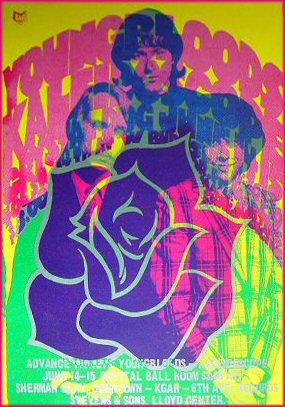
June 14-15, 1968 Youngbloods/Kaleidoscope
The Youngbloods, originally from New York City and Cambridge, MA, had moved to Marin County in September, 1967. The quartet (singer/bassist Jesse Colin Young, lead guitarist/singer Jerry Corbitt, multi-instrumentalist Lowell “Banana” Levinger and drummer Joe Bauer) had played regularly throughout the Pacific Northwest as well as the rest of the country. The group’s second album (Earth Music, on RCA) had been released in November 1967.

I assume that the Youngbloods are pictured in the poster, which is odd since they were a quartet, not a trio. Guitarist Jerry Corbitt would leave soon after this, so perhaps this was somehow anticipating the event.

June 21-22, 1968 Buddy Guy
Buddy Guy was a prominent blues guitarist in Chicago, not well known except to other guitarists. He was starting to make a name for himself on the ballroom circuit.


The city of Portland closed the Crystal Ballroom on or about July of 1968. Tim Hills reprints a headline in The Oregonian (Portland's main daily newspaper) from July 12, 1968 that says "City Closes Dance Hall: Crystal Ballroom Fails Inspection." Unhappy with the congregation of hippies downtown, the city had found a slew of code violations in June, and the operators of the Crystal--whoever they were by Summer 1968 is a bit vague--were unable to respond effectively. According to Hills, a Newsweek article (from May 20, 1968) that said that San Francisco hippies were all going to Portland for the Summer did not help matters.

The exact date of the last show isn't certain, and the venue may have put on shows as late as Saturday, July 6, 1968, but I don't know who might have played. Its known (from Billboard magazine) that Iron Butterfly had to cancel a July date at the Crystal (either 12-13 or 26-27), and according to Hills Big Brother and the Holding Company had to cancel as well, but the end of the psychedelic area came quickly for the Crystal Ballroom.


(Outside the Crystal Ballroom at Sw14th Ave and W. Burnside St, Portland, OR in July 2008. photo: me)


Although it closed as a rock venue in July, 1968, The Crystal remained dormant, a beautiful dream left sleeping downtown. Happily, the building was purchased and restored by local entrepreneurs, and the Crystal Ballroom reopened in 1997. Its “Floating Ballroom” was restored as well, and The Crystal Ballroom is once again a popular local attraction and a glamorous tour stop for a wide variety of music.

Apparently the city of Portland is concerned with the liquor license and activities of the venue, again, but as this struggle has been going on since 1873 the Crystal Ballroom is likely to weather this storm as well.

Thursday, April 8, 2010

The Crystal Ballroom, 1332 W. Burnside, Portland, OR Performance List July-December 1967 (Oregon II)

(A poster scan, probably originally in color, for the Charles Lloyd/Family Tree concert at Portland's Crystal Ballroom on October 6, 1967)

This post is the second part of a series listing the rock performances at the Crystal Ballroom in Portland, Oregon in 1967 and 1968. Also see
Portland, Oregon
Portland, Oregon was a regular stop on the touring circuit for all kinds of entertainment, but in the late 1960s it was not a major or important market. As a result of Portland’s then modest status and a tolerant attitude befitting its status as port city on the West Coast, it became a sort of satellite of the San Francisco scene. 

The Crystal Ballroom, 1332 West Burnside at N.W. 14th Avenue, Portland, OR, 97209
The Crystal Ballroom at 1332 West Burnside (at NW 14th) was built in 1914 as the Cotillion Dancehall.  It was constructed with a mechanical “Floating Dance Floor” (on ball bearings), a concept that was thought to be unique on the West Coast at the time. The building was used for dances, parties and musical performances throughout its history. The complete history of the Crystal, and in effect the entertainment history of downtown Portland, can be found in Tim Hills' book The Many Lives Of The Crystal Ballroom (1997: McMenamins Pubs & Breweries). This book is the principal source of almost all the information currently available on the web about the Crystal, and I have relied on it heavily here for background and facts about both the Crystal and the Portland scene in general.

In the early 1960s, the Crystal became an important stop on the Rhythm and Blues circuit, and many famous R&B acts like James Brown and Ike & Tina Turner had memorable performances at the hall. These shows were booked by one Charles Sullivan, who booked many R&B acts up and down the West Coast. Sullivan controlled the lease on San Francisco’s Fillmore Auditorium (Bill Graham took over the lease when Sullivan retired in 1966), and booked shows not only at the Fillmore and the Crystal but at a string of venues in the Northwest (including the University of Oregon at Eugene, the Salem Armory, the Evergreen Ballroom in Lacey [WA], the Crescent Ballroom in Tacoma and the Encore Ballroom in Seattle). Hills has excellent and detailed recollections of the various soul and R&B shows at the Crystal in the early 60s.

Hills also documents the city of Portland’s uneasiness with the popular shows in the local African American community. When the city put a freeway through the middle of downtown (now Interstate 405), many businesses near the Crystal were demolished. Although the Crystal itself was spared, many of the patrons of the Ballroom had lived in nearby residence hotels that disappeared. With Sullivan on the verge of retirement and the Crystals’ neighborhood crippled, management gave up their lease on the Crystal at the end of 1965, and the building was dormant for all of 1966.

As the “underground” rock market became bigger in the wake of the Fillmore, Whitey Davis, manager of the Caffe Espresso (previously The Folksinger), needed a bigger venue to accommodate larger crowds for bigger bands. Davis had worked at the Avalon Ballroom in San Francisco, so he was both well connected and had some idea of how to proceed. He formed a partnership with friend and Los Angeles club manager Michael Magaurn, and on January 1, 1967 they took over the lease on the then-vacant Crystal Ballroom.

Starting on Friday, January 20, 1967, Davis and Magaurn took over the Crystal Ballroom for weekend dances. Most of the initial acts were local, but by the end of 1967 the Crystal became a regular stop on the West Coast for bands touring the “ballroom circuit” that had developed from San Francisco’s Fillmore and Avalon. There may have been dances on other nights of the week as well, but our information so far has come from surviving posters and handbills, and weeknight shows seem to have been limited to when major acts were passing through Portland.

According to Hills, while the Ballroom was immediately popular with the local counterculture, Davis and Magaurn had trouble making ends meet. As a result, bands were apparently not paid well (compared to other venues), and some of them appear to have had a sour taste about the Crystal.In early 1967, however, the hippie counterculture scene was still exciting and early shows were well attended. This post is the second of a three part history of performances at the Crystal Ballroom in its brief flowering as a psychedelic rock ballroom, from January 1967 through June 1968.

I have taken the best available information from posters, books and reminiscences (cited above and throughout).   This performance list only covers the period from when Whitey Davis took over the booking in 1967 to when the city of Portland forced the closure of the ballroom in June 1968. As our research is mostly from posters, there are substantial gaps in the chronology. We do not know if the Crystal skipped a lot of weekends, or (more likely) whether we simply have not uncovered the dates.

As this remains a work in progress, anyone with corrections, insights, new informations or recovered memories (real or imagined), please Email me or post them in the Comment section. I have made some comments on some of the bands, but for more detailed information, see the fantastic Pacific Northwest Bands site (which includes an alphabetical list of Crystal performers, but not by date). For a sharper picture of the Portland scene, and particularly the move from  based acoustic folk music to electric rock music, see Valerie Brown's exceptional article in the Summer 2007 Oregon Historical Quarterly (From Folk To Acid Rock In Portland Coffeehouses, 1967-70).

This post covers Crystal Ballroom rock performances from July to December 1967 (for January to June 1967, see here).

We have no firm information on gigs at the Crystal from June through September 1967. According to Tim Hills' book, the Crystal continued to put on shows, but very little evidence has survived. According to Hills, memories and facts about performances at the Crystal in the Summer of 1967 are very hard to come by. For one thing, co-promoters Michael Magaurn and Whitey Davis were playing a considerably smaller role. Magaurn was focusing on other, more profitable promotions around the Portland area, and Davis was simply “not around” (update: I have since learned that Whitey Davis was scouting bands in North Lake Tahoe, and that he took one of them to New York City, although nothing ever came of it).  Booking was left to Melvin Olsen, the proprietor of the psychedelic shop next door. Since Olsen was not familiar with the rock business, he had fewer connections (and even less financial clout) to bring out of town bands to the Crystal.

It may seem strange that there were not many rock concerts in Portland during the Summer Of Love, but that may have been partially because many Portland hippies had gone to California for the Summer. College students at Portland State and elsewhere were an important part of the Crystal’s paying audience, and they were of course out of school, and likely that many of the hippest ones made a beeline to California. This was not unprecedented in Portland history—an apocryphal story says that when news of the California Gold Rush hit Oregon in 1849, the population of Portland was reduced to three.

Nonetheless, Hills cites some foggy memories of the Steve Miller Blues Band, Moby Grape, the Electric Prunes and possibly even Big Brother and The Holding Company as playing the venue. I find the Steve Miller booking quite likely and Moby Grape plausible. Since the Electric Prunes played in the Fall (see October 28, 1967), that may account for the idea that they played the Summer, although I’m not ruling it out. Big Brother may simply be wishful thinking, but its still within the realm of the possible.

It appears that during 1967 the Crystal stopped using posters for publicity, or at least artistically interesting posters, as it is usually the colorful “psychedelic” posters that endure. Along these lines, it is reasonable to speculate that mostly local or regional groups played the Crystal during this period, since even artistically dull flyers of world famous groups were typically retained as artifacts. The dates we have found for the balance of 1967, from the tour schedules of better known acts, are listed below. Note that most of the dates are single dates, suggesting that the Portland market could not sustain multiple dates of headline acts.

August 4-5, 1967 Steve Miller Blues Band
The Steve Miller Blues Band, with newly-joined rhythm guitarist Boz Scaggs (replacing the ill Curley Cook), had become quite a popular band around the San Francisco Bay Area. I have looked at their touring schedule for the period, and there are some open weekends in August, so I find a Crystal performace by them to be quite likely. I am asserting August 4-5 as a plausible date, but August 19-20 and August 25-26 are just as likely.

October 6, 1967  Charles Lloyd Quartet/Family Tree/Wild Wild Weeds
Charles Lloyd and his excellent quartet (probably featuring Keith Jarrett-piano, Ron McClure-bass and Jack DeJohnette-drums) were an established jazz group, but they were one of the few to regularly play The Fillmore, Avalon and other rock ballrooms. Charles Lloyd had played the Denver Dog the previous weekend. The 6th was a Friday, and I do not know if there was another show on Saturday night.

Note that the poster retains the name "Crystal Ball" for the venue. Also, the top line says "Carol & The Dom Present." I wonder who that was, and if it implies that outside promoters were also booking shows at The Crystal.

October 13-14, 1967  Country Joe McDonald
Electric Flag was the original headliner, but canceled as some members were arrested in Los Angeles.  Country Joe and The Fish were supposed to replace them, but the show featured just Country Joe (solo), as Joe and the rest of the band were squabbling, so they were touring separately. 

unknown 1967 Them
According to Hills, the great Irish band Them played a rocking show at the Crystal Ballroom, and the red-haired Irishman fronting the band brought down the house. It was only later that Portlanders figured out that Van Morrison had left Them the previous year. Since Van played on October 17, I have to presume Them played before that. I am unfamiliar with latterday Them and their touring history, so it could have been considerably earlier in the year.

Hills describes the story slightly differently and implies that Them played around the time of the Van Morrison date, but since the Morrison date is confirmed, this has the distinct sound of a story that has been somewhat embellished in the telling. A related entity called Them Again did play Portland on February 19, 1967 at a coffee house called Caffe Espresso (409 SW 13th Ave), just around the corner from the Crystal, and in early 1967 most fans would not have been aware that Van Morrison had left Them. My own supposition is that Them Again played the Espresso in February, and people did not realize that Van was not in the group, as they had never seen him, and found out otherwise in October when he played the Crystal. Somehow the story got simplified in the telling, even though it was probably fundamentally true.

October 17, 1967 Van Morrison/Daily Flash
After leaving Them at the height of their success, Van Morrison had moved to Cambridge, MA. By late 1967 Morrison was touring the West Coast on his own. He played the Denver Family Dog on October 13-14, 1967 and the Avalon in San Francisco on October 21-23. This show was on a Tuesday night, suggesting a one-off gig for a relatively popular bill, and the initial stirrings of Chet Helms’s strategy of providing multiple dates throughout the West for touring acts. The specific date comes from the extraordinarily well-researched Van Morrison chronology. “Brown-Eyed Girl” was a popular radio hit in many cities at this time.

The Daily Flash were a popular Seattle band who moved to Los Angeles, although they were on their last legs at this time.

October 20-21, 1967 The Incredible Fish
This was the Fish without Country Joe (see October 13-14, 1967)), with lead guitarist Barry Melton fronting the quartet. This was a Saturday night date also.

October 28, 1967 Electric Prunes
The Electric Prunes, thanks to their rather dated name and complex recording history, are unfairly maligned as a sort of bland wannabe psych band. In fact, surviving evidence suggests that the San Fernando Valley based band was a driving psychedelic outfit in concert. This was a Saturday night date.

November 18, 1967 The Incredible Fish
Barry Melton and the rest of the band (David Cohen, Bruce Barthol and Chicken Hirsh) returned. This was a Saturday night date also.

December 1-2, 1967 PH Phactor
The PH Phactor Jug Band were a local Portland folk-rock-jug band (if such a combination exists). Groups like PH Phactor probably played the Crystal on many Friday and Saturday nights, but there is scant evidence of the shows.

December 3, 1967 B.B. King
B.B. King very likely had played the Crystal Ballroom before, when it was on the R&B circuit. Thanks to constant accolades from the likes of Mike Bloomfield and Eric Clapton, BB was now bringing his swinging blues orchestra to white rock audiences. This show was on a Sunday night. Eyewitnesses in Hills book recall King playing an electrifying show on a cold and rainy night, with water leaking onto the stage while the musicians played. 

December ?, 1967 The Fugs
On the December 1-2 poster (above) you can see it says "Fugs-Commin," so I assume they played later in December.

There were certainly many more shows at The Crystal for which we have not yet found a trace. There is every reason to believe that the Crystal put on shows many more weekends, but we are unable to confirm that. Anyone with additional information about Crystal shows during this period should Comment or email me.  

next: Crystal Ballroom rock performances from January to June 1968

Although it closed as a rock venue in June, 1968, The Crystal remained dormant, a beautiful dream left sleeping downtown. Happily, the building was purchased and restored by local entrepreneurs, and the Crystal Ballroom reopened in 1997. Its “Floating Ballroom” was restored as well, and The Crystal Ballroom is once again a popular local attraction and a glamorous tour stop for a wide variety of music.

Sunday, April 4, 2010

The Crystal Ballroom, 1332 W. Burnside, Portland, OR Performance List January-June 1967


(A poster advertising the February 3-4-5, 1967 weekend at the Crystal Ballroom, soon after it opened as a rock venue. h/t Ross for all the scans)

Portland, Oregon
Portland, Oregon was a regular stop on the touring circuit for all kinds of entertainment, but in the late 1960s it was not a major or important market. As a result of Portland’s then modest status and a tolerant attitude befitting its status as port city on the West Coast, it became a sort of satellite of the San Francisco scene. 

The Crystal Ballroom, 1332 West Burnside at N.W. 14th Avenue, Portland, OR, 97209
The Crystal Ballroom at 1332 West Burnside (at NW 14th) was built in 1914 as the Cotillion Dancehall.  The third floor ballroom was constructed with a mechanical “Floating Dance Floor” (on ball bearings), a concept that was thought to be unique on the West Coast at the time. The building was used for dances, parties and musical performances throughout its history. The complete history of the Crystal, and in effect the entertainment history of downtown Portland, can be found in Tim Hills' book The Many Lives Of The Crystal Ballroom (1997: McMenamins Pubs & Breweries). This book is the principal source of almost all the information currently available on the web about the Crystal, and I have relied on it heavily here for background and facts about both the Crystal and the Portland scene in general.

In the early 1960s, the Crystal became an important stop on the Rhythm and Blues circuit, and many famous R&B acts like James Brown and Ike & Tina Turner had memorable performances at the hall. These shows were booked by one Charles Sullivan, who booked many R&B acts up and down the West Coast. Sullivan controlled the lease on San Francisco’s Fillmore Auditorium (Bill Graham took over the lease when Sullivan retired in 1966), and booked shows not only at the Fillmore and the Crystal but at a string of venues in the Northwest (including the University of Oregon at Eugene, the Salem Armory, the Evergreen Ballroom in Lacey [WA], the Crescent Ballroom in Tacoma and the Encore Ballroom in Seattle). Hills has excellent and detailed recollections of the various soul and R&B shows at the Crystal in the early 60s.

Hills also documents the city of Portland’s uneasiness with the popular shows in the local African American community. When the city put a freeway through the middle of downtown (now Interstate 405), many businesses near the Crystal were demolished. Although the Crystal itself was spared, many of the patrons of the Ballroom had lived in nearby residence hotels that disappeared. With Sullivan on the verge of retirement and the Crystals’ neighborhood crippled, management gave up their lease on the Crystal at the end of 1965, and the building was dormant for all of 1966.

As the “underground” rock market became bigger in the wake of the Fillmore, Whitey Davis, manager of the Caffe Espresso (previously The Folksinger), needed a bigger venue to accommodate larger crowds for bigger bands. Davis had worked at the Avalon Ballroom in San Francisco, so he was both well connected and had some idea of how to proceed. He formed a partnership with friend and Los Angeles club manager Michael Magaurn, and on January 1, 1967 they took over the lease on the then-vacant Crystal Ballroom.

Starting on Friday, January 20, 1967, Davis and Magaurn took over the Crystal Ballroom for weekend dances. Most of the initial acts were local, but by the end of 1967 the Crystal became a regular stop on the West Coast for bands touring the “ballroom circuit” that had developed from San Francisco’s Fillmore and Avalon. There may have been dances on other nights of the week as well, but our information so far has come from surviving posters and handbills, and weeknight shows seem to have been limited to when major acts were passing through Portland.

According to Hills, while the Ballroom was immediately popular with the local counterculture, Davis and Magaurn had trouble making ends meet. As a result, bands were apparently not paid well (compared to other venues), and some of them appear to have had a sour taste about the Crystal.In early 1967, however, the hippie counterculture scene was still exciting and early shows were well attended. This post is the first of a three part history of performances at the Crystal Ballroom in its brief flowering as a psychedelic rock ballroom, from January 1967 through June 1968.

I have taken the best available information from posters, books and reminiscences (cited above and throughout).   This performance list only covers the period from when Whitey Davis took over the booking in 1967 to when the city of Portland forced the closure of the ballroom in June 1968. As our research is mostly from posters, there are substantial gaps in the chronology. We do not know if the Crystal skipped a lot of weekends, or (more likely) whether we simply have not uncovered the dates.

As this remains a work in progress, anyone with corrections, insights, new informations or recovered memories (real or imagined), please Email me or post them in the Comment section. I have made some comments on some of the bands, but for more detailed information, see the fantastic Pacific Northwest Bands site (which includes an alphabetical list of Crystal performers, but not by date). For a sharper picture of the Portland scene, and particularly the move from  based acoustic folk music to electric rock music, see Valerie Brown's exceptional article in the Summer 2007 Oregon Historical Quarterly (From Folk To Acid Rock In Portland Coffeehouses, 1967-70).

This post covers Crystal Ballroom rock performances from January to June 1967.

January 20, 1967 Weeds/Tweedy Bros/Family Tree
It appears that the psychedelic ballroom era of The Crystal Ballroom began on Friday, January 20, 1967. The existing poster says nothing about Saturday night, so I have no idea if there were other bands (or anyone) the next night.

The Tweedy Brothers were a Portland band, and The Weeds were a transplanted Las Vegas band who had settled in Portland (The Weeds would move to Los Angeles in February 1968 and change their name to the Lollipop Shoppe). The Family Tree were a California band, but they were regulars in venues North of San Francisco and in Southern Oregon. Besides frontman/singer Bob Segarini, the Family Tree at this time also featured guitarist Jimmy DeCocq, bassist Kooch Trochim and drummer Vann Slater. The Family Tree had released one obscure 45 on Mira Records, recorded in Lake Tahoe, but they were becoming a popular live act  on the West Coast. 

January 27-29, 1967 Weeds/Redcoats/US Cadenza
Gary Puckett, later of The Union Gap (“Young Girl”), was in The Redcoats at some point, but may have left by this time.

February 3-4, 1967 Sopwith Camel/Tweedy Bros/Gozero and The Psychedelics
February 5, 1967 Sopwith Camel/Tweedy Bros/ Wild Wild Weeds/The Others
Posters from this period, such as the one at the head of the post (through May 12-13) refer to the venue as “Crystal Ball”, although I list the venue as Crystal Ballroom.

The Sopwith Camel had been one of the earliest San Francisco ballroom groups, but they had since had a modest hit single with the song “Hello Hello.” Various foggy stories suggest that the Sopwith Camel didn't get paid, or didn't get what they were promised, and the Crystal's reputation as a fun but frustrating venue for out-of-town bands was initiated.  

February 10-12, 1967 Family Tree/Gazebo/Warlocks
The Warlocks were a band from Tigard, OR. It is possible that a single they had released in 1965 caused the San Francisco's Warlocks to change their name. At any rate Phil Lesh saw a single in a record store by some band called the Warlocks, precipitating the name change to the Grateful Dead and some believe it must have been the Oregon Warlocks.

Note that the Family Tree had already returned for their second weekend. However some San Francisco bands may have been treated, Family Tree returned again and again, so they must have done alright there.

Hills' book refers to Drake Levin's band The Golden Hind playing the venue about a week after Sopwith Camel, but its not certain if it was this weekend or a subsequent one (Levin had been in the hugely popular Paul Revere and The Raiders, but had left for National Guard service, and only performed part time at this point).

March ? 1967 Music Machine
Advertised as “coming in March” on the February 10, 1967 poster. The Music Machine, from Los Angeles, had had a hit with the song “Talk Talk.” Presumably there were shows every weekend in February and March, but we have only been able to determine the dates listed here.

March 22, 1967 Buffalo Springfield/Mr. Lucky and The Gamblers/The Warloks/The Weeds
Buffalo Springfield, a very popular band at the time, was on a tour of the Pacific Northwest. This accounts for the atypical Wednesday night show at the Crystal. Mr. Lucky and The Gamblers, originally from Newport, OR were a very popular Northwestern group, but in the more typical Northwestern R&B style rather than overtly psychedelic.

The Weeds remained in Portland because lead singer Fred Cole fell in love Toody Conner, who worked at a club called The Folksinger, where the Weeds were playing for gas money. By Spring 1967, Toody Conner was helping to run the Crystal, although according to Hills book neither she nor other volunteers were ever really paid. In any case, for obvious reasons, then, The Weeds seem to have been regular performers at the Crystal (Fred and Toody are still married, by the way). 

March 31, 1967 Gazebo/Sound Transfusion
April 1, 1967 Gazebo/The Moguls 

April 14, 1967 Family Tree/Warloks
April 15, 1967 Family Tree/Redcoats
The Family Tree returned to The Crystal regularly during its ballroom period. They apparently were a terrific live act.

April 28, 1967 New Direction/US Cadenza
April 29, 1967 Pre-Cambrian Lightning Bolt/Moguls

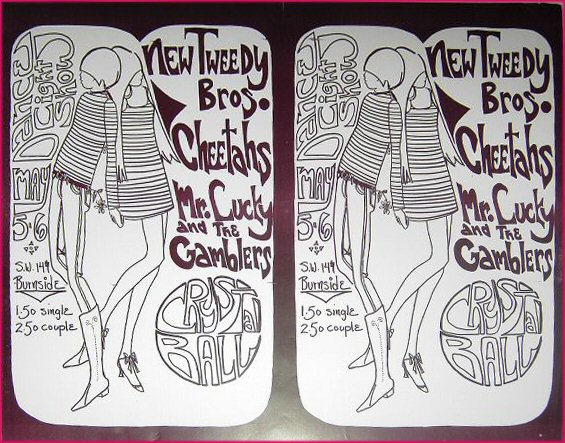
May 5-6, 1967 New Tweedy Bros/Cheetahs/Mr Lucky and The Gamblers


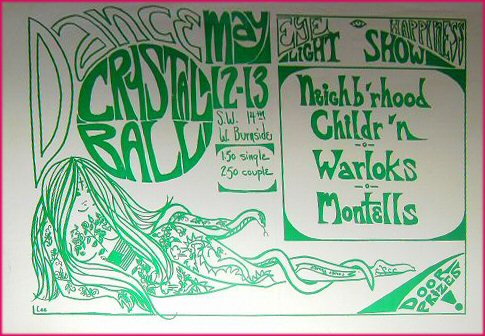
May 12-13, 1967 Neighb’rhood Childr’n/Warloks/Montells
The Neighb’rhood Childr’n were from Medford, OR, and they were the finest (and only) psychedelic band from there. The Southern Oregon/Northern California region was a separate economic entity from either the San Francisco Bay Area or the Portland area, and the Childr’n were extremely popular in that region. They also played on the fringes of the San Francisco ballroom circuit, and throughout Central California, Nevada and the Pacific Northwest. They made one excellent 1968 album, Long Years In Space (on Acta Records), since re-released as a cd on Sundazed.

May 21, 1967 Benefit for SNAP
Allen Ginsberg/PH Phactor/Great Pumpkin/Tweedy Brothers/Laura and The Vipers
SNAP was the Society for New Action Politics. The show was a fundraiser for local activists called The Portland Provos, who (similar to San Francisco's Diggers and the Berkeley Provos) were focused on the city's indigent.

May 21 was a Sunday night. Presumably there was a regular bill on Friday and Saturday night, but we haven’t yet uncovered any evidence.

May 31, 1967 The Fugs/Family Tree
According to Steve Stanley’s excellent liner notes for the cd release of Family Tree’s only album, Miss Butters (RCA May 68, cd Rev-Ola 2007), The Fugs and Family Tree were playing the Crystal Ballroom, and David Crosby (in town for the Byrds show at the Memorial Coliseum) came over and played the groups a reel-to-reel tape of Sgt. Pepper’s Lonely Hearts Club Band, which would not be released for two more days. The exact dates of the actual gigs are not precise, but Family Tree singer Bob Segarini’s memory of hearing the tape is very certain.

The information about this gig suggests there were many more gigs at The Crystal for which there may not have been posters. There is every reason to believe that the Crystal put on shows many more weekends, but we are unable to confirm that.  

next: Crystal Ballroom rock performances from July to December 1967

Although it closed as a rock venue in June, 1968, The Crystal remained dormant, a beautiful dream left sleeping downtown. Happily, the building was purchased and restored by local entrepreneurs, and the Crystal Ballroom reopened in 1997. Its “Floating Ballroom” was restored as well, and The Crystal Ballroom is once again a popular local attraction and a glamorous tour stop for a wide variety of music.

Sunday, March 21, 2010

The Dream Bowl, Vallejo, CA February-April 1969 (Solano & Napa County Rock History)

The Dream Bowl in Vallejo would be an entirely forgotten venue except for the fact that a few Grateful Dead tapes from February 21 and 22, 1969 remain in the vaults. Deadhead persistence seems to have unearthed the poster above.  Despite its brief tenure, however, The Dream Bowl has a quite interesting history, and the brief run of shows from February to about April 1969 represent an excellent idea just a little bit ahead of its time.

Known Rock Shows at The Dream Bowl, Vallejo, CA
February 7-8, 1969 It's A Beautiful Day/Country Weather
February 14-15, 1969 Sons Of Champlin/Blues Helping
February 21-22, 1969 Grateful Dead/Dancing Food & Entertainment/Amber Wine
February 28-March 1, 1969  Santana/Sanpaku
March 14-15, 1969 Mad River/Overbrook Express/Browness [just added 20260713]
April 25-26, 1969 Sons Of Champlin/Rose/Amber Wine

Although the run of "psychedelic" rock shows at the Dream Bowl is quite brief, it had been a music venue since the 1930s--possibly earlier--and had hosted big bands, Texas Swing music, rhythm and blues, country stars and teen rock and roll dances prior to its hippie incarnation. The Dream Bowl was apparently about 10 miles North of Vallejo on Highway 29 (currently the Napa-Vallejo Highway). Apparently it was near the intersection of Highway 29 and Kelly Road (just past Napa Junction). That would actually put it in the town of American Canyon, but as that town was only incorporated in 1992, the Dream Bowl would have been considered part of Vallejo back in the 60s. Supposedly the building still exists, as a furniture warehouse.

Vallejo, Solano County and Napa County
Vallejo, California is the largest city in Solano County, which is just East of Napa County. Vallejo provided access to San Francisco Bay for farmers from Solano, Napa and Sonoma. The area had become prosperous at the turn of the 20th Century when the San Francisco, Napa and Calistoga Railroad provided electric rail and a ferry connection to San Francisco. The initial Napa to Vallejo leg, along with the Ferry, opened in 1905, extending to Calistoga in 1908 (the same general right-of-way is followed by today's Napa Wine Train).

Solano, Napa and Sonoma Counties shipped produce throughout the West (via Southern Pacific) and was a San Francisco resort area as well. Sometime in the late 1920s or early 30s the Dream Bowl was constructed by contractor Walter Polley as a Dance Hall for Big Band music. Local and touring acts played the hall. Although the railroad waned in the 1930s, the Golden Gate and Bay Bridges allowed increased transit across the area.

Area Music History
In World War 2 Vallejo housed a substantial naval base at Mare Island. As a result of the Mare Island base, Vallejo was also a center for shipbuilding in World War 2. Many workers from the South, both black and white, moved to the Bay Area to work in the Defense industry, which mostly revolved around building Merchant Ships. Other shipbuilding centers around the bay included Hunters Point in San Francisco, Oakland, Richmond and Marin City (not coincidentally, all those areas have had relatively large African-American populations since then).

Since the wartime Defense industry ran around the clock, there were large numbers of workers with money burning a hole in their pockets, waiting to be entertained. Musicians from the South played substantial shows up and down the West Coast, from San Diego and Los Angeles to the Bay Area, and in Portland and Seattle as well. The audience for these musicians had moved to the West Coast, so the performers did to. San Pablo Avenue in the East Bay had so many venues it was known as "Music Row." All types of music were represented, and the Dream Bowl seems to have done a prosperous business, as did most music venues around the Bay (not to mention bars) during the war. The Duke Ellington Orchestra, for example, played The Dream Bowl on February 7, 1945.

San Francisco Examiner columnist Phil Elwood recalled the Dream Bowl many decades later (published Oct 27, 1995), remembering seeing Big Jay McShann there

In 1944, I drove the family's '33 Chevy with its A-sticker (ask your grandparents) in the window up Highway 29 north of Vallejo to an oversized Quonset hut roadhouse-dancehall-brawl arena called the Dream Bowl to hear McShann's band on its first California gig.

The Dream Bowl would feature, for example, Bob Wills and his Texas Playboys one night, McShann and his Kansas City jazz-blues band the next. Whites (only) went to Wills; blacks flocked to their music, such as McShann's. But any jazz and blues out of the black community drew some whites, like me.

Although the Vallejo shipyards reduced their activity after World War 2, the Naval Base at Mare Island was still active. The Bay Area had a considerably larger agricultural footprint than it does today, and country music was very popular in places like San Jose, Fremont and Vallejo. There are many reports of seeing country stars like Bill Monroe at the Dream Bowl in the 1950s, and Berkeley's Herb Pedersen (later in The Dillards and Desert Rose Band) recalls playing bluegrass shows there in the 1960s (with Vern And Ray).

Very casual googling shows that Vallejo area residents fondly remember going to regular Saturday night dances at the Dream Bowl in the early and mid-1960s, probably dancing to rock and roll. There are other recollections of seeing early performances by Vallejo's greatest musical export, Sylvester Stewart, later to become famous as Sly Stone, and that suggests that the Dream Bowl's history of providing all sorts of music for different audiences remained intact.

Napa Town and County Fairgrounds, Summer 1967
As rock music expanded beyond the confines of San Francisco, teenagers in the surrounding communities got interested. In the Summer of 1967 there were a series of concerts at the Napa Town and County Fairgrounds (at 575 Third Street), probably in the building now called Chardonnay Hall. The Grateful Dead (May 29), Country Joe and The Fish (June 15 ), Big Brother and The Holding Company (June 30), Quicksilver Messenger Service (uncertain) and Blue Cheer (uncertain) all seemed to have played that Summer, often on weeknights.

The Grateful Dead show seems to have been the first of the Fillmore invasions. The show went off without a hitch, but Napa was still quite rural, and when Country Joe and The Fish played two weeks later, some local toughs looking to "beat up hippies" ended up punching out Bruce Barthol and Barry Melton (the local toughs were apparently notorious). When Country Joe and The Fish put out a "board game" as part of their second album, one square said "Napa: You Lose" thus immortalizing the event in a tiny sort of way.

The San Francisco rock community was quite small, however, and when Big Brother played two weeks after the Fish, a few Hells Angels rode up with them and hung around the stage. The local toughs did not choose to harass the band.

I do not know of any interesting rock concerts in Napa in 1968. As the rock market got bigger, more and more Solano and Napa teenagers simply drove to the Fillmore or Avalon. There were a few interesting local bands, like Project Hope, but they were not major Bay Area acts. It does appear that the "false Moby Grape" played there (too long a story to go into here), and its possible that Blue Cheer was in 1968 rather than 1967, but the Napa Fairgrounds seem to have been sized out of the rock market.


The Dream Bowl, 1969
I do not know who was promoting psychedelic rock concerts at the Dream Bowl in early 1969, but it seems a logical progression for the venue. Since it was already a music venue, no special permission would be needed to change the musical lineup. And since it was relatively isolated (as near as I can tell), any noise would not be a bother. It appears that the parking lot had been a teen hangout on weekends anyway, so a mere change in entertainment was probably not so big a change for the community, even if they might not have approved of long haired hippie music.

One unseen hand in rock music in the Greater Bay Area in 1969 was the Millard Agency. The Millard Agency was part of Bill Graham's empire, but they booked talent into different venues rather than promoted concerts. An old Federal Law prevented band managers from acting as booking agents, so Talent Agents acted as middlemen, taking a fee for finding bookings for bands by providing acts for promoters. The Millard Agency, as far as I know, was spearheaded by two agents, Paul Barratta and Barry Imhoff, but there must have been other agents as well.

A look at concerts around the Bay Area in 1969 shows the ubiquity of Millard Agency clients. The Millard Agency had a relationship with the Grateful Dead (involving paying back a $12,000 loan from 1968), but the agency also booked Santana, Its A Beautiful Day, Elvin Bishop, Lee Michaels, Cold Blood, AUM, Sanpaku, Country Weather and Frumious Bandersnatch. Although some of these acts are quite well known now, in early 1969 Santana, IABD and Elvin Bishop did not yet have records. Nonetheless all the Millard bands played small and middle sized venues around the greater Bay Area--High School and Junior College gymnasiums, rock nightclubs and outdoor events.

By 1969, rock was big business and fans would make great efforts to see the biggest bands at the Fillmore West. Yet not everyone was able (or willing) to drive to San Francisco, so some of the second tier Fillmore bands could play outlying areas and bring the Fillmore cachet with them. Famous as the Grateful Dead are today, they were not nearly as popular as Janis Joplin or the Jefferson Airplane, so they too played the outlying areas.

The first month of Dream Bowl bookings, on the poster above, is dominated by Millard Agency acts: The Dead, Santana, IABD, Country Weather, Sanpaku and Dancing Food and Entertainment (with Tom Glass and Naomi Eisenberg) were all Millard acts. This seems like a conscious strategy to create a whole new paying venue for the Agency clients. It seems like a great idea, too, but it appears to have been about two decades too early. Other than an April 25-26 show with The Sons of Champlin (who came through the West-Pole Agency, not Millard), the Dream Bowl seems to have disappeared as a music venue of any sort. Either Napa and Solano Counties lacked the population, or the Dream Bowl wasn't a pleasant place to see a rock band, or both. Without direct eyewitness memories, its hard to be certain. One of the few eyewitnesses suggests that the March 1 Santana concert was the last one. I do recall seeing a Sons of Champlin poster for the Dream Bowl on April 25-26, but that is no guarantee it actually occurred.

Update: A Commenter reports that the April 25-26, 1969 Sons Of Champlin show did indeed occur. The billing was Sons Of Champlin/Rose/Amber Whine. Rose was a Marin County band, who were friendly with some members of The Sons. The fact that the April show occurred lends even more mystery to the history of the Dream Bowl, since it didn't quite close after the March shows.

A poster for Mad River, the Overbrook Express and Browness at the New Dream Bowl Ballroom on March 14 & 15, 1969

[update 20260612]
A Commenter (below) reports that Mad River and Overbrook Express played the Dream Bowl on the weekend of March 14-15, so that seems to support the story that rock bands continued to play the Dream Bowl. Mad River were a psychedelic band from Yellow Springs, OH, that had moved to Berkeley. Mad River put out two album on Capitol in 1968. The first was a truly epic psychedelic classic, while the second was, rather unexpectedly, an ahead-of-its-time country rock album. 

[update 20260713] poster added! 

Now, of course, Napa and Sonoma are both world-famous wine-growing regions, with wealthy residents and free spending visitors; the new town of American Canyon and Vallejo itself have expanded substantially (probably too much, for the moment, but that's a different issue) and nearby attractions include the Marine World Park and nearby Infineon Raceway (formerly Sears Point). A rock venue that presented Santana, Its A Beautiful Day or the Grateful Dead would be welcome indeed by people in the region, but the moment seems to have passed and left only a furniture warehouse.

A number of questions still remain:

  • What was the exact location of The Dream Bowl?
  • Is the building still intact?
  • Who were the promoters in early 1969?
  • Were there any rock shows prior to February 7, 1969?
  • Were there any shows later than March 1, 1969?
Anybody with insights, corrections, speculation or recovered memories (real or imagined) is encouraged to Comment or Email me.

Wednesday, March 3, 2010

Kinetic Playground, Chicago, IL 4812 N. Clark Street: Performance List 1968-69

(h/t Brad for the scan of the July 24, 1968 poster)

(for an updated version of the 1968 list, see here)

Chicago is one of the world's great cities, by any accounting, and it has a musical heritage to match. While today it is mostly renowned for introducing electric blues to the outside world, Chicago has made memorable contributions to jazz, soul, folk and rock music as well. Chicago had always been a critically important outpost for any touring act, regardless of the style of music. While the weather in Chicago can be daunting, there has always been excellent public transportation and fearless cab drivers, so a patron can always get home at 4am when the bars close.

In the 1960s, Chicago was an essential stop for any rock band looking to make it big. Chicago fans love a good time, but they have high standards too, as the blues band playing down the street in Chicago was better than most blues bands headlining in London or San Francisco. The pace of the city and the barriers of the weather make Chicago fans enthusiastic about good performers and ferociously dismissive of pretenders. Any discussion about music with a Chicago rock fan will immediately lead to stories of over the top concerts that seem to happen every month (a friend of mine once described seeing fans tear apart the Chicago Opera House during a 1970 Iggy and The Stooges concert by saying "If I was born the night I saw Iggy, I'd be old enough to drink now"). Nevertheless, the history of sixties rock in Chicago remains unnecessarily scattered, so I will begin to rectify that now.

Despite, or perhaps because, of its financial importance, Chicago did not have a single venue that was Nationally recognized like The Fillmores. The city of Chicago had numerous old buildings that could easily be converted to rock concert duty, even if all of the buildings had a variety of flaws. As a result, the late 1960s and early 1970s saw numerous venues rise and fall, such as The Cheetah, which became The Aragon Ballroom (at 1106 N. Lawrence) and the Chicago Coliseum, which became The Syndrome (on Wabash Avenue). Other venues were also regularly used for rock shows, like The Auditorium Theater and  the International Amphitheatre. However, Chicago's principal stop on the 60s rock circuit was The Kinetic Playground, at 4812 N. Clark Street.

4812 N. Clark Street was originally known as The Rainbo Gardens, and it was a sort of dance hall and entertainment center. It was used for various functions over the years, but in 1968 Brooklyn-born promoter Aaron Russo (then 24 years old) took over the ballroom. The building itself was somewhat larger, and included a skating rink, but Russo opened a rock nightclub in the former Rainbo Gardens Ballroom on April 3, 1968, and named it the Electric Theater. Russo had worked in his family's garment business and put on rock shows as a High School student, so despite his young age he was well prepared for the cutthroat rock business.

The Electric Theater opened in April of 1968, and by June, 4812 N. Clark Street in Chicago was an essential stop on the "Fillmore Circuit." Bands that played such venues as the Fillmores, the Boston Tea Party and The Electric Factory always played on N. Clark Street as well. Talent agent Frank Barsalona, all but single-handedly responsible for breaking English bands in America, made The Electric Theater a critical stop for his bands, and many of the most legendary concerts in Chicago were early appearances by groups like Led Zeppelin, Jethro Tull and Ten Years After.

What follows is my working list of known performances at 4812 N. Clark Street, as both the Electric Theater and later the Kinetic Playground. It appears that it was only open on weekends, but there may have been additional shows that I am not aware of. This list has been constructed from surviving handbills and from the chronologies of the various bands. The existing handbills for the venue are primarily just lists of upcoming shows, with little in the way of collectible or interesting artwork, so Chicago handbills did not stay on people's dormitory walls the way posters did from San Francisco or Detroit, making research somewhat harder.

I believe the venue was open every weekend, even in the Winter, from April 3, 1968 until November 7, 1969, so there are many more shows to be discovered. Anyone who has additions, corrections and memories (real or imagined) regarding shows is encouraged to Comment or Email me.

1968

April 3-5, 1968 Electric Theater The Paupers
The Electric Theater opened on April 5 1968 with Toronto's Paupers as the headline act

April 23, 1968 Electric Theater Harumi

April 26-28, 1968 Electric Theater Little Boy Blues/The Rush

May 3-4, 1968 Electric Theater Siegal Schwall Blues Band

May 10-11, 1968 Electric Theater Finchley Boys

May 17-19, 1968 Electric Theater Canned Heat

May 22-26, 1968 Electric Theater Steppenwolf

May 31-June 1, 1968 Electric Theater Muddy Waters/Holy Om

June 7-9, 1968 Electric Theater Love/Chicago Slim Blues Band

June 10, 1968 Electric Theater Loading Zone 
This was a Monday night show, probably a relatively rare occurrence. The Loading Zone were a San Francisco band getting a big push from RCA behind their debut album. The record company probably rented the hall for the night and distributed some (or all) tickets through radio stations.

June 12-15, 1968  Electric Theater Rotary Connection
Rotary Connection was a popular "psychedelic soul" band from Chicago. They recorded for a Chess subsidiary, and featured singer Minnie Ripperton. 

June 26-27, 1968 Electric Theater Hello People
June 28-30, 1968 Electric Theater Blue Cheer/Hello People
The Hello People were a peculiar mixture of mime, vocal harmonies and rock. I believe they headlined themselves on Wednesday and Thursday (26 and 27). Blue Cheer, at the time, touted itself as the loudest band in the world, with a tower of Marshall Stax turned up to the max. Who do you think Chicago liked better?

July 3-4, 1968 Electric Theater Country Joe and The Fish/Hawk
Besides being Berkeley's leading rock export, Country Joe and The Fish were acutely aware that the 1968 Democratic Convention would be held in Chicago from August 25-29.

July 5-7, 1968 Electric Theater Rotary Connection/Growin Concern
Rotary Connection seems to have been the only Chicago-based headliner in 1968, but of course since we do not have a list yet of every show, I don't know if that was entirely true.

July 24, 1968 Electric Theater Jefferson Airplane/Iron Butterfly (two shows)
Note the nice poster above. I don't know how many shows had custom posters.

July 25-28, 1968 Electric Theater Iron Butterfly

August 1, 1968 Electric Theater The Who 

August 14-15, 1968 Electric Theater Mothers Of Invention/Julie Driscoll, Brian Auger and The Trinity  

August 23, 1968 Electric Theater Country Joe and The Fish 

August 30, 1968 Electric Theater Litter/Nova
August 31, 1968 Electric Theater Nova/Chicago Transit Authority
September 1, 1968 Electric Theater Litter/Nova
The groups replaced Pink Floyd, who canceled. 

September 2, 1968 Electric Theater Eric Burdon and The Animals

Soon after the opening of The Electric Theater, a well-known New York "hippie discoteque" called The Electric Circus had sued the Electric Theater for copying its trademark (or something like that). For whatever reasons, Aaron Russo changed the name of his club to The Kinetic Playground. Some flyers still included some representation of the name Electric Theater (like "The Electric Theater Presents At The Kinetic Playground"). It appears that the sound company associated with the club retained the name Electric Theater, and many Chicagoans seemed to have used the names Electric Theater and Kinetic Playground interchangeably. 

September 13-14, 1968 Kinetic Playground Pride/Illinois Speed Press
Pride was the new name for the Lemon Pipers


September 20-21, 1968 Kinetic Playground Kensington Market

October 4-6, 1968 Kinetic Playground John Mayall/Pacific Gas & Electric
I do not know the exact date of the name change of the venue. The gap in known performances on this list is only because I have not found any flyers for August or September of 1968. 

October 11, 1968 Kinetic Playground Jeff Beck Group/Pacific Gas & Electric/Fever Tree

October 12, 1968 Kinetic Playground Steppenwolf

October 18, 1968 Kinetic Playground Steppenwolf

October 21-22, 1968  Kinetic Playground Moody Blues/Rotary Connection

October 25-26, 1968 Kinetic Playground Quicksilver Messenger Service/SRC

November 1-2, 1968 Kinetic Playground Moby Grape/Eire Apparent/Rotary Connection (1 only) 

November 8, 1969 Kinetic Playground Spencer Davis

November 9, 1968 Kinetic Playground Canned Heat

November 15-16, 1968 Kinetic Playground Moody Blues/Charles Lloyd

November 22-23, 1968 Kinetic Playground Blue Cheer/Creedence Clearwater Revival

November 27-28, 1968 Kinetic Playground Grateful Dead/Procol Harum/Terry Reid


November 29-30, 1968 Kinetic Playgroud Tim Buckley/Terry Reid/Canned Heat

December 6-7, 1968 Kinetic Playground Buddy Miles Express/Deep Purple
I assume that Deep Purple was not the headliner of this show. This was the original version of Deep Purple, best known for the song "Hush," and featuring Rod Evans on vocals.

December 13-14, 1968 Kinetic Playground Iron Butterfly/Group Image

December 20-21 Kinetic Playground New York Rock and Roll Ensemble/Amboy Dukes/Charlie Musselwhite

December 22, 1968 Kinetic Playground Rotary Connection

December 31, 1968 Kinetic Playground The Byrds/Muddy Waters/Fleetwood Mac

1969

January 3-4, 1969  Kinetic Playground Muddy Waters/Fleetwood Mac/The Byrds
On Friday (3), Muddy Waters left the stage after just one number, as he was not well.

Kaleidoscope were originally booked for Friday, but ended up canceling.

January 10-11, 1969 Kinetic Playground Albert King/Linn County

January 17-18, 1969  Kinetic Playground Buddy Rich/Genesis
This would not have been the English band. Most likely it was the Los Angeles band called Genesis, but there could have been a regional band by that name. An alternate (and reliable) source has Taj Mahal.

January 24-25, 1969  Kinetic Playground Spirit/Velvet Undergound 
Another poster has Buddy Rich and His Orchestra/Buddy Miles Express/Rotary Connection on this weekend.

January 31-February1, 1969 Kinetic Playground Grateful Dead/The Grass Roots

February 7-8, 1969 Kinetic Playground  Vanilla Fudge/Led Zeppelin/Jethro Tull
Led Zeppelin was on their first American tour, and their first album had just been released. As if that wasn't enough, Jethro Tull was opening the show. Chicago has loved Jethro Tull since this day.

February 14-15, 1969 Kinetic Playground Tim Hardin/Spirit/The Move
The Move were an English band, but they canceled their American tour because bassist Trevor Burton quit.

February 19-20, 1969 Kinetic Playground Flying Burrito Brothers
According to John Einarson's fine book about Chris Hillman and the Burritos, these shows came after a long train trip, and Gram Parsons was much the worse for wear. Despite the power of their songs, the band's performances were less than stellar. February 19 and 20 were a Wednesday and Thursday, so I don't know if there were other acts on the bill.

February 21, 1969 Kinetic Playground Jeff Beck/Savoy Brown/Mother Earth
February 22, 1969 Kinetic Playground Blood, Sweat & Tears/Savoy Brown/Aorta
Jeff Beck canceled his American tour and didn't play. I don't know who replaced him. An earlier poster has Mother Earth opening on the 22nd, but they seem to have been replaced by the Chicago group Aorta.

February 28, 1969 Kinetic Playground Paul Butterfield/B.B. King/Albert King
March 1, 1969 Kinetic Playground Paul Butterfield/Albert King/Lumpy Gravy
An earlier poster had the Bob Seger System as one of the opening acts. Seger was from Detroit, and had played Chicago many times. I assume he played Kinetic Playground on occasion, as I think most Detroit bands probably did, but I have yet to be able to demonstrate that.

March 7-8, 1969 Kinetic Playground John Mayall/Richie Havens/The Flock
The Flock were an interesting band, a sort of only-in-Chicago concoction of progressive rock and soul. The group featured electric violinist Jerry Goodman leading a horn section. During this period, Columbia had signed four bands from Chicago, and chose to put out all their albums at the same time (May 1969)to make it seem like there was a "happening scene" in Chicago. In fact, there was a lot of great rock music coming out of Chicago, but stunts like this made fans suspicious (the other groups were Aorta, Illinois Speed Press and Chicago Transit Authority).

The Flock’s horn section joined Mayall for his last set on Saturday night. Mayall was very enthusiastic about the group, and wrote the liner notes for their debut album.

March 14-15, 1969 Kinetic Playground Jeff Beck Group/Sweetwater/Van Morrison

March 21-22, 1969 Kinetic Playground Julie Driscoll, Brian Auger and The Trinity/Magical Mystery Tour film

March 22, 1969 Kinetic Playground Sam and Dave Revue
Although the Kinetic Playground was a rock club, rock fans in Chicago were all generally big fans of Soul and Blues music as well, part of what made Chicago music so exciting. I don't know if the Sam and Dave show happened, or it was an afternoon show with Jools and Brian in the evening, or what.

March 28-29, 1969  Kinetic Playground TBA/Pacific Gas & Electric
The flyer does not list a headliner yet. Pacific Gas & Electric were a Los Angeles blues-rock band.

April 11-12, 1969 Kinetic Playground Ten Years After/Buddy Guy and Junior Wells

April 18-19, 1969 Kinetic Playground Everly Brothers/Cannonball Adderley/Aynsley Dunbar Retaliation

April 20, 1969 Kinetic Playground The Flock

April 25-26, 1969 Kinetic Playground Grateful Dead/Velvet Underground/SRC
This memorable pairing of two sixties opposites was covered in depth in Richie Unterburger's fine Velvet Underground chronology (White Light White Heat). The first night, the Velvet Underground played an extended set, and as a result the Grateful Dead were limited (by their standards) to one set. The next night, of course, the Dead came on before the Velvets and played an extended set, thus limiting the Velvets. Whether this was a result of some imaginary "feud" or just poor scheduling (I suspect the latter), it makes for a great sixties story.

As if the New York/SF pairing of the Velvets and the Dead wasn't enough, SRC was a famous powerhouse Detroit band, if lesser known, so three great bands from three great scenes were represented. It must have been some evening.

May 2-3, 1969 Kinetic Playground Albert King/Aum

May 14, 1969 Grant Park, Chicago  Jefferson Airplane
Over 50,000 people attended a free Jefferson Airplane show in one of Chicago's biggest parks. It was a legendary show in Chicago rock history, but unlike bucolic San Francisco, there were numerous cops and much craziness.

Apparently the Airplane were playing at least one Chicago concert around this time, but I don't know if it was at Kinetic Playground or elsewhere.

May 16-17, 1969 Kinetic Playground Buffy St. Marie/The Nice/Colwell-Winfield

May 23-24, 1969  Kinetic Playground Led Zeppelin/Pacific Gas and Electric/Illinois Speed Press
May 25, 1969 Kinetic Playground Illinois Speed Press
The Illinois Speed Press had actually moved to Los Angeles by this time, as had Chicago Transit Authority, but they were still being pitched (fairly enough) by CBS as a Chicago band. They featured guitarists Paul Cotton and Kal David, later in Poco and the Fabulous Rhinestones, respectively.

May 29-30, 1969  Kinetic Playground The Who/Buddy Rich and His Orchestra/Joe Cocker and The Grease Band 
May 31, 1969 Kinetic Playground The Who/Joe Cocker and The Grease Band/Soup
The Thursday show (29) reduced a double show into a single performance.

June 6-8, 1969 Kinetic Playground Vanilla Fudge/Muddy Waters/Rotary Connection
Vanilla Fudge was not scheduled to play on Sunday night (8).

June 13-14, 1969 Kinetic Playground Eric Burdon/The Zombies/It’s A Beautiful Day
June 15, 1969 Kinetic Playground The Zombies/It’s A Beautiful Day
Eric Burdon had broken up his "New Animals, " but he had undertaken a brief tour to support his Best Of album. I believe he was backed by Blues Image.

The Zombies had broken up in 1968, but thanks to Columbia staff producer Al Kooper, their last album (Odyssey and Oracle) had become a big hit behind the single "Time Of The Season." However, the lineup of The Zombies that toured did not feature any original members of the group, and was somewhat bogus.

June 20-22, 1969 Kinetic Playground (headliner not yet listed)/Crazy World of Arthur Brown/Youngbloods
Arthur Brown was not scheduled to play on Sunday (22).

June 27-28, 1969 Kinetic Playground Canned Heat/Black Pearl/Soup

July 3-4-5, 1969 Kinetic Playground Grateful Dead/Buddy Miles Express/Sir Douglas Quintet
The Dead seemed to have played the Kinetic Playground more than any out of town band, but that was true of a lot of 60s venues.
[update] A Commenter observes that the Grateful Dead actually played in Colorado on July 3. My presumption is that the other two acts played without them. Since the Colorado show was outdoors, it's not totally impossible that the plan was for the Dead to fly to Chicago and play a late night set, and it's not even totally impossible that it happened, but it's more likely the Dead's gig started on Saturday July 4.

July 11-12, 1969 Kinetic Playground Spirit/Pentangle/Alice Cooper

July 18-19, 1969 Kinetic Playground Led Zeppelin/Savoy Brown/The Litter
[update] Correspondent Michael M writes in to point out that The Litter canceled, and were replaced by Jethro Tull. Tull's presence is confirmed by the ever-reliable Ministry Of Truth site. Keep in mind that not only were Tull and Zep soon-to-be rock legends, but Savoy Brown was a great band too, featuring 3/4 of the future Foghat.


July 25-26, 1959 Kinetic Playground Richie Havens/Jethro Tull/Spooky Tooth

August 1-2, 1969 Kinetic Playground Jeff Beck/Terry Reid/Blues Image
Jeff Beck canceled—the last Jeff Beck Group show was July 26 in Detroit. I do not know who replaced them on the bill. Another flyer has Fleetwood Mac in place of Blues Image.

August 8-9, 1969  Kinetic Playground Al Kooper Revue/Mountain
Al Kooper canceled, due to illness. This would have been one of Mountain's first gigs. They would play Woodstock just a week later.

August 15-16, 1969 Kinetic Playground Paul Butterfield/Johnny Winter/The Flock

Both Paul Butterfield and Johnny Winter were playing at Woodstock the same weekend. 

August 22-23, 1969 Kinetic Playground Country Joe and The Fish

September 5-6, 1969 Kinetic Playground Ten Years After/Bo Diddley


October 4-5, 1969 Kinetic Playground Farioso The Lion

October 10-11, 1969 Kinetic Playground Pacific Gas & Electric/Lee Michaels/Lonnie Mack/Bonzo Dog Band
I don't know if the Bonzo Dog Band actually played in Chicago, as they did not play all their American dates.

October 17-18, 1969  Kinetic Playground B.B. King/Albert King/Santana

October 19, 1969 Kinetic Playground Led Zeppelin/Santana/Lighthouse (two shows)

October 24-25, 1969 Kinetic Playground Spirit/Joe Cocker/Blodwyn Pig

October 31, 1969   Kinetic Playground The Who/The Kinks/Liverpool Scene
The Kinks had not toured America since 1965, because Ray Davies had apparently punched a Musicians Union honcho backstage in Los Angeles. Thus they missed the height of "British Invasion" tours and the first waves of American touring at places like the Fillmore. Things were settled by Fall 1969, however, and they finally began their belated assault on America.

The Kinks found themselves in Chicago opening for The Who, who had formed much later than them. Pete Towshend announced from the stage “in the old days, we used to dream about opening for The Kinks.  So its come to this. This show’s for them.”

November 1, 1969  Kinetic Playground Poco/Liverpool Scene
Poco replaced The Kinks.

November 7, 1969 Kinetic Playground Iron Butterfly/Poco/King Crimson
A fire after the show caused the November 8 show to be canceled, and closed the Kinetic Playground. 

Aaron Russo continued as a successful rock promoter in Chicago and Detroit (at the East Towne Theater) throughout the 1970s. He also successfully managed the career of Bette Midler. He produced her breakthrough movie The Rose. In the 1980s he went on to produce many other successful movies like Trading Places and Wise Guys.

The Kinetic Playground did not reopen. The building had various uses until it was torn down in 2003. After it was torn down, bones were discovered under the foundation. Chicagoans were sure that they were human bones, and that the original Rainbo Gardens were built over a mob burial ground. True or not (probably not), it made a great Chicago coda to the Electric Theater and the Kinetic Playground.

This has only been a start on the history of the Kinetic Playground and Chicago rock in the 1960s. Anyone with additional information, corrections or insights is actively encouraged to Comment or email me. As I get more information, I will update the post.

Thursday, February 25, 2010

Avalon Ballroom, July 1-2-3, 1966: Grass Roots/Daily Flash/Sopwith Camel

This post is part of a series analyzing every show at the Avalon Ballroom

July 1-2-3, 1966 Grass Roots/Daily Flash/Sopwith Camel 
Since the 4th of July was on a Monday, the Avalon had a three day booking for the weekend instead of just the normal Friday and Saturday night shows. The Sopwith Camel were not booked for Sunday night, July 3--I do not currently know if any other band performed on that night.

The LA folk-rock bands are now playing the Fillmore and Avalon regularly.  ‘Folk-rock’, epitomized by The Byrds, was not only popular, but hip, and bands like The Turtles, The Grass Roots and The Association appeared to have more in common with Quicksilver or The Airplane than they do today.     The Grass Roots were starting to break out nationally.  Their current Dunhill single, “Where Were You When I Needed You,” peaked at  #28 nationally.

The Daily Flash, while founded in Seattle, had relocated to Los Angeles, where they shared management with the Buffalo Springfield. Nonetheless, they had been a huge hit at the Avalon, so they had a following in San Francisco. The Daily Flash’s repertoire actually included a lot of folk covers at this time, so this show really was a folk-rock bill, although the obscurity of these bands recorded releases meant that the audience would not know what they sounded like until they were actually at the show.

The Sopwith Camel were another group that had been founded out of the rooming house at 1090 Page Street, just like Big Brother. They had begun rehearsing at a place called The Firehouse (an abandoned Fire Station) where a few shows were presented as well. Their second show was at the Fillmore in February. They had improved steadily, however, and became a viable band. 

By July, The Sopwith Camel had been signed by Kama Sutra Records. In May, a friend of the band had sent an early demo tape of the song “Hello Hello” to Lovin Spoonful producer Erik Jakobsen, who immediately sought the group out.  He met them returning from a gig at a private girls school, and they were all dressed in tuxedos.  Nonetheless, Jakobsen recognized the potential and signed them immediately.Jakobsen was on the prowl because The Lovin Spoonful were getting even bigger.  “Daydream” had reached #2 in the spring, and “Did You Ever Have To Make Up Your Mind”, their current single, would reach #2 as well.

The Spoonful’s biggest hit, “Summer In The City” would not even hit the charts for a few more weeks. However, the Lovin Spoonful would never play the Avalon or the Fillmore. Sometime in the Summer (probably after a May 21, 1966 show at the Greek Theatre in Berkeley), Spoonful guitarist Zal Yanofsky was busted for pot, and he gave up his dealer, apparently a member of The Committee improv troupe. This poisoned the band's reputation in the Underground, and the Spoonful were persona non grata at the Avalon and the Fillmore, so they were never booked there. The drug bust problems of Yanofsky would have seemed like trivial show-biz problems to the record companies.  The idea that a band’s inability to play obscure venues in San Francisco would affect their future popularity would have been incomprehensible to a New York record company.

Oddly enough, the Sopwith Camel appear on a Fillmore poster for Saturday, July 2 (supporting Great Society and The Charlatans), and that presents a conflict with the Avalon poster. By this time, Bill Graham and Chet Helms were fierce competitors and would not have allowed a band to play both venues on the same night. Given that the Camel did not play the Avalon on Sunday, July 3, perhaps the Fillmore poster was mistaken and the Camel played on July 3 at the Fillmore (which was billed as Love/Grateful Dead/Group B).

next: July 8-9-10, 1966: Sir Douglas Quintet/Everpresent Fullness