Showing posts with label Family Dog. Show all posts

Friday, April 9, 2010

The Crystal Ballroom, 1332 W. Burnside, Portland, OR Performance List January-June 1968 (Oregon III)

(The poster from the February 2-3, 1968 performance by The Grateful Dead and Quicksilver Messenger Service at Portland's Crystal Ballroom)

This post is the third and last part of a series listing the rock performances at the Crystal Ballroom in Portland, Oregon in 1967 and 1968. Also see
Portland, Oregon
Portland, Oregon was a regular stop on the touring circuit for all kinds of entertainment, but in the late 1960s it was not a major or important market. As a result of Portland’s then modest status and a tolerant attitude befitting its status as port city on the West Coast, it became a sort of satellite of the San Francisco scene. 

The Crystal Ballroom, 1332 West Burnside at N.W. 14th Avenue, Portland, OR, 97209
The Crystal Ballroom at 1332 West Burnside (at NW 14th) was built in 1914 as the Cotillion Dancehall.  It was constructed with a mechanical “Floating Dance Floor” (on ball bearings), a concept that was thought to be unique on the West Coast at the time. The building was used for dances, parties and musical performances throughout its history. The complete history of the Crystal, and in effect the entertainment history of downtown Portland, can be found in Tim Hills' book The Many Lives Of The Crystal Ballroom (1997: McMenamins Pubs & Breweries). This book is the principal source of almost all the information currently available on the web about the Crystal, and I have relied on it heavily here for background and facts about both the Crystal and the Portland scene in general.

In the early 1960s, the Crystal became an important stop on the Rhythm and Blues circuit, and many famous R&B acts like James Brown and Ike & Tina Turner had memorable performances at the hall. These shows were booked by one Charles Sullivan, who booked many R&B acts up and down the West Coast. Sullivan controlled the lease on San Francisco’s Fillmore Auditorium (Bill Graham took over the lease when Sullivan retired in 1966), and booked shows not only at the Fillmore and the Crystal but at a string of venues in the Northwest (including the University of Oregon at Eugene, the Salem Armory, the Evergreen Ballroom in Lacey [WA], the Crescent Ballroom in Tacoma and the Encore Ballroom in Seattle). Hills has excellent and detailed recollections of the various soul and R&B shows at the Crystal in the early 60s.

Hills also documents the city of Portland’s uneasiness with the popular shows in the local African American community. When the city put a freeway through the middle of downtown (now Interstate 405), many businesses near the Crystal were demolished. Although the Crystal itself was spared, many of the patrons of the Ballroom had lived in nearby residence hotels that disappeared. With Sullivan on the verge of retirement and the Crystals’ neighborhood crippled, management gave up their lease on the Crystal at the end of 1965, and the building was dormant for all of 1966.

As the “underground” rock market became bigger in the wake of the Fillmore, Whitey Davis, manager of the Caffe Espresso (previously The Folksinger), needed a bigger venue to accommodate larger crowds for bigger bands. Davis had worked at the Avalon Ballroom in San Francisco, so he was both well connected and had some idea of how to proceed. He formed a partnership with friend and Los Angeles club manager Michael Magaurn, and on January 1, 1967 they took over the lease on the then-vacant Crystal Ballroom.

Starting on Friday, January 20, 1967, Davis and Magaurn took over the Crystal Ballroom for weekend dances. Most of the initial acts were local, but by the end of 1967 the Crystal became a regular stop on the West Coast for bands touring the “ballroom circuit” that had developed from San Francisco’s Fillmore and Avalon. There may have been dances on other nights of the week as well, but our information so far has come from surviving posters and handbills, and weeknight shows seem to have been limited to when major acts were passing through Portland.

According to Hills, while the Ballroom was immediately popular with the local counterculture, Davis and Magaurn had trouble making ends meet. As a result, bands were apparently not paid well (compared to other venues), and some of them appear to have had a sour taste about the Crystal.In early 1967, however, the hippie counterculture scene was still exciting and early shows were well attended. This post is the third of a three part history of performances at the Crystal Ballroom in its brief flowering as a psychedelic rock ballroom, from January 1967 through June 1968.

I have taken the best available information from posters, books and reminiscences (cited above and throughout).   This performance list only covers the period from when Whitey Davis took over the booking in 1967 to when the city of Portland forced the closure of the ballroom in July 1968. As our research is mostly from posters, there are substantial gaps in the chronology. We do not know if the Crystal skipped a lot of weekends, or (more likely) whether we simply have not uncovered the dates.

As this remains a work in progress, anyone with corrections, insights, new informations or recovered memories (real or imagined), please Email me or post them in the Comment section. I have made some comments on some of the bands, but for more detailed information, see the fantastic Pacific Northwest Bands site (which includes an alphabetical list of Crystal performers, but not by date). For a sharper picture of the Portland scene, and particularly the move from  based acoustic folk music to electric rock music, see Valerie Brown's exceptional article in the Summer 2007 Oregon Historical Quarterly (From Folk To Acid Rock In Portland Coffeehouses, 1967-70).

This post covers Crystal Ballroom rock performances from January to June 1968 (for January to June 1967, see here; for July to December 1967, see here; for additional Oregon rock history see here and here).

February 2-3, 1968 Grateful Dead/Quicksilver Messenger Service/PH Phactor Jug Band
There were likely other rock shows at the Crystal Ballroom in January 1968, but this show was the first known Crystal event in 1968, by far its most successful event, and the only one memorialized by a recording that was actually released.

In January and February 1968, the Grateful Dead and Quicksilver Messenger Service had a particularly legendary tour of the Pacific Northwest, dubbed “The Quick and The Dead” on posters. Tim Hills writes about the show at some length. The Grateful Dead had played Portland twice before--a January 1966 Acid Test at Portland's tiny Beaver Hall, and on Wednesday, July 18, 1967 at the Masonic Temple in downtown Portland. However, the Dead/QMS bill had already played Eureka, CA, hopscotched over Oregon for a weekend in Seattle, and then played two College shows in Oregon, at Portland State (Jan 29) and at the University of Oregon at Eugene (Jan 30). Thus the word was out when the bands hit the Crystal Ballroom for the weekend of February 2-3.

According to Toody Conner, who was one of the volunteers who helped run the Crystal (per Hills), there were lines around the block, and there was so much money in gate receipts that they had to borrow an equipment case to stuff it into, which she sat on during most of the show. The Crystal had had financial struggles throughout its entire existence as a psychedelic venue, but for this weekend, with the audience primed and the Dead firing on all cylinders--not to mention the formidable Quicksilver Messenger Service--everything happened the way it was supposed to, if only for a weekend.

We know how well the Grateful Dead played, too, because they taped it. The Dead had recorded their Northwest shows so they could use them as part of the sound collage for their second album, Anthem Of The Sun (released June 1968). Partial tapes of Dead sets from both nights survive —the only live tapes I know of from The Crystal—and one track was released on a Grateful Dead vault cd in 2009 (“Dark Star” from 2/2/68, as a bonus track on Road Trips Vol. 2 No. 2: Carousel 2/14/68). 

February 16-17, 1968 Blue Cheer/Nazzare Blues Band
In February 1968, the Crystal Ballroom tried to make amends for its distant location from California by aligning itself with Chet Helms and the Family Dog. At this juncture, Whitey Davis had returned to California to become some sort of manager at the Avalon Ballroom, where he had worked in 1966. The Avalon had been very successful in 1967, but now it was getting squeezed by the increasing size of the rock market on one side and the Bill Graham empire on the other. Helms had the shrewd idea that if he could offer bands a series of West Coast dates, he could compete directly with Graham. This was a very sharp idea, but it was about a year too late.

According to a long circulating story, the Crystal and the Avalon were part of a Family Dog "empire" that included Vancouver and Anchorage, Alaska. While the Dog clearly had some connections in Vancouver, the Anchorage connection seems to have simply been a tall tale (and financially absurd in any case). Helms had opened a Family Dog outpost in Denver in 1967, but it was done in by constant harassment from the Denver police. If Helms had been able to link Denver, Portland and San Francisco, he might have had some clout, but after the financial draining of the Denver debacle, the undercapitalized Portland effort seems to have been a good idea executed too late.

Nonetheless, the "Crystal Dog" began with the rising San Francisco band Blue Cheer. Blue Cheer’s legendarily heavy debut album, Vincebus Eruptum, with its proto metal single ‘Summertime Blues”, had just been released. Blue Cheer was famous for touring with an enormous sound system (with a huge bank of Marshall Stax amplifiers), and was generally the loudest band around.

February 23-24, 1968 The Weeds/PH Martin’s Magic Medicine Show
This was the second Portland Family Dog show. By this time, The Weeds had moved to Los Angeles, where their manager had changed their name to The Lollipop Shoppe, but they would have been better known in Portland as The Weeds.

"P.H. Martin's Magic Medicine Show" was the name of Gary Ewing's light show. By this time, Ewing had probably become a partner in the operation of The Crystal.

March 1-2, 1968 Quicksilver Messenger Service/Nazzare Blues Band
This was the third Portland Family Dog show. Quicksilver were Family Dog regulars. Although they had not yet released their debut album,  they would have been known to locals, having just come through town with the Grateful Dead.


The Nazzare Blues Band, while a local Portland band, were named after the same Lord Buckley monologue ("The Nazz") that the Yardbirds named a song after. Whether the Portland band named themselves after the Yardbirds song (as Todd Rundgren's Philadelphia band The Nazz did) or directly after the joke isn't clear.

March 8-9, 1968 Amazing Charlatans/Alexander’s Timeless Bluesband
This was the fourth and apparently final Portland Family Dog show. At this point, the arrangement seems to end, although the whole story is murky. My assumption is that the financial benefits of a partnership between Chet Helms and The Crystal were not able to be realized. Helms’s bargaining power had been greatly reduced by the Denver debacle, and he may not have had sufficient cash to make the arrangement worthwhile in Portland. Like many of Helms’s ideas, the concept was sound but the execution was spotty.

The Charlatans, of course, had played the very first Family Dog dance in San Francisco on October 16, 1965. By 1968, other groups had passed them by, but they were still an interesting band.

March 29, 1968 Fringe Benefit/Nazz Are Blues Band/Quorem 
March 30, 1968 Fringe Benefit/Nazz Are Blues Band/ Rainy City Spring 
It appears that the Crystal returned to booking local and regional bands.

April 26, 1968 Tweedy Brothers/The Moss
April 27, 1968 Fringe Benefit/The Moss

May 3, 1968 The Fugs/Kaleidoscope
There were apparently regular rock shows at the Crystal Ballroom, probably every weekend, but save for the few listed above, we have no evidence of what they might have been. A brief spurt of national touring acts in May and June suggests that there was still some informal cooperation between the Family Dog in San Francisco and the Crystal.

The poster for the May 4 show in Eugene advertised it as a Family Dog show, paired with the similar bill playing the at the Crystal. Neither show was part of the “official” Family Dog series (in February and March), so its unknown what the relationship was of this show (and the shows on 17-18 May) to the Crystal’s arrangement with the Family Dog. Nonetheless, Whitey Davis was probably still managing the Avalon, so its plausible that an informal arrangement was intact. It was also not unheard of for former associates of The Dog to use The Family Dog logo with at least tacit approval from Chet Helms, for reasons that remain obscure (as happened in February, 1968 in Denver).

Kaleidoscope were a legendary Southern California band who invented “world music” about 20 years before the world was ready for it. The group featured David Lindley, Chester Crill, Solomon Feldthouse and Stuart Brotman (as well as drummer Paul Lagos) on numerous exotic instruments, all played with talent and flair.

May 17-18, 1968 Kaleidoscope/Family Tree
The poster for this show also indicates that it was a Family Dog show, and equally little is known about the use of the logo and any formal connection to Chet Helms or The Dog.

The Family Tree had just released their debut album Miss Butters (on RCA), and they continued to be popular on the live circuit. However, their ambitious album failed to make a dent on the charts, and the group soon broke up. Bob Segarini then formed a group in Los Angeles called Roxy, the next step in a long and fascinating career.

May 24-25, 1968 Junior Wells Blues Band
May 31, June 1, 1968 Junior Wells Blues Band 
Chicago blues bands like Junior Wells were now a regular part of the psychedelic ballroom scene. So many local and national bands covered blues songs that a lot of standard Chicago material was quite well known around the country, even to kids who had never heard the original.
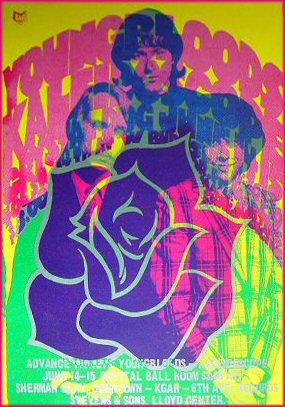
Apparently guitarist Buddy Guy, Junior Wells's sometime partner, was not part of this tour.

June 14-15, 1968 Youngbloods/Kaleidoscope
The Youngbloods, originally from New York City and Cambridge, MA, had moved to Marin County in September, 1967. The quartet (singer/bassist Jesse Colin Young, lead guitarist/singer Jerry Corbitt, multi-instrumentalist Lowell “Banana” Levinger and drummer Joe Bauer) had played regularly throughout the Pacific Northwest as well as the rest of the country. The group’s second album (Earth Music, on RCA) had been released in November 1967.

I assume that the Youngbloods are pictured in the poster, which is odd since they were a quartet, not a trio. Guitarist Jerry Corbitt would leave soon after this, so perhaps this was somehow anticipating the event.

June 21-22, 1968 Buddy Guy
Buddy Guy was a prominent blues guitarist in Chicago, not well known except to other guitarists. He was starting to make a name for himself on the ballroom circuit.


The city of Portland closed the Crystal Ballroom on or about July of 1968. Tim Hills reprints a headline in The Oregonian (Portland's main daily newspaper) from July 12, 1968 that says "City Closes Dance Hall: Crystal Ballroom Fails Inspection." Unhappy with the congregation of hippies downtown, the city had found a slew of code violations in June, and the operators of the Crystal--whoever they were by Summer 1968 is a bit vague--were unable to respond effectively. According to Hills, a Newsweek article (from May 20, 1968) that said that San Francisco hippies were all going to Portland for the Summer did not help matters.

The exact date of the last show isn't certain, and the venue may have put on shows as late as Saturday, July 6, 1968, but I don't know who might have played. Its known (from Billboard magazine) that Iron Butterfly had to cancel a July date at the Crystal (either 12-13 or 26-27), and according to Hills Big Brother and the Holding Company had to cancel as well, but the end of the psychedelic area came quickly for the Crystal Ballroom.


(Outside the Crystal Ballroom at Sw14th Ave and W. Burnside St, Portland, OR in July 2008. photo: me)


Although it closed as a rock venue in July, 1968, The Crystal remained dormant, a beautiful dream left sleeping downtown. Happily, the building was purchased and restored by local entrepreneurs, and the Crystal Ballroom reopened in 1997. Its “Floating Ballroom” was restored as well, and The Crystal Ballroom is once again a popular local attraction and a glamorous tour stop for a wide variety of music.

Apparently the city of Portland is concerned with the liquor license and activities of the venue, again, but as this struggle has been going on since 1873 the Crystal Ballroom is likely to weather this storm as well.

Thursday, February 25, 2010

Avalon Ballroom, July 1-2-3, 1966: Grass Roots/Daily Flash/Sopwith Camel

This post is part of a series analyzing every show at the Avalon Ballroom

July 1-2-3, 1966 Grass Roots/Daily Flash/Sopwith Camel 
Since the 4th of July was on a Monday, the Avalon had a three day booking for the weekend instead of just the normal Friday and Saturday night shows. The Sopwith Camel were not booked for Sunday night, July 3--I do not currently know if any other band performed on that night.

The LA folk-rock bands are now playing the Fillmore and Avalon regularly.  ‘Folk-rock’, epitomized by The Byrds, was not only popular, but hip, and bands like The Turtles, The Grass Roots and The Association appeared to have more in common with Quicksilver or The Airplane than they do today.     The Grass Roots were starting to break out nationally.  Their current Dunhill single, “Where Were You When I Needed You,” peaked at  #28 nationally.

The Daily Flash, while founded in Seattle, had relocated to Los Angeles, where they shared management with the Buffalo Springfield. Nonetheless, they had been a huge hit at the Avalon, so they had a following in San Francisco. The Daily Flash’s repertoire actually included a lot of folk covers at this time, so this show really was a folk-rock bill, although the obscurity of these bands recorded releases meant that the audience would not know what they sounded like until they were actually at the show.

The Sopwith Camel were another group that had been founded out of the rooming house at 1090 Page Street, just like Big Brother. They had begun rehearsing at a place called The Firehouse (an abandoned Fire Station) where a few shows were presented as well. Their second show was at the Fillmore in February. They had improved steadily, however, and became a viable band. 

By July, The Sopwith Camel had been signed by Kama Sutra Records. In May, a friend of the band had sent an early demo tape of the song “Hello Hello” to Lovin Spoonful producer Erik Jakobsen, who immediately sought the group out.  He met them returning from a gig at a private girls school, and they were all dressed in tuxedos.  Nonetheless, Jakobsen recognized the potential and signed them immediately.Jakobsen was on the prowl because The Lovin Spoonful were getting even bigger.  “Daydream” had reached #2 in the spring, and “Did You Ever Have To Make Up Your Mind”, their current single, would reach #2 as well.

The Spoonful’s biggest hit, “Summer In The City” would not even hit the charts for a few more weeks. However, the Lovin Spoonful would never play the Avalon or the Fillmore. Sometime in the Summer (probably after a May 21, 1966 show at the Greek Theatre in Berkeley), Spoonful guitarist Zal Yanofsky was busted for pot, and he gave up his dealer, apparently a member of The Committee improv troupe. This poisoned the band's reputation in the Underground, and the Spoonful were persona non grata at the Avalon and the Fillmore, so they were never booked there. The drug bust problems of Yanofsky would have seemed like trivial show-biz problems to the record companies.  The idea that a band’s inability to play obscure venues in San Francisco would affect their future popularity would have been incomprehensible to a New York record company.

Oddly enough, the Sopwith Camel appear on a Fillmore poster for Saturday, July 2 (supporting Great Society and The Charlatans), and that presents a conflict with the Avalon poster. By this time, Bill Graham and Chet Helms were fierce competitors and would not have allowed a band to play both venues on the same night. Given that the Camel did not play the Avalon on Sunday, July 3, perhaps the Fillmore poster was mistaken and the Camel played on July 3 at the Fillmore (which was billed as Love/Grateful Dead/Group B).

next: July 8-9-10, 1966: Sir Douglas Quintet/Everpresent Fullness

Wednesday, February 17, 2010

August 22-23-24, 1969 Fillmore West/Family Dog, San Francisco--Wild West 'Makeup' Shows

 
The Summer of 1969 was the Summer of Rock Festivals. Woodstock was the most famous, but every region had a major outdoor event of some kind or another featuring numerous bands over a period of days. Ironically, San Francisco, the City where the 1967 Human Be-In inaugurated the idea of an outdoor rock festival as a collective celebration, had its giant outdoor event canceled at the last second. This cancellation was one of the catalysts of the Altamont concert four months later (on December 6, 1969). Ironically, the characterization of Altamont as a symbolic "Anti-Woodstock" has caused foggy notions about the Wild West Festival and complete amnesia about the concerts that took place in its stead at Fillmore West and The Family Dog On The Great Highway.

The Wild West Festival: A Brief Overview
Most 1969 Rock Festivals were on the "muddy field" model, either on an empty farm or an isolated auto racing track, with music running 16 to 24 hours a day, overnight camping and general madness. All of these events were marked (if not marred) by the attendant isolation, lack of facilities, lack of food and water attendant on packing tens of thousands of people in a place not equipped for it. Many of the events effectively turned into free concerts when security broke down. 

Despite the shaky footing of all these events, all the major touring bands played at least one if not several festivals in late 1968 and throughout 1969. The San Francisco bands in particular were mainstays of these events. Thus it only seemed appropriate that the big event planned for San Francisco would be a unique and forward looking event that would set the City apart from other places, always a desirable result in Northern California.

Among the distinguishing characteristics of the plan for the Wild West Festival were the following:
  • A three day event in Golden Gate Park that featured three nightly paid concerts in the football stadium, while a free festival went on throughout the park during the day
  • A collective approach that featured all the major players in the San Francisco concert scene, Bill Graham and Chet Helms most prominent among them
  • The stadium acts would be exclusively Bay Area bands
In 1969, only San Francisco had the musical firepower to have 10 headline acts that were hometown heroes, all of them willing to take the gig for a comparatively reduced fee, possibly as little as just expenses. Every other Festival imported acts from America and England, particularly San Francisco, but San Francisco had no need for recourse to elsewhere. According to the poster, the scheduled acts for the events in Kezar Stadium (itself located in Golden Gate Park) were
  • Friday, August 22: Janis Joplin/Grateful Dead/Quicksilver Messenger Service/Turk Murphy
  • Saturday, August 23: Jefferson Airplane/Mike Bloomfield & Nick Gravenites/Edwin Hawkins Singers/Sons of Champlin/Fourth Way
  • Sunday, August 24: Sly and The Family Stone/Santana/Country Joe and The Fish/Steve Miller Band/The Youngbloods
There were 10 ballroom headliners amongst these acts. Amongst the acts included for "diversity," Oakland's Gospel group The Edwin Hawkins Singers had had big hit with "Oh Happy Day," Turk Murphy's group was the leading Dixieland band, and The Fourth Way were an electric jazz-rock group.

All of the major acts were in the midst of ferocious Summer touring schedules, and were prepared to go well out of their way to make the hometown event. Six of the bands had been at Woodstock the weekend before, on the opposite Coast. If the Wild West had gone off as planned, The Grateful Dead, for example, were in between gigs in Seattle (Wed Aug 20) and Oregon (Saturday Aug 23), and would have had to fly in and out for the Friday night show. Janis Joplin was on the East Coast, and had a Saturday night show (Aug 23) in New Jersey (at Asbury Park) but had promised to fly in to headline Friday night. Country Joe and The Fish had a weekend gig in Chicago, Santana would have just finished three nights in Boston, and both would have had to race back to play Sunday night, but none of the bands were going to miss out on this. 

It was not to be. The Wild West Festival collapsed amongst the insistence of too many parties that the show should be free, while others, particularly Bill Graham, pointed out that appropriate sound, lights and security were not at all free. When it all collapsed the week before the event, there was a wave of public hostility throughout the San Francisco hip community, mostly directed at Bill Graham, who in turn publicly threatened to close the Fillmore West and quit the rock business altogether. Whatever the Summer Of Love had been, free concerts in Golden Gate Park were not viable. The City of San Francisco, for its part, was plainly relieved that no such mammoth event occurred in the City limits, and made sure to refuse every permit for a major outdoor concert in the Park for the next 22 years. Ironically, the ban was lifted in 1991 to allow a free concert honoring Bill Graham after his untimely death.

The Wild West "Makeup" Concerts
Amidst all the bad feelings, the week after Woodstock there was a giant hole in the San Francisco concert calendar. The Fillmore West and Family Dog had not booked concerts for the weekend, expecting that their staff, performers and audiences would all be in Golden Gate Park. While some bands, like The Dead, Janis and Santana, had their travel schedules simplified, many of the local bands found an empty weekend date on their calendars. Various other parties who had committed funds to planning the Wild West event, particularly Chet Helms, were left in a difficult financial situation, accenting Graham's point that free concerts weren't free at all.

The solution to this void was very San Francisco: empty ballrooms, available bands and audiences with nothing to do equaled a prime opportunity to have some big rock concerts on a moment's notice. These shows were billed as fundraisers for the Wild West organizers, but exactly who profited from them isn't clear, and I'm not certain whether or to what extent the bands got paid. Nonetheless, there were some interesting rock concerts, and they are usually left completely out of Fillmore West chronologies because they do not have posters that are part of the BGP series. Thanks to Ralph J Gleason's column in the San Francisco Chronicle on Monday, August 25 (excerpted below), and a few other peripheral sources, I have some idea of what happened, so I will summarize these lost events here.


Gleason wrote
The Wild West, driven into the ballrooms this weekend by its enemies, still managed to present an absolutely beautiful grouping of bands, for some of the most interesting rock the city has known. 

Friday August 22, 1969 Fillmore West
Quicksilver Messenger Service/The Youngbloods/Ace Of Cups/Womb/The Fourth Way/The Committee
This show was described in some detail by then-teenage diarist Faren Miller (accessible to determined googlers). Quicksilver, largely invisible in concert in 1969, made the public debut of their new lineup, with pianist Nicky Hopkins effectively in place of Gary Duncan. The Youngbloods were riding a wave of popularity at the time because of the hit re-release of their single "Get Together." The Ace Of Cups, Womb and The Fourth Way were popular bands in local clubs, and The Committee was a popular counterculture Improv troupe.
Saturday, August 23, 1969 Family Dog At The Great Highway
Quicksilver Messenger Service/Sons Of Champlin/Jimmy Witherspoon/Anonymous Artists of America
Gleason writes in some detail about the Quicksilver performance Saturday night at the Family Dog. He makes some interesting points in passing: apparently Quicksilver played a few hitherto unknown stealth gigs in Golden Gate Park. Gleason also observes that Dan Healy plays occasional bass, presumably to free up Freiberg to sing (Miller made the same observation about the night before). Healy was Quicksilver's engineer, and he had recently left his job as the Grateful Dead's soundman, a job to which he would return in a few years. This seems to have been Healy's only stab at sustained performance until his own Healy-Treece Band that began in 1979. The "Denise Jewkes" referred to is the married name of Ace Of Cups member Denise Kaufman, who wrote some songs used on the Shady Grove album.
 
Jimmy Witherspoon, an Oakland-based blues singer, seems to have been backed by The Sons Of Champlin. The comparatively unheralded Sons were among the very best musicians on the Fillmore scene, and could play authoritatively in any style. The Anonymous Artists of America, by contrast, originally a Santa Cruz Mountains band, had a reputation for being fun yet sloppy, so when  Gleason says they "surprised me by the way they swung," it is because they had not done so in the past. From what I know, they had moved to San Francisco and got a hot young drummer from Texas (Richard somtehing), so that probably improved matters.

Saturday, August 23, Fillmore West
Jefferson Airplane/Aum/Los Flamencos De Santa Lucia

 
Gleason heads across town to the Fillmore West on Saturday night to catch the Jefferson Airplane. One of the most interesting points is that Gleason says
the Airplane was on when I arrived...and Jorma Kaukonen and Jack Casady were doing their acoustical guitar and electric bass duet which now provides a very effective interlude in the Airplane's program.
Just a few weeks later, Jack and Jorma would record their first album as a duo at Berkeley's New Orleans House, dubbing their band Hot Tuna, but at this time it did not yet have a name. Jorma and Jack had played around The Matrix and elsewhere in 1969, but the name Hot Tuna was invented for the record.

Gleason goes on to describe Quicksilver, having finished their set at Family Dog, stopping by the Fillmore West to hear the Airplane. While its a fact that the Fillmore West was on the way home to Marin, the band still had no obligation to stop and hang out, yet it was a sign of the vitality of the scene that the bands were still friends and enjoyed socializing, a fact of life that would slowly fade away over the next few years.

Sunday August 24 Fillmore West
Country Joe and The Fish/Its A Beautiful Day/Sons Of Champlin
This is the show about which I know the least. Country Joe and The Fish had played Woodstock the weekend before, and then had a weekend gig (Aug 22 and 23) in Chicago at the Kinetic Playground. They too would have had to fly in for the show, but other than that I don't know anything about it. Its A Beautiful Day had just released their extremely popular first album (with "White Bird" and other classics) and were rapidly rising out of the "local band" category.

The Wild West Festival is a lost San Francisco event, although given the ambitious and unrealistic plans for the event, it probably would have been a debacle. Of course, if there had been a public debacle in San Francisco in August, the Grateful Dead and The Rolling Stones would probably have not concocted a scheme to put on a huge San Francisco Bay Area rock concert, and the Altamont mess might have been avoided. But without Altamont, of course, what would have stood as the official ending to the 1960s?

Lost in these events are some fine concerts in San Francisco by some of the best exponents of the rock music of the City. Since the hastily scheduled events lacked posters, they are not part of typical chronologies, even though by Gleason's (and Faren Miller's) account they were a memorable musical weekend in San Francisco.

Friday, December 18, 2009

January 13-14-15, 1967 San Francisco--Rock Weekend


From this great distance, most rock historiography is siloed, as researchers delve deeper and deeper into the details of a specific rock band's history or the minutiae of a certain event. I myself am acutely guilty of profoundly detailed research of little interest even to the participants. While the best information comes from determined research, it's also important to think about the context in which events occur. The Human Be-In, a free concert and gathering in Golden Gate Park in San Francisco, where 15,000 or so long-haired gathered peacefully to listen to Berkeley radicals, some Beat poets and several San Francisco rock bands, all for free, was a seminal event in rock history.

The Be-In was seminal not least because the event was picked up by national TV news, and a sunny San Francisco afternoon with "acid, incense and balloons" (in Paul Kantner's words) seemed awfully engaging to a lot of young people around the country feeling cold and alienated by parents, the threat of the Vietnam War or the snow. Publicity about the Be-In was the key event that triggered San Francisco's "Summer Of Love," and accelerated the San Francisco music scene from a happening Underground scene to a flash point for the next rock explosion after the Beatles and The "British Invasion."

All the importance and symbolism attached to the Human Be-In is worthy of interest, and that was recognized at the time. The Be-In triggered Be-Ins throughout the country, and triggered the phenomenon of the outdoor rock festival, starting several months later at Monterey Pop, and culminating at the apogee and perogee of Woodstock and Altamont in 1969. What is usually lost in discussions of the Human Be-In, however, was what a happening musical weekend it was around the Bay Area. The Human Be-In was the biggest event, but it would have been musically memorable in any case, a sign of the vitality of the San Francisco scene at the time. This post will look at the wide variety of rock events on the Human Be-In weekend, showing how the Be-In was a fair representation of what was happening in the City at the time (h/t Ross for the poster scans).


Friday, January 13, 1967
San Francisco
Fillmore: The Grateful Dead/Junior Wells/The Doors
Avalon: Moby Grape/The Sparrow/Charlatans
Basin Street West: Jefferson Airplane/Dizzy Gillespie (401 Broadway, North Beach)
The Matrix: Steve Miller Blues Band/Steve Mann (3138 Fillmore, The Marina)
The Both/And: Charles Lloyd (350 Divisadero)
Friday night in San Francisco was fraught with great events--

At the Fillmore, the Grateful Dead had to race over from Berkeley, where they had filled in for Jose Feliciano (see below). The Doors had played the previous weekend (with The Rascals and Sopwith Camel), and with their first album just released, were the hottest band to come out of Los Angeles. They apparently were a huge success the the first weekend, but for mysterious reasons of his own, Jim Morrison chose to spend the evening at a movie theater in Sacramento, watching Casablanca three times, so The Doors did not perform at the Fillmore Friday night. 

The bands at the Avalon were all without recording contracts, but all featured members who would go on to great success. Moby Grape, having just formed a few months earlier, were San Francisco's latest underground sensation; given their members' vast performing experience, its no surprise they were reputedly a terrific live band right from the start. The Charlatans, while legends, never lived up to their possibilities, but drummer Dan Hicks went on to achieve his own peculiar immortality. The Sparrow, from Toronto but based in Sausalito, would move to Los Angeles in June and reconfigure themselves as Steppenwolf.

At North Beach's biggest jazz club, the Jefferson Airplane, San Francisco's biggest stars, were playing a high profile engagement (January 11 through 22) with trumpeter Dizzy Gillespie. The formidable Charles Lloyd quartet (with Keith Jarrett, Ron McClure and Jack DeJohnette) was playing a week at the tiny Both/And, near the Haight. Over at The Matrix, newly arrived from Madison, WI, via Chicago, was the Steve Miller Blues Band, already a fine live band. Opening for Miller was Steve Mann, as good a guitar player as anyone playing this weekend.

East Bay
Berkeley Community Theater: The Mamas And The Papas/Jose Feliciano/The Hard Times
(Allston and Grove, two shows 8:00 and 10:45)
Rollarena, San Leandro: Mojo Men/Mark & Stanley & The Four Fendermen/The Opposition
Ligure Hall, Oakland: Maybe Tomorrow/Loading Zone (4799 Shattuck)
New Orleans House, Berkeley: Notes From The Underground(1505 San Pablo)
Just across the Bay Bridge--

The Mamas And The Papas were one of the most popular groups in the country, and Bill Graham presented them at Berkeley Community Theater, supported by Jose Feliciano and a local group called The Hard Times. The show almost never appears in lists of Bill Graham shows, probably because there was no poster for it. The show sold out quickly and a late show was added. According to Ralph Gleason's review in the Chronicle (on January 16), Jose Feliciano was late arriving, and the Hard Times were unavailable.

A locally based group called The Canadian Fuzz opened both shows, but to fill in for Feliciano, the Grateful Dead played a brief set for the early show, prior to returning to the Fillmore to headline. Gleason, a fan of the Dead, was dismissive of their performance at Berkeley. Interestingly, they would not have been playing through their own sound system, a rare event for the Dead even then. The Dead would have been done by 9:00 o'clock, leaving plenty of time to get to the Fillmore even with The Doors being absent.

San Leandro's Rollarena had been a happening spot for teenagers the previous year, but it was being eclipsed by the Fillmore and Avalon. The Mojo Men, with singing drummer Jan Errico and their hit "Sit Down I Think I Love You" were apparently a pretty good live band. I know nothing about the event at Ligure Hall, and I can't imagine it was well attended. The New Orleans House was just starting to present original rock in the East Bay.

North Bay
Santa Venetia Armory: Big Brother and The Holding Company/Moby Grape (155 Madison)
Even in then-sleepy Marin, something was happening. The former National Guard Armory, just North of San Rafael, had been used for many teen dances in the mid-60s and was used briefly for psychedelic bands before it too succumbed to the Fillmore. Moby Grape was playing two gigs in the same night. Of course, since Chet Helms both promoted the Avalon and managed Big Brother, he was responsible for both gigs, so it was certainly OK with him. This show probably ended early.


Saturday, January 14, 1967
San Francisco
Human Be-In, Polo Grounds, Golden Gate Park
Jefferson Airplane/Grateful Dead/Quicksilver Messenger Service/Sir Douglas Quintet/Loading Zone/The New Age
Fillmore: The Grateful Dead/Junior Wells/The Doors
Avalon: Moby Grape/The Sparrow/Charlatans
Basin Street West: Jefferson Airplane/Dizzy Gillespie (401 Broadway, North Beach)
The Matrix: Steve Miller Blues Band/Steve Mann (3138 Fillmore, The Marina)
The Both/And: Charles Lloyd (350 Divisadero)
Goman's Gay 90s: The Sparrow (345 Broadway, North Beach 2am Breakfast Show)

The Human Be-In was attended by just about every hippie in the Bay Area, and is remembered fondly by everyone I ever talked to who attended. The musical performances were brief, as there were many speakers and poets as well as the musicians. The Grateful Dead's brief (half-hour set) included Charles Lloyd on flute for "Good Morning Little Schoolgirl." The rest of the groups were reported by the San Francisco Chronicle, so there may in fact have been other groups who played as well. The Chronicle incorrectly reported that Country Joe and The Fish played, when in fact a Berkeley band called The New Age performed, with whom Joe and some Fish joined in.

Most of the musicians playing San Francisco were probably present. Lloyd played with the Dead, and a member of The New Age described jamming offstage with Dizzy Gillespie. The Doors were certainly present, as well.

The Doors did play on Saturday night at the Fillmore, and many of the people at the Fillmore must have been at the Be-In, and seeing The Dead, The Doors and Junior Wells each play two sets after spending all day in the park must have made for some day, but you could say the same about the Avalon or Basin Street West. And if you just couldn't sleep (for one reason or another), The Sparrow were playing 2-6am "Breakfast Shows" at a North Beach Topless Club called Goman's Gay 90s, as were the Airplane and Dizzy Gillespie in North Beach.

Bay Area

Sonoma County Fairgrounds, Santa Rosa: The Mojo Men
New Orleans House, Berkeley: Notes From The Underground
Continental Ballroom, Santa Clara: The Turtles/William Penn Five/The Chosen Few (1600 Martin Ave) 

The out-of-town fare was considerably less on Saturday, fortunate for any promoters who didn't have to be competing with the Be-In.


Sunday January 15, 1967
San Francisco
Fillmore: The Grateful Dead/Junior Wells/The Doors (afternoon show)
Basin Street West: Jefferson Airplane/Dizzy Gillespie (401 Broadway, North Beach)
The Matrix: Steve Miller Blues Band/Steve Mann (3138 Fillmore, The Marina)
The Both/And: Charles Lloyd (350 Divisadero)
Goman's Gay 90s: The Sparrow (345 Broadway, North Beach 2am Breakfast Show)

The dust had settled somewhat by Sunday, but there was still music to be had. Sunday afternoon Fillmore shows often did not include the weekend's headline act. Both the previous weekend at the Fillmore (headlined by The Rascals) and the next weekend (headlined by Butterfield Blues Band), notices in the Chronicle explicitly stated that the headliner would not be performing. The Wes Wilson posters for all of the January shows (BG 44, 45, 46 and 47) include ambiguous wording that says 'Our Reg Sun Afternoon Dance Concert Kiddies Free!' The Friday Chronicle datebook (above) lists the Dead instead of "rock jam" as it had other Sundays, but I am not certain if the Dead actually played Sunday. If they didn't, it would actually be consistent with other January headliners.

East Bay
Provo Park, Berkeley Loading Zone/Ulysses S Crockett (Grove and Allston, 2-4pm, free)
New Orleans House, Berkeley: Notes From The Underground

Although the entire Bay Area longhair community had to fairly spent, there was a free concert in downtown Berkeley's main park, announced in Ralph Gleason's column, featuring The Loading Zone, an Oakland band who had gigged on all three days. Notes From Underground played Sunday evening, for anyone who was still awake.

Many of the events of the weekend of January 13-15, 1967 have gotten their due in rock chronologies. The Human Be-In had social and political consequences, symbolizing a movement from radical Berkeley politics to much larger questions, and the event all but singlehandedly guaranteed the Summer Of Love in San Francisco. At the same time, The Doors, one of the most important rock groups of the 1960s, were playing San Francisco just as their new album was released, and the Jefferson Airplane shared a two-week billing with Charlie Parker's former trumpet player. Moby Grape was just springing into the light, The Sparrow were laying the groundwork for Steppenwolf, Steve Miller had just started performing in San Francisco, and established pop stars like The Mamas And The Papas and The Turtles headlined around the Bay Area.

By Summer 1967, most of these bands (in some form) were starting to tour the country, and they wouldn't be in the same place at the same time except at a Festival, but for one weekend, San Francisco and the Bay Area was its own rock festival.

Tuesday, December 15, 2009

The Strange Affair of the Forged Family Dog Handbills

Although the tiniest bit off subject, Corry’s recent discussions on early Family Dog shows bought to mind the subject of a few Family Dog handbills that were forged circa 1980.

This picture shows both an FD-3 handbill for a Butterfield, Quicksilver show put on by the Family Dog at the Fillmore and an FD-6 handbill for the second of the Family Dog shows at the Avalon Ballroom. This show featured the Grass Roots, the Sons of Adam together with Big Brother and the Holding Company. Of particular note are the annotations Reprinted Flyer and Genuine Counterfeit.

A number of years ago Jacaebor Kastor, who was still running Psychedelic Solutions in New York City at the time, discovered that some of the early FD handbills had been forged. These bootlegged handbills included FD-1, FD-3, FD-6, FD-9 and FD-12, and to all but the trained eye of the scholar were indeed of a good quality. This is of course borne out by the forgeries not being identified for nearly twenty years.

Eric King’s authoritative guide for Bay Area paper collectors, or more specifically Family Dog and Fillmore series collectors, provides guidance for distinguishing the originals from the bootlegs. However, early Family Dog handbills are rare – in some cases very rare. At one time, a near complete print run of an early handbill were cut in to thirds, turned over and used as scrap as the office had run out of notepads. To buy original copies of these five Family Dog handbills from the folks at Wolfgang’s Vault today would cost a cool $15,742.

So the annotations? It seems that upon discovery of the forgeries, Jay and Eric managed to obtain a reasonable quantity of the handbills and took the opportunity to stamp them as Genuine Fake, Genuine Counterfeit or Reprinted Flyer. The use of the word genuine was perhaps a nod toward the quality of the product, whilst the stamp would hopefully put an end to any possible deception. An interesting aside of course is the inclusion of these items in Eric’s guide makes them collectable in their own right. And the cost of a set of five? Perhaps $742 nowadays – but not $15,742.

Tuesday, December 8, 2009

Avalon Ballroom June 24-25, 1966: Big Brother and The Holding Company/Quicksilver Messenger Service


This post is part of a series analyzing every show at the Avalon Ballroom. Above is the Kelly/Mouse poster, FD-014 (h/t Ross for the scan)

June 24-25 Big Brother and The Holding Company/Quickilver Messenger Service

Big Brother and Quicksilver were both popular local bands, but they were still essentially underground bands. On June 24, this changed. This weekend was Janis Joplin's debut as a member of Big Brother and The Holding Company. While Janis's mark was instantaneous, it still took some time for the group to reach beyond underground San Francisco. Still, the magical combination of Janis's emotionally charged vocals and Big Brother's feedback driven madness was one of San Francisco's principal musical exports, and it began this weekend.

Over the years, there has been some confusion over which night Janis debuted with Big Brother. For many years it was assumed to be on June 10, but that date makes little sense. Not only was Big Brother not even on the bill--although they very well could have just dropped in, since their manager ran the venue--but Janis had only arrived in San Francisco on June 4. Chet Helms had sent a lieutenant, Travis Rivers, to Austin and they had hitchhiked back. Its extremely unlikely that she would have met the band, rehearsed and performed in less than a week. In any case, since the group was on the bill June 24-25, it makes perfect sense that this would be her debut.

Janis had moved to San Francisco in the early 1960s, hoping to make it as a folksinger, and hung out with Chet Helms at the time. Although she was locally known, acoustic folk music and Janis weren't quite ready for each other, and Janis ended up getting too involved with speed, and she returned to Austin. While she laid low, Big Brother seemed to have hit a plateau in San Francisco. They were a creative live band, but no one was a really good singer, and there was no visual focus to the group. The Jefferson Airplane and Great Society both had "chick singers", and that seemed to be the way to go. Various names were tossed about, and its not clear if any of those singers actually rehearsed with Big Brother. In any case, Helms sent Rivers to Austin to retrieve Janis, and introduced her to the band.

It was not even certain that the ambitious Joplin would even join Big Brother.  Ritchie Unterburger wrote that Paul Holzmann of Elektra tried to form a group around Janis Joplin at this time, immediately after she moved to San Francisco.  Supposedly, Janis, Taj Mahal and guitarists Stefan Grossman and Steve Mann actually rehearsed at least once.  Grossman said that Holzmann said some months later that “the contracts made it impossible.” Regardless of the reality quotient of any of this story, it is a clear sign that record companies are hovering around San Francisco ready to jump on the next big thing.

In any case, Janis's appearance at the Avalon was a suprise to many or most of the people at the show. I know someone who attended the show, and she said that Janis's voice "sounded like tape being rewound." Since Janis and the members of Big Brother's had all been folk musicians, they knew a similar set of songs, like "I Know You Rider" and "The Cuckoo," so they had a base of material to put their stamp on immediately. The earliest Big Brother tape is from just a month later (July 28 at The Fillmore) and the band's sound is fully formed, so its clear that Janis and the band knew it was a perfect match.

Although to most of the crowd at the Avalon this must have seemed like another fun summer night at the Avalon with some hot local bands, in fact San Francisco rock was taking a huge step towards going National. Appropriately, the Kelly/Mouse "Zig Zag Man" poster for the show became an iconic poster as well. Now, of course, we see the poster and think about people rolling joints, but at the time pot was still underground enough that this reference would have been lost on all but the few longhairs who would have wanted to attend the show.

Next: July 1-2-3, 1966 Grass Roots/Daily Flash/Sopwith Camel

Thursday, November 26, 2009

Avalon Ballroom June 17-18, 1966: Captain Beefheart and The Magic Band/Oxford Circle

This post is part of a series analyzing every performance at the Avalon Ballroom

June 17-18, 1966 Captain Beefheart and The Magic Band/Oxford Circle

Captain Beefheart and The Magic Band had supported Love at the Avalon the month before, but they returned in June as headliners. Beefheart was seen as a blues musician with a big voice, rather than the avant-garde experimentalist he would become. The Magic Band at this time would have been Doug Mono and Alex St. Clair on guitars, Jerry Handley on bass and Paul Blakely on drums.

Oxford Circle were making what appears to be their San Francisco debut. The group were from Davis, CA, near Sacramento, just 75 miles Northeast of The Avalon. Davis had a newly-opened (1959) branch of the University of California, and between the college town and Sacramento proper there were a lot of gigs and a lively music scene. The Oxford Circle had originally been a surf band called The Hideaways, but as their music moved towards a British Invasion style, they changed their name to The Oxford Circle, because it sounded more English, and was the name of a woman's dorm at UC Davis. They were one of the most popular bands in the Davis/Sacramento area.

However, unlike other groups popular on the teen dance circuit, the Oxford Circle was starting to do their own thing, so they fit in very well at the Avalon. Their music was modeled more on the harder rocking bands like The Yardbirds and Them, and more and more time was being allotted to lead guitarist Dehner Patten. Lead singer Gary Yoder was starting to write his own songs, and along with the solid foundation of bassist Jim Keylor and drummer Paul Whaley, the experienced Oxford Circle were a powerful live band. Many underground San Francisco groups were made up of folkies still struggling to figure out electric instruments;  the Oxford Circle was already made up of rock and roll veterans ripe for something wilder. The band were instant crowd favorites in San Francisco.

San Francisco and the Bay Area has a great sense of self-importance (to be kind about it), and an innate tendency to look down its nose at the surrounding areas. Oxford Circle had been trying to break into Bill Graham's Fillmore for some time, but Graham wanted no part of them. Abruptly, after getting booked by the Avalon, and particularly after rocking the house, Graham invited Oxford Circle to audition for him, so they opened a show for Them at the Fillmore on June 23, and two weeks later were booked with The Turtles (July 5-6). Many San Francisco bands noticed that Bill Graham waited for the hipper Chet Helms to figure out who was right for San Francisco, and then used his financial leverage to get them into the Fillmore. 

In the liner notes for their Big Beat cd (see below), Yoder recalls auditioning for Chet Helms and playing on the bill the same night, and being booked for two weeks later. This suggests that Oxford Circle had played a previous show at the Avalon, probably on June 3 or 4 (opening for Grass Roots and Big Brother). It also suggests that many more bands played the Avalon than appeared on the poster, an idea borne out by the number of groups who recall playing at the Avalon and yet don't appear on the poster.

One unique aspect of the June 17-18 weekend of shows is that we have a pretty good idea of how the bands sounded. Recordings from the Avalon in 1966 are few and far between, but there are extant tapes of both Captain Beefheart and Oxford Circle from this period, and they very well have been from one of these nights. Avalon soundman and partner Bob Cohen did tape many Avalon shows, and kept the best of them. In 1997, Big Beat Records released a tremendous cd from Cohen's tapes, The Oxford Circle Live At The Avalon 1966. The exact date of the show is uncertain, as Oxford Circle played the Avalon many times, but at the very least we have a complete and lively document of how the Circle really sounded live. Alec Palao's liner notes give the complete story of The Oxford Circle, along with some great photos as well. The cd is a must-have for any fans of San Francisco bands and good music in general.

A Captain Beefheart tape from the Avalon in 1966 also circulates. It is only about 4 songs long, and hardly of the quality of Bob Cohen's perfectly preserved recording, but it gives a picture of the Captain's 1966 sound. As with many old tapes, there is no way to be certain which night at the Avalon it represents, but this is a rare bill where tapes allow us to know what it must have sounded like in general if not precisely.

Next: June 24-25 Big Brother and The Holding Company/Quicksilver Messenger Service

Friday, November 13, 2009

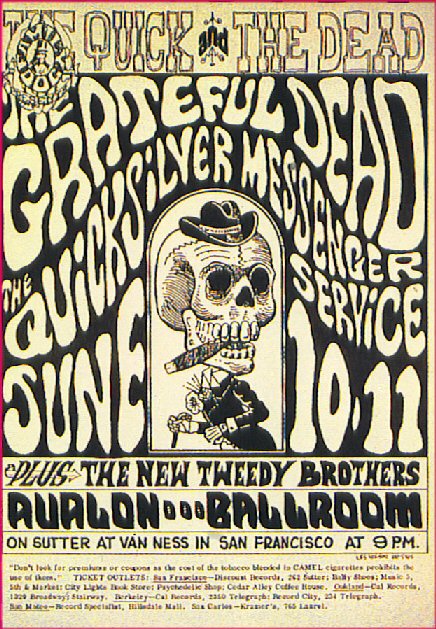
Avalon Ballroom June 10-11, 1966: Grateful Dead/Quicksilver Messenger Service/New Tweedy Brothers


This post is part of a series analyzing every performance at the Avalon Ballroom. Above is the Wes Wilson poster (FD12-thanks to Ross for the scan)

The Dead and Quicksilver Messenger Service had just played the Fillmore together, (June 3-4), and so they played consecutive weekends for Bill Graham and then Chet Helms.  The bands generally preferred playing the Avalon , but made more money at the Fillmore.  Quicksilver and The Dead were ‘summering’ at neighboring ranches in Marin County, across the bay.  The Dead dressed as Indians, and Quicksilver as Cowboys, and the bands and their crews and friends chased each other through the woods until the peace pipe was smoked. Many hippies identified with Native Americans, seeing them as peaceful, resilient people who lived off the land (not all of them did--by late 1966, the manager of Country Joe and The Fish [Ed Denson] would lament  “All this Indian crap.  There are so many fake Indians in Berkeley you wouldn’t believe it”)

In the audience on the previous weekend at The Fillmore was a friend of John Cipollina, a local radio engineer named Dan Healy.  When the Dead’s equipment broke, Cipollina recommended Healy, who promptly fixed the problem.  Healy criticizes the Dead’s vocal sound, and Garcia challenged him to do better.  Healy ended up becoming the Dead’s sound man until the early 1990s and did indeed do better. While he may not have yet been a member of the crew, he was almost certainly present and starting to get involved at this weekend's show.

At the Dead's first appearance at a Family Dog show two weeks earlier (May 28), the band's Owsley Stanley constructed sound system was so large, it blocked Bill Ham's light show. By this show, the band had painted the sound system white, so it became the screen for the light show.

The New Tweedy Brothers were a band from Oregon that had moved to San Francisco in 1966. They had an an obscure single on Dot, and recorded an album. However, their only album, released in 1968 ) on Ridon Records showed definite folk roots, with strummed guitars and nice harmonies, somewhat like The Byrds. In concert, they apparently also did a rock version of “Cold Rain and Snow,” no doubt being familiar with the same obscure Obray Ramsey record that Garcia had heard.

Their album, however, was pressed in a unique, oversize hexagonal sleeve too large to fit in record store racks, thus insuring that the poorly distributed album would sell as few copies as possible. The band returned to Oregon around 1967. Shadoks re-released the album on CD around 2001, retaining a tiny version of the oddly-shaped sleeve.

Next: June 17-18, 1966: Captain Beefheart and The Magic Band/The Oxford Circle

Avalon Ballroom June 3-4, 1966: The Grass Roots/Big Brother and The Holding Company/The Buddha


This post is part of a series analyzing every concert at the Avalon Ballroom. Above is the Victor Moscoso poster (FD-11-thanks to Ross for the scan)

By mid-1966, the Avalon had rapidly become an established venue. Chet Helms usually determined a theme for each weekend, and the poster artists created something that fit in with the theme. This week's theme was "Stone Facade," and Helms probably decorated the stage appropriately, and the light show probably worked within the theme as well. Lacking photos, however, we can only guess exactly what it looked like.

The Grass Roots were back for the second weekend in a row. This was only the 7th weekend that the Avalon had been open, and Big Brother and The Holding Company had played four of those. While it was a distinct advantage to be managed by the promoter of one of the town's exciting venues, and Big Brother's wild, ragged music was getting an enthusiastic response, the band had no good singers. Since the popular groups in town were the Jefferson Airplane and The Great Society (not to mention the We Five), Big Brother decided they needed a "chick singer" to complete their band. This very weekend, Helms sent his friend Travis Rivers to recruit his old friend Janis Joplin, and the two of them would hitchhike back to San Francisco.

The Buddha, billed as The Buddha From Muir Beach, was a local DJ and promoter. I don't know his real name. The Buddha put on a series of parties at Muir Beach Tavern in remote Western Marin, so he was known around the underground as well as a radio personality. However, I think he would have been some sort of emcee, not a performer.

There is some suggestion that the Oxford Circle may have auditioned for Chet Helms on one of these nights, and played so well that he added them to the bill the same night.  Certainly they opened a show after an audition somewhere around this time.

Next: June 10-11, 1966: The Grateful Dead/Quicksilver Messenger Service/New Tweedy Brothers

Friday, October 30, 2009

Avalon Ballroom, San Francisco May 27-28, 1966: The Leaves/The Grass Roots/Grateful Dead (28th)

(This post is part of a series analyzing every show at the Avalon Ballroom)

Friday May 27, 1966 The Leaves/The Grass Roots
Saturday May 28, 1966 The Grateful Dead/The Leaves/The Grass Roots

The Leaves were part of the Los Angeles/Sunset Strip scene.  They had started out as The Rockwells in 1964 playing fraternity parties at San Fernando State College.They kept evolving, however, and when they replaced The Byrds at Ciro's in 1965, they had changed their name to The Leaves. Their ‘emblem’ was a marijuana leaf, the kind of in joke that could be pulled off at the time. Bassist Jim Pons, one of the founders, was later in The Turtles and The Mothers of Invention (around 1971), and guitarist Bill Rinehart would end up in a variety of bands as well. 

The Leaves played LA clubs like Ciro’s and The Whiskey after The Byrds had graduated to larger places.  The Leaves had a hit with “Hey Joe”, which entered the Billboard charts in June 1966, so it would have been getting heavy local radio airplay at the time of this show.  Love, The Byrds, and The Leaves were all performing and recording “Hey Joe” at the same time, but the Leaves had the hit. The Leaves' first album, also entitled Hey Joe (on Surrey) was released in 1966 as well, although I don't know exactly when. The Leaves professional experience apparently made them quite a good live band, and in any case a group whose emblem was a marijuana leaf was definitely welcome at the Avalon.

The Grass Roots were returning to the Avalon, having played there a month earlier.

The Grateful Dead had played the Avalon just nine days earlier, but this was their first time playing for Chet Helms and The Family Dog. I do not know why the Dead did not play the Friday night show at the Avalon (May 27), but I have to assume they had a gig elsewhere. I am certain that they did not play there, too, since I have a friend who chose not to go the Avalon that night because the Grateful Dead weren't playing, and chose to see some unknown bands at the Fillmore instead (and as a result my friend's first San Francisco rock concert was Mothers/Velvet Underground).

At this time, Grateful Dead soundman and patron Owsley Stanley had been purchasing more and more equipment in an attempt to invent modern sound systems. According to Dennis McNally's book What A Long Strange Trip (p.149), by the time of this show Owsley's PA was so large it blocked Bill Ham's light show.

Next: June 3-4, 1966 Grass Roots/Big Brother and The Holding Company

Tuesday, October 27, 2009

Avalon Ballroom, San Francisco May 20-21, 1966: Love/Captain Beefheart and His Magic Band/Big Brother and The Holding Company (21st)

This post is part of a series analyzing every show at the Avalon Ballroom

Friday May 20, 1966: Love/Captain Beefheart and The Magic Band
Saturda May 21, 1966: Love/Captain Beefheart and The Magic Band/Big Brother and The Holding Company

These shows were the first time Love played the Avalon, but they had already played for The Family Dog at their last show at The Fillmore on April 8, 1966.   At the time, Los Angeles had a burgeoning and complex underground scene as well.  Love, featuring Arthur Lee, were the first and best of the LA underground bands.  Lee’s ‘black hippie’ clothes and spacey soul sound was acknowledged by Jimi Hendrix as a big influence, and Love’s hard driving version of “Hey Joe” was appropriated by everyone:  Hendrix, The Byrds and The Leaves (who had the hit).  In 1965, Jim Morrison had hoped the Doors would someday be as big as Love. Also in Love was ex-Byrds roadie Bryan MacLean (whose much younger sister was singer Maria McKee).

All eyewitnesses report that Love was a tremendous live band in the 65-67 eras, although I am not aware of a surviving live recording. Already legendary in the LA underground, Love’s first album has just been released on Elektra.  Their single “My Little Red Book,” a driving cover of a Burt Bachrach song (Bachrach reputedly hated it), was getting AM airplay throughout California.

Captain Beefheart and The Magic Band were from the High Desert area of California (Lancaster, etc) now a suburb but then quite remote.  They had cut their teeth in 1965 playing blues and R&B for hot-rod shows and the like, but now they were revered as the toughest blues band in LA.  In 1966 Beefheart (Don Van Vliet) was known as a great blues singer, rather than the avant-garde sonic poet he was known as a few years later.  Beefheart’s amazing voice allowed him to mimic the styles of great blues singers like Howlin Wolf and Muddy Waters, unheard of for a white singer.

At this time Captain Beefheart had released one single on A&M Records, a remake of Bo Diddley’s “Diddy Wah Diddy.” Amazingly, it had become a turntable hit (airplay with little sales) on Los Angeles stations, and was getting airplay in other cities.  The single was released in April of 1966, so it was probably getting at least occasional airplay on local AM stations.

The ‘Captain Beefheart’ name was made up by Van Vliet’s best friend in high school, one Frank Zappa.  The Magic Band at the time was Doug Moon and Alex St. Clair on guitars, Paul Blakely on drums and Jerry Handley on bass.  Rising Son bassist Gary Marker says that he played bass on May 21 and May 22, as Handley had to return to LA to deal with his draft board, and Marker was the regular ‘stand-in.’ The May 22 Sunday show, while advertised, was canceled and the Magic Band played in the South Bay instead.

All the evidence suggests that Captain Beefheart and The Magic Band played The Barn in Scotts Valley on May 22. Since this was Gary Marker's wife's birthday, it is unlikely he is mistaking this date for another one.

Big Brother and The Holding Company also played The Avalon on Saturday May 21. I have to assume this was due to poor ticket sales, as the Sunday show was canceled.

Next: May 27-28, 1966 Leaves/The Grass Roots/The Grateful Dead

Sunday, October 25, 2009

Avalon Ballroom, San Francisco May 13-14, 1966: Blues Project/Sons Of Adam/Quicksilver Messenger Service

This post is part of a series analyzing every show at The Avalon Ballroom.

Friday-Saturday May 13-14, 1966 Avalon Ballroom, San Francisco, CA 
Blues Project/Sons Of Adam/Quicksilver Messenger Service

Just five weeks into its existence, the Avalon Ballroom was already repeating bookings. Blues Project had played the opening of the Avalon, less than a month earlier (April 22-23). Although the release date of their first album (Live At Cafe Au Go Go) is somewhat foggy, it had definitely been released by now. Blues Project were ending a stay of several weeks in California, and their live shows had been enormously successful. The band members were much more experienced musicians than most of the musicians in the San Francisco bands, and even more so on electric instruments. The Blues Project would return East with a legion of hip fans on the West Coast.

Sons of Adam had played the second weekend of the Avalon (April 29-30). The Los Angeles band had a sterling reputation as a live band, although no recording has been released. Supposedly (per Ugly Things magazine #26) there is a good live tape of Sons Of Adam that may eventually see the light of day, where guitarist Randy Holden shines. One may hope its so.

Quicksilver Messenger Service had played for the Family Dog before, but when Chet Helms was alternating bookings with Bill Graham at The Fillmore Auditorium on February 26, 1966. Quicksilver had been formed when guitarists John Cipollina and Jim Murray met guitarist Gary Duncan and drummer Greg Elmore at the initial Family Dog event at Longshoreman's Hall (on October 16, 1965). Cipollina and Murray had been rehearsing a band at the Matrix, but the band never performed. One member, guitarist Skip Spence, was poached by the Jefferson Airplane (to be their drummer, oddly), and another, bassist David Freiberg, got busted and had to spend 60 days in jail. Supposedly there were plans to align this rehearsal group with singer/songwriter Dino Valenti, also then in jail on a drug bust, but with Spence and Freiberg gone the group disintegrated (drummer Casey Sonoban was the final member).

Duncan (nee Gary Grubb) and Elmore were from a little town in Central California called Ceres, near Merced. They had played in a variety of successful "teen" bands, most notably The Brogues, who released some fine, punky 45s. The Brogues were popular from about San Jose to Stockton, but the band broke up when some key members were drafted. Duncan and Elmore came to San Francisco to look for band members, and found Cipollina and Elmore. When Freiberg ended his 60-day sentence in late January, the band was complete. They lived on an old houseboat in Sausalito, a lodging obtained via the offices of John Cipollina's father. Initially the group had no name, and played that way at The Matrix and parties at Muir Beach Lodge in Western Marin.

Initially, Quicksilver had very little money or equipment. Their first gig was at a Christmas Party for an improvisational comedy troupe called The Committee, probably on December 24, 1965. With only two guitars, Gary Duncan mostly sang and played tambourine. At a party at Muir Beach Lodge in Western Marin, probably on January 15, 1966, they met their patron Ambrose Hollingsworth, a wealthy heir who provided some financial support for the band. The group considered their converging astrological signs and settled on a name as well.

Quicksilver Messenger Service rapidly became regulars at The Fillmore Auditorium. Initially, various promoters rented the hall from leaseholder Charles Sullivan, and shows were presented by Bill Graham, Chet Helms and various other entities, including Quicksilver themselves. By the time of their first Avalon show in May, Quicksilver had played the Fillmore 18 times from February to April.

By this time, the band had three guitars, and Duncan's driving rhythm guitar centered the band. Here and there they would switch instruments as well, as Duncan was a good bass player and he could free up Freiberg for some singing. Cipollina was working on his unique, shivering guitar style, and Duncan, Freiberg and Murray shared lead vocals. There are no tapes of Quicksilver from this early, but apparently thanks to Duncan and Elmore's live experience the band had a much more professional sound much more quickly than some of their San Francisco contemporaries.

Next: May 20-21, 1966 Love/Captain Beefheart and The Magic Band/Big Brother And The Holding Company

Sunday, October 11, 2009

Avalon Ballroom, San Francisco May 6-7, 1966: Daily Flash/Rising Sons/Big Brother and The Holding Company/The Charlatans


This post is part of a series analyzing every concert at the Avalon Ballroom. Above is the Wes Wilson poster for the event (FD07--thanks to Ross for the scan)


Friday, May 6, 1966 Daily Flash/Rising Sons/Big Brother and The Holding Company
Saturday, May 7, 1966 Daily Flash/Rising Sons/The Charlatans

For the headliners at the Avalon's third event, Chet Helms turned to happening underground bands from elsewhere on the West Coast.  Every city was starting to have its own hippie ballroom scene, but California was the promised land.  Daily Flash were the coolest band in the embryonic Seattle psychedelic scene.  The Daily Flash, seeing no financial future in Seattle, were moving to Los Angeles, but on their way they stopped off to play a few gigs at the Avalon. Guitarist Steve Lalor had lived and played (as a folkie) in San Francisco in 1963-64, so he was connected enough the small scene to get his band a gig without having a record. Connections and underground cool were enough to get a band a gig, and the Daily Flash became Avalon favorites from their very first set.

The group was led by bassist and vocalist Don MacAllister. Doug Hastings played lead guitar, Lalor played rhythm, and drummer Jon Keliehor completed the group. Ultimately, the Daily Flash released a few singles and made some demos, but they never released a full album while they were still together.  However, the Flash had been together since 1965, and had played many gigs in the Seattle area, so they were much more experienced performers than the San Francisco bands. Typical Flash sets included Bob Dylan’s “Chimes of Freedom” and jazz instrumentals like Herbie Hancock’s “Canteloupe Island.”  A 1985 retrospective album I Flash Daily (Psycho Records, later a cd on Sundazed) gives a hint of Daily Flash's live sound, although the excellent live tracks on it are actually a different 1967 lineup with Craig Tarwater on lead guitar in place of Hastings.  

Rising Sons were a popular Los Angeles band. They had signed to Columbia and recorded, but CBS couldn’t figure out what to do with them.  Taj Mahal was the lead vocalist, Ry Cooder was the lead guitarist, and other members were Jesse Lee Kincaid (guitar, vocals), Gary Marker (bass) and Kevin Kelley (drums).  Taj and Ry were into the blues, Kincaid wrote Beatles-type songs, and Marker was a Berklee School of Music-trained bassist.  Kelley was Chris Hillman’s cousin, and ended up in The Byrds (in 68).  Rising Sons were hugely popular on the LA ‘teen’ circuit, and way ahead of their time, doing great versions of "Statesboro Blues" and the like, but they couldn’t figure out what direction to go in.  Their performances were apparently well received by locals on the scene,  but this was probably one of Rising Sons last gigs.

Big Brother, who were managed by Chet Helms, had played the weekend before, but returned to fill out the bill on Friday, May 6. Local legends The Charlatans played on Saturday May 7. While its reasonably likely that all three bands on the bill each night played two sets, its not certain which bands played first or last, and in any case the Avalon was more like a party or "happening" at this stage, and the last act of the night would not have been seen as the "headliner." As near as I can tell, the Avalon followed the Fillmore pattern of going around the bill twice, so one band would perform first and fourth, another band second and fifth and the third would play third and sixth.

The Charlatans, whose presence has faded today, loomed large in psychedelic San Francisco.    The Charlatans were a bunch of arty pot-smokers from San Francisco State who decided to form a rock group. With little musical experience, they played rambling, folky blues with slide guitar and feedback.  The Charlatans, particularly guitarist George Hunter, establish the hippie look of thrift-store bought Neo-Victorian clothes and cowboy boots.  Through a chance meeting, they got a “residency” at a renovated hotel/bar called The Red Dog Saloon in a sleepy old mining town on the California border in the Summer of 1965.  Virginia City, almost a ghost town, was a Nevada version of arty desert communities like Taos, New Mexico, but with more guns.

The Charlatans (Mike Wilhelm-lead guitar, George Hunter-guitar/autoharp, Mike Ferguson-piano, Richie Olsen-bass, Dan Hicks-drums) spent the summer of 1965 dropping acid, shooting off guns and refining their loose folk blues while Bill Ham’s light show plays behind them.  Ham had perfected his light shows in the basement of the apartment house he managed at 1839 Pine.The first psychedelic poster (drawn by Charlatans Hunter and Ferguson) dates from these shows as well. Word got around San Francisco and the Red Dog received their share of visitors, including Chet Helms and John Cipollina.  The Charlatans had returned to the SF scene as local if unheard legends.

The Charlatans had played the Matrix, and then headlined the first Family Dog dance at Longshoreman's Hall on October 16, 1965. The Charlatans had been present at the founding of all the important events, but just one year later they were being superseded by brighter lights on the psychedelic scene.

Next: May 13-14, 1966 Blues Project/Sons Of Adam/Quicksilver Messenger Service