Showing posts with label Quicksilver. Show all posts

Thursday, October 9, 2014

November 21, 1968: Santana, Quicksilver Messenger Service – Los Altos High School Gym, Los Altos, CA

Guest Post by Light Into Ashes

After more than forty years, our knowledge of the Bay Area rock performances of the ‘60s is still growing. Despite the diligent efforts over the years of researchers and sites like this to compile the histories of bands and venues, show lists even for the most famous bands are still incomplete. Some shows remain unknown or forgotten to this day, lasting only in the memories of a few aging fans.
Our knowledge that a concert took place primarily comes from posters or newspaper listings from the major cities; but when those aren’t available or don’t survive, shows can often slip through the cracks and become “lost,” especially if they were played outside the traditional venues. So when someone reminisces about the old days and says, for example, “I saw Santana and Quicksilver play a show at my high school back in ’68,” it can be hard to find any corroborating dates or details, since such a show can’t be found in any of the bands’ performance listings:

Nonetheless – in this case, not only was the show played, but there is quite a lot of information about it, including audience memories, ticket stubs, photos, and even a short review!

I first heard of this show when corresponding with Randy Beucus, a graduate of Los Altos High, about various concerts he’d seen. He commented, “When I was in high school I was able to book Santana and Quicksilver… I wouldn't be surprised if a lot of these high school shows have been forgotten.” 
This show had indeed been forgotten, and I was surprised to hear that a concert with these two bands had never been reported before.

A search revealed that a few people had mentioned the show online after all – in fact, it left quite an impression on them. For instance, on the “Fandalism” site, musicians were asked, “What was the first concert you ever went to?”
Byron Laursen: “Late 1968 at Los Altos High School, with my brother, then a teacher, who had to chaperone at a concert featuring two emergent SF bands... The show was so loud that all I could be sure of was that the second band was rock-and-roll-y and the first one had some Latin influence. It was Santana opening for Quicksilver Messenger Service.”
http://www.fandalism.com/bytree
Alan Eglington: “The first pro Pop Concert I ever bought tickets for and attended without adult supervision was, dare I say it? (drum roll please!) "Chad & Jeremy" (hey! I had a good time so sue me!) at the Los Altos High School main gym. But to show how fast things changed…I attended my second pro concert in the same location, the "Santana Blues Band" opening for "Quicksilver Messenger Service!" That concert had a huge impact on my personal development, because soon after I was drumming in my second band. And that band ended up playing a lot of Santana & Quicksilver material.”
http://fandalism.com/eyebone

Eric Weitzmann also mentioned on Facebook, “Santana and Quicksilver Messenger Service played our high school (Los Altos, Ca.) in 1968. I'll never forget that show, and still have the ticket stub.”
This was exciting news, and he was able to add further details:
“The show was on Thursday, November 21, 1968. 7:30 pm in the Boys Gym, Los Altos High School. $2.50 for students with Student Body Cards and $3.00 all others. It was cool, they had a "Light Show," very psychedelic. The bands sounded really good, it wasn't unusual for rock bands to play high schools back then because there wasn't the club venue scene like there is now. I remember waiting in line before the show and all the guys from Santana walked right by us.”  
The show was well-attended, and was quite an event for the school. “The basketball floor was open for dancing, with bleacher seating on both sides… I don't recall many parents or hipsters coming. Mostly, the student body.”

Paradoxically, Randy Beucus, who’d booked the show, had no memory of it:
“I didn't go, even though it was my senior year in high school and I was pretty much responsible for putting the show together… I stayed away from the show even though I helped put it on. I just couldn't see myself seeing those bands at my high school. I was seeing both bands anyway [in San Francisco] around the same time… 
“That was the only show that I booked, but I went to a lot of rock & roll shows from my freshman year in high school, and when I found out the school had a certain amount of money to get a "big" known San Francisco group to play, someone contacted me… I must have called one of the Polte brothers (Ron & Frank) who managed Quicksilver, and maybe the same for Graham who was managing Santana at the time.”

Santana was booked by Bill Graham’s Millard Agency – Graham could be reached by phone at the Fillmore for bookings. Quicksilver would have to be contacted separately – they were booked by the West-Pole agency run by Ron Polte, who also managed the band. (Frank Polte was their road manager.)
The school’s budget is unknown, but Bill Graham for one was eager to get high school bookings, as a way of building an audience for his bands on Millard. One story from the Santanamigos site illustrates this point, when a show was booked by a San Jose high school in March ’69: “My friend Jamie called Bill Graham (promoter and Fillmore owner), and asked for Santana to play. Bill asked how much the student body had as a budget, and Jamie told him we had $2,500. Bill laughed and said ‘no way,’ Jamie said ‘thank you, we will get someone else.’ Bill called back within about 10 minutes, and said ‘OK, you can have them and the three other groups for that price!’”

Corry writes: “It was very much the Millard strategy to put their bands in the suburbs. They were all Fillmore West openers, so they could play the 'burbs and advertise truthfully, "Direct From Fillmore West." It certainly built an audience for Santana. Don't forget that the rock audience was pretty young… All of the Millard bands also played a lot of gigs at suburban gyms and movie theaters, that held 700-1000 people. A lot of parents who weren't going to let their high schoolers drive to San Francisco had no problem with letting them drive a few miles to a local place.”
It must have been a treat for the Bay Area teens who couldn’t drive to San Francisco to have the Fillmore bands come to them.

Santana played quite a few local high school shows in the year before their first album came out – in fact, the day after this show, November 22, they would play at Campolindo High in Moraga. Other examples include:
Mission San Jose High School, Fremont (fall '68 dance)
Elizabeth High School, Oakland 10/18/68
Woodside High School, Woodside 2/11/69
James Lick High School, San Jose 3/7/69
Washington High School, Fremont 3/8/69
Las Lomas High School, Walnut Creek 4/1/69
Palo Alto High School, Palo Alto 6/10/69 (graduation dance)

In contrast, Quicksilver were rarely spotted at high school shows at this time. They were the more established, well-known band and had just taken a short cross-country tour in October; whereas Santana would barely leave California until the summer of ’69. Making this booking even more unusual, this was to be one of Quicksilver’s last appearances before Gary Duncan left the band in January ‘69, effectively leaving Quicksilver in limbo for another year before he rejoined.

This was an unusually high-profile booking for Los Altos High, which typically had less well-known local bands play its dances. For instance, the Homecoming dance in ’68 was played by The People (fresh from their regional hit “I Love You”), and the prom dance in ’69 featured the Syndicate of Sound (still best-known for their ’66 hit “Little Girl”) – both popular San Jose bands who’d been in the charts, though not the kind of acts you’d see at the Fillmore.
Randy mentions: “I tried to have Paul Butterfield to play my high school the year before…but when I called Albert Grossman, the price he wanted for the Butterfield Blues Band was higher than the school could pay for.”
Other concerts at Los Altos High from ’66-70 were played by such local groups as the Tribesmen, the Lord Jim Quartet, Bogus Thunder, New Dawn, Green Catherine, and Gropus Cackus, and others even more obscure, or still in high school – we only know of these since they were pictured in yearbooks. (Chad & Jeremy’s show there is still fondly remembered by some grads, though!)

As a big show for the school, you might wonder if the Santana/QMS concert was mentioned in the school yearbook, the Excalibur. I was thrilled to find out that the show actually got a two-page spread in the 1969 yearbook, with photos and a brief report:


Pictures courtesy of Randy, who observes: “Notice the mistakes in names for the members of Santana. The yearbook company got into trouble for adding the balloon caption over Duncan's head!”

In an odd case of misreporting, the Santana bandmembers’ names are totally mistaken. In reality, the bass player was David Brown; the drummer was Bob “Doc” Livingston; and the percussionist was Marcus Malone. (Livingston and Malone were soon to leave the band within the next few months.)
The yearbook culprit who had Gary Duncan saying “I’m so sweet” has not yet been found.

The text:
Shades of Quicksilver and Santana 
“The sometimes annual fall concert featured the sounds of “Quicksilver Messenger Service” and “Santana” and the lights of Mr. What. The barrier between performers and the sizable audience of 2000 was broken when members of Quicksilver asked some of the listeners to come closer and sit on the floor. Although given second billing, Santana drew the admiration of many, and their blues sound was widely considered better than the rock of Quicksilver.”

It’s interesting that the relatively unknown Santana proved more popular with the audience. Quicksilver had one album out, but Santana had not yet recorded and their first album wouldn’t be released until October ’69, so they were perhaps known mostly by their live reputation. Some students might already have seen a few of the many San Francisco shows Santana had played that year.
On the other hand, Santana’s band and its “Latin influence” may also have seemed more fresh and new to older listeners than Quicksilver, who had been playing the same small repertoire all year.
Santana’s “blues sound” is mentioned – at the time they were sometimes still billed as the “Santana Blues Band.” (Though they’d shortened their band name back in the summer, show posters outside of San Francisco still kept the older name.)

Randy wrote: “As I recall I was told that the bands only played one set each. At that time Quicksilver's first sets were nothing special. Kind of like the Dead, they really came alive in their second sets.”
Quicksilver’s request to the audience to “come closer and sit on the floor” is also striking. Perhaps they were having trouble ‘coming alive’ – one wonders why this empty floor wasn’t filled with dancers?
But that reminds me of a recent eyewitness memory of a somewhat older crowd at the Dead/Quicksilver show at South Oregon College in Ashland, Feb 4 ’68: “I was there and it seemed the only ones dancing were the ones that had a fair amount of LSD in our systems (far too many folks were sitting on the floor with their mouths agape).”

Scheduled for 7:30, the concert probably did not run very late. As the opener on a weeknight high-school show Santana’s set may have been short, but their setlist was probably similar to the Fillmore West sets from the next month released as “Live at the Fillmore ’68.” Quicksilver’s setlist was most likely much the same as at their famed Fillmore West run earlier in November, partly used on the Happy Trails album and later circulating on tapes and bootlegs:  
So it’s easy to imagine what the show must have sounded like in the crowded gym.

Mr. What also did the light show at Santana’s 2/11/69 Woodside High concert, but I haven’t seen them listed elsewhere.

At any rate, the bands were loud, the light-show psychedelic, the gym converted to a mini-Fillmore for the night, and the experience was burned in students’ memories. No doubt before long many of them were heading off to San Francisco to see more rock shows.
While it would be nice to report that this show passed into Los Altos legend, oddly enough, any word of it instead soon vanished into the fog of the sixties. No ads or posters have survived, no press listings were found; and the yearbook spread appears to have remained unknown outside the student body. As a result, only those who attended remembered that it ever took place.
It’s possible more memories of this show may come to light, now that this article has been posted. Los Altos High also had a biweekly newspaper, the Lance, which may well have run an article on the show, if anyone has access to issues from November ’68…


Two related posts worth checking out:  
A description of a Santana/Quicksilver show with the Dead at Winterland a month later (and “so sweet” Gary Duncan’s last appearance with Quicksilver for a year) -  
And a listing of Palo Alto High School concert highlights, 1967-69 -  

Wednesday, September 28, 2011

August 17, 1966 Fillmore Auditorium, San Francisco, CA: Jefferson Airplane (and a new PA)


A promotional photo from the August 10, 1966, San Francisco Chronicle, advertising the Grateful Dead's weekend appearance on August 12 & 13

August 17, 1966 Fillmore Auditorium, San Francisco, CA: Jefferson Airplane/Mimi Farina with The Only Alternative and His Other Possibility/Quicksilver Messenger Service "A Psychedelic Fashion Show" Presented by The Mod Hatter

On Wednesday, August 17, 1966 the Fillmore had a rare midweek event, a psychedelic fashion show curated by The Mod Hatter, a hip Marin boutique. This wasn't totally unprecedented, as the Mod Hatter had held a fashion show at the Fillmore before. That June 26 event was headlined by The Great Society, with former model Grace Slick no doubt the main attraction. The event appears to have been by invitation only, although I suspect the invitations weren't hard to come by. The lettering on the invitation makes it look like Mimi Farina was the planned attraction, and the more popular Jefferson Airplane were only added at the last second. Nonetheless, I think this unheralded event was a very important one for the history of rock concerts, but the reason for its importance lies in the Grateful Dead performance the weekend before.

One of the defining contributions of the Fillmore and the Avalon to rock concerts was the seemingly foundational assumption that a true rock concert had great live sound. Both the Avalon and all three Fillmores--the Auditorium, West and East--were revered by touring musicians for their great house sound systems. However, I don't think the original Fillmore had great house sound until August 17, 1966. After that time, the Fillmore and all its successors were state of the art, and by setting the standard for live performance the Fillmore lifted up all its competitors as well. The reason I am confident of the date was that sometime in August, Bill Graham purchased the sound system that Owsley Stanley had designed for the Grateful Dead and had it installed in the Fillmore. Although I can find no confirmation of the date of purchase, it only makes sense that Owsley would bring in the system with the band, and then leave it there.

Thus the Wednesday night fashion show would have been more than just a party. It also would have been a test run for Graham's staff to try out the new sound system. The Young Rascals and Quicksilver were headlining the weekend show, and no doubt the crew would have wanted to get the bugs out of Owsley's notorious complex system. Although I know nothing about the music at the Fashion Show itself, I do know that the Fillmore had a sterling reputation for its sound system that only grew throughout the years, so the BGP crew must have figured out how to take advantage of Owsley's handiwork pretty quickly.

The First Owsley Sound System
The story of Owsley is shrouded in myth and tall tales, the majority of them created or spread by Owsley himself. In February 1966, Owsley Stanley had agreed to be the patron of the Grateful Dead's music, and he took them to Los Angeles where they put on a series of "Acid Tests" in conjunction with various Southern California crazies like Hugh (Wavy Gravy) Romney. From the proceeds of his various commercial activities, Owsley purchased the Grateful Dead their own public address system. At the time, the largest speaker available was called a "Voice Of The Theater" speaker, used for large auditoriums. Owsley reputedly went to a Bay Area music store and purchased every Voice Of The Theater speaker and wired them together. The speakers had been designed so that a single unit would provide enough sound for an auditorium, but that was insufficient for Owsley. He bought a bunch of them and wired them all up in some crazy fashion.

Thus the Grateful Dead were among the very first rock bands to actually travel with a full size public address system, louder than anyone else's at the time. Owsley was a genius, of course, and a visionary, but practicality was never his strong suit. The equipment that Owsley had purchased was designed to be installed in a theater, not hurled in the back of a panel truck and driven hundreds of miles, only to be rolled out and wired together. Apparently, many of the practical considerations of modern rock touring, like reinforced cables or easy connectors, had not yet been invented, and many things had to be done by laborious means. While no member of the Grateful Dead second guessed the sound of Owsley's system, it was furiously impractical to take on the road. According to Dennis McNally and Blair Jackson's Grateful Dead chronology The Illustrated Trip, Owsley sold the sound system to Bill Graham in August of 1966.

At the Fillmore, the sound system remained in place, so the complexities of setting it up were merely a one-time affair. Owsley purchased the Grateful Dead a new, more portable system, apparently equally fabulous sounding but more manageable on the road. Owsley's first sound system stayed in one place, wowing touring bands from afar as they came to play the Fillmore, just as Bob Cohen's system did over at the Avalon, and elevating the experience of rock concerts in general.

The Mod Hatter Fashion Show
The Mod Hatter was a hip fashion boutique in Mill Valley. The Wednesday night show was a private party, which is why there are invitations but no poster. As a result of being a party, the show was neither advertised in the paper (to my knowledge) nor reviewed, so nothing is known about it. The invitation has Mimi Farina and The Only Alternative in large letters, with "Jefferson Airplane" hand printed in an empty space. Quicksilver Messenger Service, then just an underground band, are listed in tiny print at the bottom of the invite.

Mimi Farina was Joan Baez's younger sister, and while she had a lovely voice and was stunning looking, she was much shyer than her more famous sibling. At the time, she was sort of a "guest singer" with The Only Alternative band, but this effort to be a rock singer never really suited her. Nonetheless, it was clear that the Mod Hatter needed a stylish young woman topping the bill, and Mimi fit that requirement very nicely, even if she herself may have had second thoughts. Obviously, once Signe Anderson and Jefferson Airplane were available, that meant two young women at the top of the bill, and some of the pressure may have been off both of them.

I'm sure this event was only partially a rock show. Rather than all three bands playing double sets, they probably all played single sets, interrupted by some sort of fashion shows. Indeed, with the Fillmore filled with fashion models, it must have been a pretty interesting night. If I am correct about the timeline, and Owsley had left his sound system intact on Saturday August 13, I have to think he would have dropped by as a technical adviser for the Fashion Show on Wednesday. Let's see: new sound system, Jefferson Airplane, fashion models, Quicksilver, Owsley and the future of rock music--an interesting night indeed.

Rock Concert Sound
Chet Helms's partner at the Avalon was soundman Bob Cohen, a true legend in his own right. The Avalon was always famous for having spectacular sound, so the Fillmore would have had to match it. No specific names are associated with the sound systems at the Fillmore and Fillmore West, so I think Graham had a series of technicians or consultants. While I think Graham made an effort from the beginning to make the Fillmore into a quality experience, with no Bob Cohen as a partner he needed outside expertise, and I think Owsley was the first of those. Of course, Graham's in-house staff must have started modifying the equipment immediately, so it may have strayed quite far from Owsley's original concept.

Nonetheless, the San Francisco ballrooms established the blueprint for the rock concert experience up to this very day. No rock concert goer today would expect any less than exceptional sound, loud as can be but clear as a bell, where any distortion is intended and not just an unfortunate byproduct. That's not to say we always get what we want as listeners, of course, but we know what we are supposed to get. So if I'm right, August 17, 1966 at the Fillmore marked the night that rock's most famous auditorium got a state of the art sound system and kept it that way, setting the standard for rock concert sound forever after.


Friday, December 17, 2010

September 22, 1968: Del Mar Fairgrounds, Del Mar, CA: Quicksilver Messenger Service/Grateful Dead/others (West-Pole Agency)

(one of the posters for the September 22, 1968 all-day show at Del Mar Fairgrounds in San Diego County)

Many 60s events are only recalled through the posters advertising the events. If the posters feature groups that are now famous, like the Grateful Dead, the events persist in the historical record, but with little consideration about the nature of the event itself. The all-day rock festival at the Del Mar Fairgrounds, in Del Mar, CA, near San Diego, held on Sunday, September 22, 1968, was one such event. There are a few vague eyewitness accounts, and it seems to have been a pleasant enough show. The weather is always inviting on the San Diego coast, and the bands were a mixture of some excellent well and lesser known San Francisco bands. Ten bands were scheduled in a noon-'til-dusk event, followed by fireworks, so it was probably pretty fun.

What were nine San Francisco bands doing playing an all-day festival in San Diego County in 1968? How did this come about? Without any special information, it's impossible to know for certain. However, a careful analysis of the poster will show us some of the now-forgotten factors in play. In particular, I am interested in looking at this minor, nearly unique event as a way of looking at the important role of Booking Agents in 1960s. Booking Agents, sometimes called Talent Agents, were a crucial piece of the 60s rock story and their role has been largely obscured. This 1968 event mostly featured groups booked by the same agency, San Francisco's West-Pole Agency, so I will look at this event from the point of view of the West-Pole Agency, and Booking Agencies in general.

September 22, 1968: Del Mar Fairgrounds, Del Mar, CA: Quicksilver Messenger Service/Grateful Dead/Buddy Miles Express (formerly The Electric Flag)/Youngbloods/Taj Mahal/Mother Earth/Sons Of Champlin/Ace Of Cups/Phoenix/Curly Cooke's Hurdy Gurdy Band

Booking Agents
A booking agent arranges performances by musicians or bands at different venues, in return for a fee, generally capped at 10% of the performance fee. A booking agent--by law--is different from a talent manager, whose fees are capped at 15%, but who can in turn take a percentage from all revenues, including recording and other sources. Booking agents were and are licensed by the different States, and had to follow various rules, comparable to how Real Estate Agents are overseen. In the 1960s, Booking Agents were limited to taking 10% of a performer's fee (for example, if a band was paid $1000 to play the Fillmore, the Booking Agency received $100), but if the Agent performed certain other services, usually involving publicity (such as providing and circulating posters), they could take up to another 10%. Booking Agents can and did share fees with each other.

The importance of Booking Agents to 60s rock history cannot be overstated, but it is generally completely ignored. A practical analysis shows their importance. If you consider Bill Graham's Fillmore operation, open 52 weeks of the year, with 3 bands each weekend, the need to fill the stage with an endless string of performers was critical. It would be impossible for even the most hard-working promoter to ever find the phone numbers of every band in the country that was on tour, much less those coming from England. However, Booking Agents acted as the middlemen for the touring acts, working with venues across the country to insure that there were bands to play the various auditoriums. By the same token, a band like the Grateful Dead (or any other band) could never have found the contact numbers of every venue in the country, so the Agency served as a critical go-between for bands and promoters.

It is common to look at old rock posters from the Fillmore era, like the one above, and think about the friendships of different band members. It's easy to assume that because bands were friendly, they shared bills or worked different venues, but in fact that had very little to do with friendship. The critical relationship outside of a band's local area--and even within it--was always with the Booking Agent. The Doors and The Jefferson Airplane shared many famous bills in the 60s, including an infamous 1968 European tour, but the fact that they shared a Booking Agency (APA) overrode any other connections between the groups. By the same token, venues far from San Francisco that featured then little-known San Francisco bands farther down on the bill indicate a relationship with the group's Booking Agency, rather than the bands themselves.

Booking Agency relationships are only mentioned in passing, if at all, in most rock histories, so I can only piece together the relationships from fragmentary information. Also, like Real Estate Agents, Booking Agencies shared fees where appropriate. While there were a few National Agencies (usually based in Los Angeles or New York), most Agents worked regionally. If their clients went out of town, like when a West Coast rock band toured the East, they might share with regional agencies with better connections there in return for similar considerations. Nonetheless, the 60s rock business was new enough that some clear outlines could be discerned in San Francisco, where bands had less access or appeal to the big Hollywood agents (like APA, William Morris or Famous).

West-Pole
West-Pole was a San Francisco Booking Agency that seems to have exclusively booked Fillmore-style rock bands in the late 60s and early 70s. They were not a large Agency, in the scheme of things, but as a result it has been easier to discern their operations, and it is thus easier to use them as a template for showing the interrelationship of Booking Agents to the 60s rock business in general. I should add that I am not aware of any history of these matters, so I have had to make educated guesses about a lot of things. Any readers who can illuminate me on either the specific details of the Booking of any of these bands or the general operations of Talent Agents are encouraged to do so.

The West-Pole Agency was a partnership between Quicksilver Messenger Service manager Ron Polte and former Big Brother and The Holding Company manager Julius Karpen. Both were former Chicago labor organizers who had relocated to San Francisco in the early 1960s. For many years, I was confused at Ron Polte's role as Manager and Booking Agent, and most descriptions of that are incorrect. There was even a 1969 TV documentary called "West-Pole," produced for Public Television by Ralph Gleason (available as a Bonus Disc as part of the Jefferson Airplane Go Ride The Music DVD). However, although the show features mostly (but not exclusively) West-Pole bands, the actual function of West-Pole is never explained.

Ron Polte
Ron Polte had come to San Francisco from Chicago, because the Chicago police did not want him in town anymore. Polte was friends with Paul Butterfield and Nick Gravenites, among many other musicians, and these friendships would stand him in good stead in the future. By 1967, Polte became the manager of Quicksilver Messenger Service. As the group expanded beyond just playing local shows at the Fillmore and the Avalon, it appears that Polte looked for other ways to maximize the group's returns. Polte was instrumental in putting on concerts outside of San Francisco, in particular booking the Continental Ballroom in San Jose (actually at 1600 Martin Avenue in Santa Clara) for eight weekends in Summer, 1967. While Polte made sure to hire his own band (Quicksilver), he hired all the other San Francisco groups as well.

Somewhere around the Summer of Fall of 1967 Polte seems to have recognized the expanding appeal of San Francisco music and created West-Pole. Thus if West-Pole booked Quicksilver, Polte got two bites of the apple: Polte-the-manager took 15% of the fee, and West-Pole took another 10%. At the same time, Polte had working relationships with all the San Francisco bands, so he was well positioned to work as a Booking Agent, no doubt presenting himself as more sympathetic than the archetypal cigar chomping middle-aged guy in a suit.

Julius Karpen, another expatriate Chicagoan, had taken over the management of Big Brother And The Holding Company after the band had split with Chet Helms in Fall 1966 (ironically over taking a gig Polte had arranged for them in Chicago). However, when Janis Joplin's star quality manifested itself at Monterey Pop, uber-manager Albert Grossman (who handled Bob Dylan among others) took over Big Brother's management. It appears that West-Pole took over the booking of Big Brother on the West Coast, as a kind of "consolation prize" for being pushed aside as manager. Thus the many concerts where Big Brother and Quicksilver played together resulted not just from long-standing friendships between the band but from sharing the West-Pole Booking Agency.

West-Pole Clients
To my knowledge, my best guess at the West-Pole client list was:
Ron Polte managed Quicksilver and Ace Of Cups, while Albert Grossman managed Big Brother and Electric Flag. The other groups had a variety of managers: Fred Roth managed The Sons, and George Smith managed Phoenix, for example.
(an alternate poster for the September 22, 1968 Del Mar Fairgrounds festival)

Del Mar Fairgounds Rock Festival, September 22, 1968
The Del Mar "Autumn Equinox" Festival seems to have been planned on the Monterey Pop model: using an existing outdoor venue for an all-day continuous music show. It was a nice idea, but none of those Festivals actually made any money. Monterey Pop itself only succeeded because all the bands agreed to work almost for free--an agreement that was not repeated--and because ABC-TV financed a TV special (which ultimately turned into the movie Monterey Pop). Still, it seemed like a good idea for a year or so, until the "Woodstock model" took precedence.

The Del Mar festival seems to have been a West-Pole inspired effort to have a sort of "Monterey Pop" event in San Diego. In general, it seemed like a good idea, but the economics did not favor it. Given that there were 10 acts, and a 7-8 hour window for performances (noon until dusk), 5 of the lesser acts must have played about half an hour, the headliners probably played an hour, and some of the in-between a little bit less. A few eyewitness accounts suggest that this was an enjoyable show, if not hugely attended. The members of the group Phoenix recall the show as "an ostrich racing track." While the race track was actually founded in 1937 (by Bing Crosby) as a horse racing track, it's not impossible that ostriches raced there. Nonetheless, the festival was not repeated, so good weather and good vibes aside, it must not have been a profitable event.

Nonetheless, the point I am making here is the critical role of West-Pole as the Booking Agent. Look at the list of acts in terms of Agencies-the West-Pole Acts are in bold:
  • Quicksilver Messenger Service
  • Grateful Dead
  • Buddy Miles Express (formerly The Electric Flag)
  • Youngbloods
  • Taj Mahal
  • Mother Earth
  • Sons Of Champlin
  • Ace Of Cups
  • Phoenix
  • Curly Cooke's Hurdy Gurdy Band
The two key headliners were Quicksilver and The Dead, both linchpins of the San Francisco underground, and essential to giving the Festival the hip cred it would need. The Buddy Miles Express were totally unknown, however, and even the Electric Flag were never really that popular. However, since it was clear that West-Pole played a crucial role in booking the show, Buddy Miles could be given a more prominent position on the bill than they otherwise might have deserved.

As to the Sons Of Champlin, Ace Of Cups and Phoenix, good as those groups were, they were San Francisco bands who were completely unknown in the San Diego area. However, because West-Pole was providing the headliners, they could provide the opening acts, and so were able to put their own bands on the bill. In this case, at least, the hippies of San Diego County were the beneficiaries, as all those groups were excellent. However, if different agencies had played a larger role, different groups would have opened the show.

In the 1968-69 period, the Grateful Dead were booked by the Millard Agency. The Millard Agency was the Booking Agency wing of Bill Graham' s organization, as Graham wanted multiple bites of the apple, just as Ron Polte did. The Dead (Millard) and Quicksilver (West-Pole) shared many bills, but the role of the Booking Agent can often be seen in the opening acts. When the Dead played a show opened by Santana, Sanpaku, Cold Blood, Elvin Bishop or It's A Beautiful Day (among others), the Millard Agency's hand seems plain. When groups like The Sons or Ace Of Cups open a show, West-Pole would seem to have been the driving force.

These bookings weren't just gravy: while some bands are only recalled by the likes of me, others like Santana or The Sons Of Champlin ground out a fan base all over Northern California. In the 60s and 70s, relentless touring was a way to bypass radio and the record companies, and a shrewd and efficient Booking Agent could open a lot of doors to a good live band. The most important Booking Agent in the 60s rock scene was actually Frank Barsalona's Premier Talent Agency, responsible for bringing great English bands like The Who, Led Zeppelin and Fleetwood Mac to America, but that is too large a story to tell here.

The Autumn Equinox Festival at Del Mar Fairgrounds was not repeated. Some of the West-Pole bands probably garnered a few fans, but West-Pole's primary acts disintegrated at the end of 1968. While both Quicksilver and Big Brother returned to touring in 1970, their impact was not the same (and with Janis Joplin permanently departed from Big Brother, this was no small thing). I believe West-Pole lasted until mid-1970, when various management issues caught up with it. However, because West-Pole was a small agency that represented only San Francisco bands, its footprint is easy to discern, and it provides a useful insight into the unseen role of Booking Agents in 60s rock history.

Friday, February 12, 2010

June 16, 1967 Cubberley High School Graduation Dance, Palo Alto, CA Quicksilver Messenger Service/Freedom Highway

 
(excerpt from an article in The Catamount newspaper, Cubberley High School, Palo Alto, CA June 9, 1967)

Many High Schools, if not most of them, have some sort of story about some long ago Prom Night or Graduation Dance where the coolest band in town played, right before they got big. Most of these stories get told and re-told until they become impossibly distorted, and efforts to discover the truth reveal a much more mundane reality. The narrative of every High School is always that it used to be much cooler, when in fact the experience of High School changes very little for those people in it. 

Nonetheless, once in a while these stories turn out to have a grain of truth to them, and once in a very great while they turn out to be very much true. One of those tales is the Spring 1967 entertainment calendar for Elwood P. Cubberley High School, at 4000 Middlefield Road in Palo Alto. The San Francisco Bay Area was the center of the musical universe going into the Summer Of Love, but all the rising bands were still broke. Rock concerts were not yet big business, and rock music was still seen as directed at the young. As a result, all sorts of bands would play a High School if they were available, because they needed the cash and their management believed (with some justification) that the hippest audiences were actually still in High School. 

April 27, 1967 Pavilion, Cubberley High School, Palo Alto, CA: "Spring Concert"
Buffalo Springfield/Sopwith Camel
(Cubberley Catamount newspaper, April 21, 1967. Concert coordinator Ron Jew admires Bill Perry's poster)

In 1967, Palo Alto was a booming suburb. Cubberley High School had only opened in 1956, joining Palo Alto High School, which dated back to 1898, yet the city still had to open a third high school (Gunn) in 1964 to accomodate the explosive growth of the Baby Boom teenagers. In the Spring of 1967, all three schools booked a concert for their collective student bodies. With such financial clout, they were able to get an actual Fillmore headline band as well as a group with a hit single to their names. Since the concert was on Thursday night, groups like Buffalo Springfield and Sopwith Camel would not typically have gigs, so a paying concert was found money. 

Bufalo Springfield were riding high on the hit single "For What Its Worth" as well as their debut album. In concerts, the twin lead guitars of Neil Young and Stephen Stills along with bassist Bruce Palmer matched the musical excellence of any of the Fillmore bands. Sopwith Camel had been an original San Francisco band, although they had been signed by the Lovin Spoonful's producer, long before their contemporaries, and had an album on Kama Sutra and a modest hit single in "Hello Hello." The surprising part of this show was not that it was held, by why so few High Schools in 1967, at least in the Bay Area, didn't take advantage of the abundant musical talent available.  The fact was that while California parents (at least) had grudgingly accepted The Beatles as fine young lads, they were still suspicious of long haired hippies singing about drugs and rebellion. Cubberley High School, however, was a rather different place. 

Cubberley High School
Palo Alto itself had a strange history. Originally, railroad magnate Leland Stanford had wanted to found a University in the town of Mayfield, but only if the notoriously rowdy community would agree to close all of its saloons. Not surprisingly, Mayfield refused, so Stanford and a partner (Timothy Hopkins) bought up all the land just North of Mayfield and invented the town of Palo Alto. Palo Alto was founded in 1887 as a University town that did not allow drinking, and so it was a town that was erudite yet stiff. Mayfield continued on its merry way, but come Prohibition the saloons closed anyway, and after 1925 Mayfield was grudgingly annexed to Palo Alto.

Palo Alto High School had been founded in 1898, and in 1925 it had moved to its current site across from the Stanford Football Stadium (on Embarcadero and El Camino Real). Mayfield's own High School had closed so that the Schools could merge (amusingly, Mayfield School became the Palo Alto Continuation School, a faint trace of the rowdy Mayfield legacy). Palo Alto had two downtowns, its own on University Avenue (site of The Tangent and The Poppycock) and another on California Avenue, in the former Mayfield (the future site of The Keystone Palo Alto). 

After World War 2, Palo Alto expanded enormously, as did many California suburbs. Cubberley High School was opened in 1956 in the Southern part of Palo Alto (at 4000 Middlefield). South and North (old) Palo Alto were always in competition with each other, and while the history of Mayfield was largely forgotten, the tentacles of the old rivalry was re-enacted in the differences between the two sides of town and the High Schools. By the late 1960s, Cubberley, in South Palo Alto, had the reputation as an edgy, interesting High School, which even the ever-smug Paly students would concede (Gunn, which had only opened in 1964, and located in Southwest Palo Alto, did not have much of a profile at this time).

By the mid-1960s, Palo Alto itself, while dull, was populated by well-educated progressive parents who were opposed to the Vietnam War, nuclear proliferation and racial discrimination. As a result, while most Palo Alto parents had little interest in drugs, free love or rock music, they didn't find them to be scary concepts. Thus, when their own kids were interested in underground rock bands that played the Fillmore, Palo Alto parents were not as threatened as those in other communities, even if the parents themselves were still just middle-class suburbanites. By whatever means it was conceived that there should be a rock concert for all three Palo Alto High Schools, parents would have been cheerily indifferent instead of threatened by long haired rock bands singing about rebellion (as in "Stop/Children, what's that sound/Everybody looks what's going down"). Cubberley would have been the obvious location, as Paly and Gunn were too Northerly and Southerly, respectively, and Cubberley's edgy Mayfield tradition, however sublimated, made it a receptive host.

The posters for the Buffalo Springfield/Sopwith Camel, designed by Bill Perry, have circulated over the years. The attendance for the show seems to have been limited to High School students, although it may not have been limited only to Palo Alto students (I know a contemporary Woodside High School student who went). In any case, it would have been a somewhat different environment than the Fillmore, with a much earlier starting and ending time than a City show. At the same time, the bands would have been accessible to a lot of teenagers who lacked the wherewithal (or permission) to get to San Francisco.

June 16, 1967 Graduation Dance, Cubberley High School, Palo Alto, CA: Quicksilver Messenger Service/Freedom Highway
As a result of Bill Perry's poster, there is some consciousness of the Buffalo Springfield show, and it appears on various Neil Young chronologies. Quicksilver Messenger Service's appearance at the Cubberley Graduation Dance for the Class of '67 falls into the category of Urban Legend (according to one Cubberley grad, at least) but in fact it is a true story. At least one copy of the program even circulates for sale on eBay on occasion. Nonetheless, the article from the June 9, 1967 Catamount confirms the fact.

Quicksilver Messenger Service were established Fillmore and Avalon headliners by mid-1967. They had attracted plenty of attention from record companies, but they had kept their distance, which only added to their underground cool. The group at the time was a five-piece, and all the members (John Cipollina, Gary Duncan, Jimmy Murray, David Freiberg and Greg Elmore) were handsome, stylish hippies, so the band was popular with girls as well as boys, not the case with some of the less attractive bands around at the time. 

The Friday night graduation dance wasn't Quicksilver's only gig for the weekend--they were booked at the legendary Monterey Pop Festival the next night. Indeed, Quicksilver would spend the weekend jamming with the Grateful Dead and others at the free stage at Monterey Peninsula College, when they weren't playing their brief, incandescent set at the Festival. A song from Quicksilver Messenger Service's performance at Monterey Pop is accessible on the current DVD version of the Pennebaker documentary, and they were a powerful band indeed. Grad night is a big deal for most attendees under any circumstance, but with a classic band approaching the apex of their powers, it must have been some night (openers Freedom Highway were a younger San Francisco band associated with Quicksilver's management). 

The key point about Quicksilver's graduation night appearance at Cubberley is not so much that they played, but that they played six weeks after a high profile Fillmore-style concert and the parents of the graduating Seniors were apparently okay with it. This was in distinct contrast to many sixties sagas wherein shrewd teenagers slip a popular underground or psychedelic band into a Civic or School Auditorium, the aftermath of which was a ban on such performers going forward. 

However, while there are a few eyewitness accounts of the Buffalo Springfield show at Cubberley, I know of no eyewitness description of Quicksilver's Graduation Dance performance.  No doubt it was memorable, but as attendance was limited to graduates and their dates, the prospect of a First Kiss, a Last Dance and Old Friends probably made even the mighty Quicksilver seem like part of the scenery. Still, it must have been odd eleven months later, as those who attended the show found themselves in College or Vietnam (the two main choices for young men at the time) and heard "Pride Of Man" or "Gold and Silver" and thought "hey--those guys played my graduation!"

Appendix 1-Complete Catamount article on Cubberley Graduation Night (June 9, 1967 edition)
  

Appendix 2--Additional Palo High School Concert Highlights 1967-69


A flyer for an apparent High School Prom at the Palo Alto Elks Club on May 6, 1967, featuring Quicksilver Messenger Service
May 6, 1967 "Shangri-La" Junior/Senior Ball, Elks Lodge: Quicksilver Messenger Service
[update] A recent TRPS Facebook entry presented this unknown flyer (h/t D Sullivan). Someone's father snagged this in Palo Alto in 1967. The Elks Club in Palo Alto was at 4249 El Camino Real, far down in South Palo Alto. Presumably this was a Senior Prom, but for now it is not clear for which High School. One Paly graduate recalls that the class of '67 had their Prom at Elks, but that's no guarantee that this was the same event. Elks Lodge is near Gunn High School.

It may be that the crowd at the Prom, for whichever school, didn't really know who Quicksilver were. The jocks went to Prom, not the hippies.

June 23, 1967 Gunn High School: Country Joe and The Fish
I do not think this was the Graduation dance. This concert at Gunn appears to have been the Friday night after school closed, although if some attendee or graduate wants to set me straight I would be very interested. Gunn (at 780 Arastradero Road) had the newest gym, but it was rarely used for public events to my knowledge. [update] Apparently a series of summer rock concerts were held at Gunn.

December 15, 1967 Cafetorium, Cubberley High School: Fritz Rabyne Memorial Dance
The December 8 Catamount reports that Cubberley's Christmas Formal was named after the band, the Fritz Raybne Memorial Band. Not very imaginative, but prescient, since the Menlo-Atherton High School based band featured lead singer Stephanie (Stevie) Nicks and guitarist Lindsey Buckingham.

June 6, 1968 Gym, Palo Alto High School: Cold Blood
I am told by Paly '68 Grads that Cold Blood played the Graduation Dance.

June 6, 1968 Fiesta Lanes Bowling Alley: People!/The Jaguars
According to the Catamount of May 31, 1968, the Cubberley Grad Night party was at the Fiesta Lanes Bowling Alley, and featured People and The Jaguars, both popular South Bay bands.

I do not know who performed at Gunn's '68 Grad night party.

Apri1 18, 1969 Gunn High School: Its A Beautiful Day/Cold Blood/Lamb/AB Skhy
This was another "tri-school" event. I do not know if one was held in 1968 as well. 

June 10, 1969 Gym, Palo Alto High School: Santana
Paly's 1969 graduation had Santana, two months before Woodstock, but after they had begun recording their classic first album. This was the event in Paly's history that no class could ever top. Paly had the oldest facility at the time, so its not surprising it was not widely used for public events, compared to the newer High Schools.

June 10, 1969 Frontier Village: Cold Blood
According to the June 5, 1969 Catamount, Cubberley High's Newspaper, Cubberley and Gunn held a joint Graduation Dance at Frontier Village, featuring Cold Blood. The joint Grad Dance appears to be due to poor attendance, a very 60s phenomenon. This is worth noting, however, since it suggests that considerably fewer people saw Santana's performance at Paly than have claimed to do so.

I do not know what bands played the 1967-68-69 graduation dances, other than the ones mentioned here. Any Palo Alto residents who can fill me in would be greatly appreciated.


Friday, December 18, 2009

January 13-14-15, 1967 San Francisco--Rock Weekend


From this great distance, most rock historiography is siloed, as researchers delve deeper and deeper into the details of a specific rock band's history or the minutiae of a certain event. I myself am acutely guilty of profoundly detailed research of little interest even to the participants. While the best information comes from determined research, it's also important to think about the context in which events occur. The Human Be-In, a free concert and gathering in Golden Gate Park in San Francisco, where 15,000 or so long-haired gathered peacefully to listen to Berkeley radicals, some Beat poets and several San Francisco rock bands, all for free, was a seminal event in rock history.

The Be-In was seminal not least because the event was picked up by national TV news, and a sunny San Francisco afternoon with "acid, incense and balloons" (in Paul Kantner's words) seemed awfully engaging to a lot of young people around the country feeling cold and alienated by parents, the threat of the Vietnam War or the snow. Publicity about the Be-In was the key event that triggered San Francisco's "Summer Of Love," and accelerated the San Francisco music scene from a happening Underground scene to a flash point for the next rock explosion after the Beatles and The "British Invasion."

All the importance and symbolism attached to the Human Be-In is worthy of interest, and that was recognized at the time. The Be-In triggered Be-Ins throughout the country, and triggered the phenomenon of the outdoor rock festival, starting several months later at Monterey Pop, and culminating at the apogee and perogee of Woodstock and Altamont in 1969. What is usually lost in discussions of the Human Be-In, however, was what a happening musical weekend it was around the Bay Area. The Human Be-In was the biggest event, but it would have been musically memorable in any case, a sign of the vitality of the San Francisco scene at the time. This post will look at the wide variety of rock events on the Human Be-In weekend, showing how the Be-In was a fair representation of what was happening in the City at the time (h/t Ross for the poster scans).


Friday, January 13, 1967
San Francisco
Fillmore: The Grateful Dead/Junior Wells/The Doors
Avalon: Moby Grape/The Sparrow/Charlatans
Basin Street West: Jefferson Airplane/Dizzy Gillespie (401 Broadway, North Beach)
The Matrix: Steve Miller Blues Band/Steve Mann (3138 Fillmore, The Marina)
The Both/And: Charles Lloyd (350 Divisadero)
Friday night in San Francisco was fraught with great events--

At the Fillmore, the Grateful Dead had to race over from Berkeley, where they had filled in for Jose Feliciano (see below). The Doors had played the previous weekend (with The Rascals and Sopwith Camel), and with their first album just released, were the hottest band to come out of Los Angeles. They apparently were a huge success the the first weekend, but for mysterious reasons of his own, Jim Morrison chose to spend the evening at a movie theater in Sacramento, watching Casablanca three times, so The Doors did not perform at the Fillmore Friday night. 

The bands at the Avalon were all without recording contracts, but all featured members who would go on to great success. Moby Grape, having just formed a few months earlier, were San Francisco's latest underground sensation; given their members' vast performing experience, its no surprise they were reputedly a terrific live band right from the start. The Charlatans, while legends, never lived up to their possibilities, but drummer Dan Hicks went on to achieve his own peculiar immortality. The Sparrow, from Toronto but based in Sausalito, would move to Los Angeles in June and reconfigure themselves as Steppenwolf.

At North Beach's biggest jazz club, the Jefferson Airplane, San Francisco's biggest stars, were playing a high profile engagement (January 11 through 22) with trumpeter Dizzy Gillespie. The formidable Charles Lloyd quartet (with Keith Jarrett, Ron McClure and Jack DeJohnette) was playing a week at the tiny Both/And, near the Haight. Over at The Matrix, newly arrived from Madison, WI, via Chicago, was the Steve Miller Blues Band, already a fine live band. Opening for Miller was Steve Mann, as good a guitar player as anyone playing this weekend.

East Bay
Berkeley Community Theater: The Mamas And The Papas/Jose Feliciano/The Hard Times
(Allston and Grove, two shows 8:00 and 10:45)
Rollarena, San Leandro: Mojo Men/Mark & Stanley & The Four Fendermen/The Opposition
Ligure Hall, Oakland: Maybe Tomorrow/Loading Zone (4799 Shattuck)
New Orleans House, Berkeley: Notes From The Underground(1505 San Pablo)
Just across the Bay Bridge--

The Mamas And The Papas were one of the most popular groups in the country, and Bill Graham presented them at Berkeley Community Theater, supported by Jose Feliciano and a local group called The Hard Times. The show almost never appears in lists of Bill Graham shows, probably because there was no poster for it. The show sold out quickly and a late show was added. According to Ralph Gleason's review in the Chronicle (on January 16), Jose Feliciano was late arriving, and the Hard Times were unavailable.

A locally based group called The Canadian Fuzz opened both shows, but to fill in for Feliciano, the Grateful Dead played a brief set for the early show, prior to returning to the Fillmore to headline. Gleason, a fan of the Dead, was dismissive of their performance at Berkeley. Interestingly, they would not have been playing through their own sound system, a rare event for the Dead even then. The Dead would have been done by 9:00 o'clock, leaving plenty of time to get to the Fillmore even with The Doors being absent.

San Leandro's Rollarena had been a happening spot for teenagers the previous year, but it was being eclipsed by the Fillmore and Avalon. The Mojo Men, with singing drummer Jan Errico and their hit "Sit Down I Think I Love You" were apparently a pretty good live band. I know nothing about the event at Ligure Hall, and I can't imagine it was well attended. The New Orleans House was just starting to present original rock in the East Bay.

North Bay
Santa Venetia Armory: Big Brother and The Holding Company/Moby Grape (155 Madison)
Even in then-sleepy Marin, something was happening. The former National Guard Armory, just North of San Rafael, had been used for many teen dances in the mid-60s and was used briefly for psychedelic bands before it too succumbed to the Fillmore. Moby Grape was playing two gigs in the same night. Of course, since Chet Helms both promoted the Avalon and managed Big Brother, he was responsible for both gigs, so it was certainly OK with him. This show probably ended early.


Saturday, January 14, 1967
San Francisco
Human Be-In, Polo Grounds, Golden Gate Park
Jefferson Airplane/Grateful Dead/Quicksilver Messenger Service/Sir Douglas Quintet/Loading Zone/The New Age
Fillmore: The Grateful Dead/Junior Wells/The Doors
Avalon: Moby Grape/The Sparrow/Charlatans
Basin Street West: Jefferson Airplane/Dizzy Gillespie (401 Broadway, North Beach)
The Matrix: Steve Miller Blues Band/Steve Mann (3138 Fillmore, The Marina)
The Both/And: Charles Lloyd (350 Divisadero)
Goman's Gay 90s: The Sparrow (345 Broadway, North Beach 2am Breakfast Show)

The Human Be-In was attended by just about every hippie in the Bay Area, and is remembered fondly by everyone I ever talked to who attended. The musical performances were brief, as there were many speakers and poets as well as the musicians. The Grateful Dead's brief (half-hour set) included Charles Lloyd on flute for "Good Morning Little Schoolgirl." The rest of the groups were reported by the San Francisco Chronicle, so there may in fact have been other groups who played as well. The Chronicle incorrectly reported that Country Joe and The Fish played, when in fact a Berkeley band called The New Age performed, with whom Joe and some Fish joined in.

Most of the musicians playing San Francisco were probably present. Lloyd played with the Dead, and a member of The New Age described jamming offstage with Dizzy Gillespie. The Doors were certainly present, as well.

The Doors did play on Saturday night at the Fillmore, and many of the people at the Fillmore must have been at the Be-In, and seeing The Dead, The Doors and Junior Wells each play two sets after spending all day in the park must have made for some day, but you could say the same about the Avalon or Basin Street West. And if you just couldn't sleep (for one reason or another), The Sparrow were playing 2-6am "Breakfast Shows" at a North Beach Topless Club called Goman's Gay 90s, as were the Airplane and Dizzy Gillespie in North Beach.

Bay Area

Sonoma County Fairgrounds, Santa Rosa: The Mojo Men
New Orleans House, Berkeley: Notes From The Underground
Continental Ballroom, Santa Clara: The Turtles/William Penn Five/The Chosen Few (1600 Martin Ave) 

The out-of-town fare was considerably less on Saturday, fortunate for any promoters who didn't have to be competing with the Be-In.


Sunday January 15, 1967
San Francisco
Fillmore: The Grateful Dead/Junior Wells/The Doors (afternoon show)
Basin Street West: Jefferson Airplane/Dizzy Gillespie (401 Broadway, North Beach)
The Matrix: Steve Miller Blues Band/Steve Mann (3138 Fillmore, The Marina)
The Both/And: Charles Lloyd (350 Divisadero)
Goman's Gay 90s: The Sparrow (345 Broadway, North Beach 2am Breakfast Show)

The dust had settled somewhat by Sunday, but there was still music to be had. Sunday afternoon Fillmore shows often did not include the weekend's headline act. Both the previous weekend at the Fillmore (headlined by The Rascals) and the next weekend (headlined by Butterfield Blues Band), notices in the Chronicle explicitly stated that the headliner would not be performing. The Wes Wilson posters for all of the January shows (BG 44, 45, 46 and 47) include ambiguous wording that says 'Our Reg Sun Afternoon Dance Concert Kiddies Free!' The Friday Chronicle datebook (above) lists the Dead instead of "rock jam" as it had other Sundays, but I am not certain if the Dead actually played Sunday. If they didn't, it would actually be consistent with other January headliners.

East Bay
Provo Park, Berkeley Loading Zone/Ulysses S Crockett (Grove and Allston, 2-4pm, free)
New Orleans House, Berkeley: Notes From The Underground

Although the entire Bay Area longhair community had to fairly spent, there was a free concert in downtown Berkeley's main park, announced in Ralph Gleason's column, featuring The Loading Zone, an Oakland band who had gigged on all three days. Notes From Underground played Sunday evening, for anyone who was still awake.

Many of the events of the weekend of January 13-15, 1967 have gotten their due in rock chronologies. The Human Be-In had social and political consequences, symbolizing a movement from radical Berkeley politics to much larger questions, and the event all but singlehandedly guaranteed the Summer Of Love in San Francisco. At the same time, The Doors, one of the most important rock groups of the 1960s, were playing San Francisco just as their new album was released, and the Jefferson Airplane shared a two-week billing with Charlie Parker's former trumpet player. Moby Grape was just springing into the light, The Sparrow were laying the groundwork for Steppenwolf, Steve Miller had just started performing in San Francisco, and established pop stars like The Mamas And The Papas and The Turtles headlined around the Bay Area.

By Summer 1967, most of these bands (in some form) were starting to tour the country, and they wouldn't be in the same place at the same time except at a Festival, but for one weekend, San Francisco and the Bay Area was its own rock festival.

Wednesday, December 16, 2009

June 7-8 Fillmore East Electric Flag/Quicksilver Messenger Service/Steppenwolf

(this post is part of a series analyzing every performance at the Fillmore East)

June 7-8, 1968 Electric Flag/Quicksilver Messenger Service/Steppenwolf

Electric Flag had been formed behind enormous hype in Spring 1967.  The band featured former Butterfield Blues Band guitarist Mike Bloomfield, along with lead vocalists Nick Gravenites and Buddy Miles (who was also the drummer).  The concept of Electric Flag was to merge blues, soul and rock, and they had the skill and charisma to do it.  They debuted at the Monterey Pop Festival in June 1967, and they had released one fine album A Long Time Comin’ (Columbia Mar 68).  Live tapes from this period indicate a band capable of being sensationally good since they had been playing since Summer 67. 

The original expectations for The Electric Flag had been extraordinarily high. The original Butterfield Blues Band had had a huge impact, and Bloomfield was America's first rock guitar hero. Bloomfield had quit the Butterfield band for many reasons, not least his own anxiety towards stardom, but when he formed the Electric Flag he had the backing of super-manager Albert Grossman, who was also the manager of Paul Butterfield, Bob Dylan and Big Brother, and one of the financial backers of the Fillmore East. Despite or perhaps because of the high expectations for the band, while Electric Flag had its moments in concert, they had been eclipsed musically and professionally by the likes of Cream.

The Flag had gone through a variety of personnel changes, and drummer Buddy Miles was the de facto band leader. Bloomfield's reservations about stardom arose again, and along with his own personal demons he was determined to step away from the Flag just as he had with Butterfield. Ironically, Bloomfield had just recorded his part in Al Kooper's Super Session album the previous month, that would make him an even bigger star, but at this time it was widely known that Bloomfield was leaving Electric Flag. Nonetheless, even Bloomfield could not dismiss a high profile gig at Fillmore East, so he flew the Electric Flag for the last time on this weekend.

According to various descriptions, Bloomfield was somewhat distracted, and there was a second guitarist on stage the whole night, presumably his replacement Hoshal Wright. The rest of Electric Flag at this time was Miles (drums, vocals), Nick Gravenites (vocals), Herbie Rich (organ), Harvey Brooks (bass) and a horn section (Stemzie Hunter and Peter Strazza (saxes), Marcus Doubleday (trumpet)). At one of the late shows, Jimi Hendrix came on stage to jam with the Flag for the encore, as he was good friends with Buddy Miles and Herbie Rich, but by all accounts Bloomfield had left the stage by that time.

The Fillmore East shows were Mike Bloomfield's last with the original Electric Flag. He took part in occasional reunions and guest appearances over the years, but he was never comfortable living up to the excitement that was caused by his amazing talents.

Considerably more memorable for New Yorkers was San Francisco's Quicksilver Messenger Service. This show featured the “classic” four-piece Quicksilver Messenger Service, with John Cippolina/Gary Duncan/David Freiberg/Greg Elmore. Although Quicksilver had been SF ballroom legends, their first album had only been released in May 1968 (Capitol), so the rest of the country had only heard rumors. Electric Flag lead vocalist Nick Gravenites was Quicksilver’s producer. Unlike many ballroom bands, who were much more experimental, the Quick had been pretty much working over the same material since 1966 and were now an absolutely killer live band.  Many people  outside of San Francisco who saw all the Fillmore bands only after they started touring beyond California were more impressed with Quicksilver than with the Dead, the Airplane or any others.

Steppenwolf would break later in the summer when "Born To Be Wild" became a hit in the Fall of 1968. They had just released their first album (Dunhill May 68). This weekend featured the original lineup, with John Kay on vocals (along with Michael Monarch on guitar, Goldy McJohn on organ, Rushton Moreve on bass and Jerry  Edmonton on drums). John Kay and some other members of the group had moved from Toronto to San Francisco, where they were called the Sparrow.  The Sparrow fell apart, and the remaining members moved to Los Angeles and formed Steppenwolf. “Born To Be Wild” had been written by former Sparrow guitarist Dennis Edmonton (the drummer’s brother), and although he had left the group they recorded his song.  Subsequently, Dennis Edmonton starting calling himself Mars Bonfire.

next: June 14-15, 1968 Grateful Dead/Jeff Beck/Seventh Sons

Tuesday, December 8, 2009

Avalon Ballroom June 24-25, 1966: Big Brother and The Holding Company/Quicksilver Messenger Service


This post is part of a series analyzing every show at the Avalon Ballroom. Above is the Kelly/Mouse poster, FD-014 (h/t Ross for the scan)

June 24-25 Big Brother and The Holding Company/Quickilver Messenger Service

Big Brother and Quicksilver were both popular local bands, but they were still essentially underground bands. On June 24, this changed. This weekend was Janis Joplin's debut as a member of Big Brother and The Holding Company. While Janis's mark was instantaneous, it still took some time for the group to reach beyond underground San Francisco. Still, the magical combination of Janis's emotionally charged vocals and Big Brother's feedback driven madness was one of San Francisco's principal musical exports, and it began this weekend.

Over the years, there has been some confusion over which night Janis debuted with Big Brother. For many years it was assumed to be on June 10, but that date makes little sense. Not only was Big Brother not even on the bill--although they very well could have just dropped in, since their manager ran the venue--but Janis had only arrived in San Francisco on June 4. Chet Helms had sent a lieutenant, Travis Rivers, to Austin and they had hitchhiked back. Its extremely unlikely that she would have met the band, rehearsed and performed in less than a week. In any case, since the group was on the bill June 24-25, it makes perfect sense that this would be her debut.

Janis had moved to San Francisco in the early 1960s, hoping to make it as a folksinger, and hung out with Chet Helms at the time. Although she was locally known, acoustic folk music and Janis weren't quite ready for each other, and Janis ended up getting too involved with speed, and she returned to Austin. While she laid low, Big Brother seemed to have hit a plateau in San Francisco. They were a creative live band, but no one was a really good singer, and there was no visual focus to the group. The Jefferson Airplane and Great Society both had "chick singers", and that seemed to be the way to go. Various names were tossed about, and its not clear if any of those singers actually rehearsed with Big Brother. In any case, Helms sent Rivers to Austin to retrieve Janis, and introduced her to the band.

It was not even certain that the ambitious Joplin would even join Big Brother.  Ritchie Unterburger wrote that Paul Holzmann of Elektra tried to form a group around Janis Joplin at this time, immediately after she moved to San Francisco.  Supposedly, Janis, Taj Mahal and guitarists Stefan Grossman and Steve Mann actually rehearsed at least once.  Grossman said that Holzmann said some months later that “the contracts made it impossible.” Regardless of the reality quotient of any of this story, it is a clear sign that record companies are hovering around San Francisco ready to jump on the next big thing.

In any case, Janis's appearance at the Avalon was a suprise to many or most of the people at the show. I know someone who attended the show, and she said that Janis's voice "sounded like tape being rewound." Since Janis and the members of Big Brother's had all been folk musicians, they knew a similar set of songs, like "I Know You Rider" and "The Cuckoo," so they had a base of material to put their stamp on immediately. The earliest Big Brother tape is from just a month later (July 28 at The Fillmore) and the band's sound is fully formed, so its clear that Janis and the band knew it was a perfect match.

Although to most of the crowd at the Avalon this must have seemed like another fun summer night at the Avalon with some hot local bands, in fact San Francisco rock was taking a huge step towards going National. Appropriately, the Kelly/Mouse "Zig Zag Man" poster for the show became an iconic poster as well. Now, of course, we see the poster and think about people rolling joints, but at the time pot was still underground enough that this reference would have been lost on all but the few longhairs who would have wanted to attend the show.

Next: July 1-2-3, 1966 Grass Roots/Daily Flash/Sopwith Camel

Friday, November 13, 2009

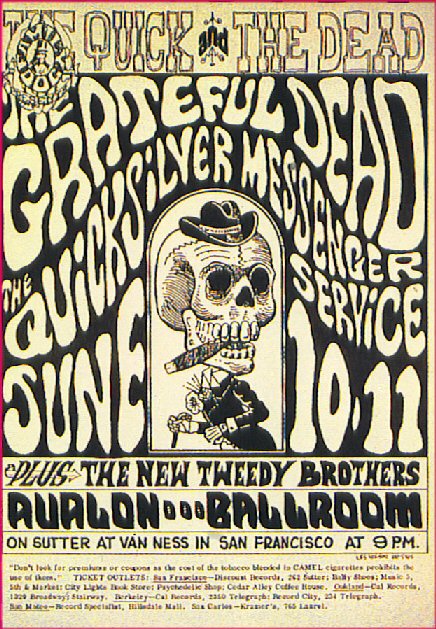
Avalon Ballroom June 10-11, 1966: Grateful Dead/Quicksilver Messenger Service/New Tweedy Brothers


This post is part of a series analyzing every performance at the Avalon Ballroom. Above is the Wes Wilson poster (FD12-thanks to Ross for the scan)

The Dead and Quicksilver Messenger Service had just played the Fillmore together, (June 3-4), and so they played consecutive weekends for Bill Graham and then Chet Helms.  The bands generally preferred playing the Avalon , but made more money at the Fillmore.  Quicksilver and The Dead were ‘summering’ at neighboring ranches in Marin County, across the bay.  The Dead dressed as Indians, and Quicksilver as Cowboys, and the bands and their crews and friends chased each other through the woods until the peace pipe was smoked. Many hippies identified with Native Americans, seeing them as peaceful, resilient people who lived off the land (not all of them did--by late 1966, the manager of Country Joe and The Fish [Ed Denson] would lament  “All this Indian crap.  There are so many fake Indians in Berkeley you wouldn’t believe it”)

In the audience on the previous weekend at The Fillmore was a friend of John Cipollina, a local radio engineer named Dan Healy.  When the Dead’s equipment broke, Cipollina recommended Healy, who promptly fixed the problem.  Healy criticizes the Dead’s vocal sound, and Garcia challenged him to do better.  Healy ended up becoming the Dead’s sound man until the early 1990s and did indeed do better. While he may not have yet been a member of the crew, he was almost certainly present and starting to get involved at this weekend's show.

At the Dead's first appearance at a Family Dog show two weeks earlier (May 28), the band's Owsley Stanley constructed sound system was so large, it blocked Bill Ham's light show. By this show, the band had painted the sound system white, so it became the screen for the light show.

The New Tweedy Brothers were a band from Oregon that had moved to San Francisco in 1966. They had an an obscure single on Dot, and recorded an album. However, their only album, released in 1968 ) on Ridon Records showed definite folk roots, with strummed guitars and nice harmonies, somewhat like The Byrds. In concert, they apparently also did a rock version of “Cold Rain and Snow,” no doubt being familiar with the same obscure Obray Ramsey record that Garcia had heard.

Their album, however, was pressed in a unique, oversize hexagonal sleeve too large to fit in record store racks, thus insuring that the poorly distributed album would sell as few copies as possible. The band returned to Oregon around 1967. Shadoks re-released the album on CD around 2001, retaining a tiny version of the oddly-shaped sleeve.

Next: June 17-18, 1966: Captain Beefheart and The Magic Band/The Oxford Circle