Showing posts with label Oregon. Show all posts

Thursday, April 22, 2010

Oregon Rock Concerts 1968 (Oregon VI)

(a poster for the Charlatans at the Crystal Ballroom on March 8-9, 1968, a Family Dog production. h/t Ross for the scan)

Previous posts on the late 1960s in Oregon have focused narrowly on specific venues in Portland, whether high profile like the Crystal Ballroom or less well known ones. However, while Portland had a thriving local rock scene in the 1960s, the signal feature of Portland rock music was geography. Since Portland was on an Interstate Highway midway between San Francisco and Seattle, it made the city an attractive stop on many West Coast rock tours. Portland was not a large city in the 1960s, but its location meant that numerous bands played a show in Portland while heading North and South.

I should emphasize at the outset that my blogs have a very narrow focus towards Fillmore and Avalon style underground ("psychedelic") 60s rock bands. In fact, the whole Pacific Northwest had had a booming live music scene since the early 1960s, and rock bands all over Oregon played weekend shows at armories, rec halls and community centers all around the state, and continued to do so throughout the 1960s. However, my historical focus is on the sort of bands who played the Fillmore and Avalon, or at least aspired to do so.

I am attempting a list of every out-of-state touring rock band who played in Oregon in 1968 (1967 is here and 1969 will follow). I am not counting regional bands from Washington or Idaho as "out-of-state"-my focus is on bands who were on tour who played a show (or a few) in Oregon. This list is drawn from my own research and the lists of various bands' rock concert history. Within the confines of my interests (i.e.  Fillmore bands), it is as complete as I can make it. I have included shows from my Crystal Ballroom list or other lists if they feature touring bands. Anyone with additions, corrections, insights or recovered memories (real or imagined) is encouraged to Comment or email me.

1968 Portland Rock Concerts

January 20, 1968 Eureka Municipal Auditorium, Eureka, CA Grateful Dead/Quicksilver Messenger Service
It may seem strange to start a history of concerts in Oregon with a show in California, but Eureka has a peculiar relationship to both California and Oregon. The Grateful Dead and Quicksilver Messenger Service had planned a joint tour of the Pacific Northwest, and following the "pay-as-you-go" nature of 60s rock tours, they booked a show in the North Coast town of Eureka, CA. The Dead were on their way to Seattle (where they would play the weekend of January 26-27), but they stopped halfway for a paying gig in Eureka.

Far Northern California and Southern Oregon see themselves as a state apart from Northern California (San Francisco and the Central Valley) and Central Oregon (Portland, Eugene and Salem). The area from Ashland, OR to Eureka, CA sees itself as another entity (google "State Of Jefferson"). The Grateful Dead's first foray into this area was a show at the tiny Municipal Auditorium at 1120 F Street. The Dead were in fact well received, for the most part, but they rapidly became too big to play such tiny outposts.

The Dead were taping all of the shows on this tour in order to use the material for their forthcoming album Anthem Of The Sun (released June 1968). A portion of the show has circulated amongst Dead tape collectors over the years. Two songs from the Eureka show ("Viola Lee Blues" and "Good Morning Little Schoolgirl") were released as bonus tracks on the 2009 archival Grateful Dead cd Road Trips Vol. 2 No. 2: Carousel 2/14/68. At the beginning of "Viola Lee Blues," Jerry Garcia regretfully informs the Eureka audience that "the cops say you can't dance," a sign of the tension that often ensued when the Dead broke in new territory. Pigpen then adds "Cops ain't God, man," and Phil Lesh helpfully observes "you can't dance, but that doesn't mean you can't take off your clothes and wriggle around," which helps to explain how the Dead created a lot of tension.

January 29, 1968 PMC College Center Ballroom, Portland State College, Portland, OR Grateful Dead/Quicksilver Messenger Service/PH Phactor Jug Band
After the weekend in Seattle, the Grateful Dead/Quicksilver tour--dubbed "The Quick and The Dead"--pulled into Oregon at Portland State College. This was a Wednesday night show at a relatively small college venue.

January 30, 1968  EMU Ballroom (U of O), Eugene, OR Grateful Dead/Quicksilver Messenger Service/PH Phactor Jug Band
PH Phactor Jug Band, a local Portland group, was not on the poster, but contemporary newspaper reports confirm their presence. Once again, the bands are playing on a weeknight (Thursday) at a much smaller college facility than they would ever play again.

February 2-3, 1968 Crystal Ballroom, Portland, OR Grateful Dead/Quicksilver Messenger Service/PH Phactor Jug Band
The Crystal Ballroom played a peculiar role in Portland rock history, as it was the highest profile venue, but it was run on a shoestring basis. When the Crystal was functioning well, however, it provided some of the great memories of 60s Portland rock. When the Grateful Dead and Quicksilver tour hit the Crystal on a Friday and Saturday night, all the stars were aligned. After a few smaller shows at Portland State and U of O, hip Portland was primed for the shows at the Crystal.


According to Toody Conner, who was one of the volunteers who helped run the Crystal (per Tim Hills book), there were lines around the block, and there was so much money in gate receipts that they had to borrow an equipment case to stuff it into, which she sat on during most of the show. The Crystal had had financial struggles throughout its entire existence as a psychedelic venue, but for this weekend, with the audience ready and the Dead firing on all cylinders--not to mention the formidable Quicksilver Messenger Service--everything happened the way it was supposed to, if only for a weekend.

We know how well the Grateful Dead played, too, because they taped it. Partial tapes of Dead sets from both nights circulate —the only live tapes I know of from The Crystal—and one track was released on a Grateful Dead vault cd in 2009 (“Dark Star” from 2/2/68, as a bonus track on Road Trips Vol. 2 No. 2: Carousel 2/14/68).

February 4, 1968 Memorial Coliseum, Portland, OR Beach Boys/Buffalo Springfield (afternoon)
The eternally huge Beach Boys returned to the Portland Memorial Coliseum for a Sunday afternoon show, this time supported by the Buffalo Springfield. The Springfield were a popular band on AM radio, if nowhere near the status of the Beach Boys, and their management booked them for popular shows like this one. The musicians in the band, however (at this point Neil Young, Stephen Stills, Richie Furay, Dewey Martin and bassist Jim Messina) saw themselves as a primarily live band who were more comfortable in a Fillmore-type environment. The frustrated Springfield broke up for good in May 1968.

February 4, 1968 Britt Ballroom, South Oregon College, Ashland, OR Grateful Dead/Quicksilver Messenger Service
The "Quick and The Dead" Northwest tour concluded with a Sunday night show in Ashland, OR at the Gymnasium of South Oregon College, 290 miles South of Portland. South Oregon College (today Southern Oregon University) had been founded in 1926. This was the Dead's only appearance in Southern Oregon, as their increasingly popularity in Oregon insured that they played the larger population centers around Portland the two largest State Universities for the rest of their career.

I assume the Dead and Quicksilver played McNeal Pavilion at 1250 Siskiyou Boulevard, since it was opened in 1957. The Pavilion was renovated in 1990, doubling its capacity to 1,400. Thus the Dead and Quicksilver played a tiny gym with 700 seats--and no doubt some people on the floor. Did they get to dance? No information or tape has ever surfaced about this interesting event, to my knowledge [update: apparently the bands played the tiny, 300-capacity Britt Ballroom].

February 16-17, 1968 Crystal Ballroom, Portland, OR Blue Cheer/Nazzare Blues Band
In February 1968, the Crystal Ballroom tried to make amends for its distant location from California by aligning itself with Chet Helms and the Family Dog. At this juncture, Whitey Davis had returned to California to become some sort of manager at the Avalon Ballroom, where he had worked in 1966. The Avalon had been very successful in 1967, but now it was getting squeezed by the increasing size of the rock market on one side and the Bill Graham empire on the other. Helms had the shrewd idea that if he could offer bands a series of West Coast dates, he could compete directly with Graham. This was a very sharp idea, but it was about a year too late.

According to a long circulating story, the Crystal and the Avalon were part of a Family Dog "empire" that included Vancouver and Anchorage, Alaska. While the Dog clearly had some connections in Vancouver, the Anchorage connection seems to have simply been a tall tale (and financially absurd in any case). Helms had opened a Family Dog outpost in Denver in 1967, but it was done in by constant harassment from the Denver police. If Helms had been able to link Denver, Portland and San Francisco, he might have had some clout, but after the financial draining of the Denver debacle, the undercapitalized Portland effort seems to have been a good idea executed too late.

Nonetheless, the "Crystal Dog" began with the rising San Francisco band Blue Cheer. Blue Cheer’s legendarily heavy debut album, Vincebus Eruptum, with its proto metal single ‘Summertime Blues”, had just been released. Blue Cheer was famous for touring with an enormous sound system (with a huge bank of Marshall Stax amplifiers), and was generally the loudest band around. Tim Hills, in his excellent 1997 book The Many Lives Of The Crystal Ballroom, recounts a story of the Crystal staff's brief panic when Blue Cheer did a full volume soundcheck on Friday afternoon, while normal people were still at work.

March 1-2, 1968 Crystal Ballroom, Portland, OR Quicksilver Messenger Service/Nazzare Blues Band
This was the third Portland Family Dog show (the second featured The Weeds). Quicksilver were Family Dog regulars. Although they had not yet released their debut album,  they would have been known to locals, having just come through town with the Grateful Dead.

March 8-9, 1968 Crystal Ballroom, Portland, OR Amazing Charlatans/Alexander’s Timeless Bluesband
This was the fourth and apparently final Portland Family Dog show (poster up top). At this point, the arrangement seemed to end, although the whole story is murky. My assumption is that the financial benefits of a partnership between Chet Helms and The Crystal were not able to be realized. Helms’s bargaining power had been greatly reduced by the Denver debacle, and he may not have had sufficient cash to make the arrangement worthwhile in Portland. Like many of Helms’s ideas, the concept was sound but the execution was spotty.

The Charlatans, of course, had played the very first Family Dog dance in San Francisco on October 16, 1965. By 1968, other groups had passed them by, but they were still an interesting band.

March 16, 1968  Cirque Club, Hillsboro, OR Family Tree/Jefferson Davis Five
The Cirque Club was just outside of Hillsboro, a suburb about 20 miles West of Portland. Directions on the surviving flyers do not give an address, but just say "1 mile East of Hillsboro on the TV [Tualatin Valley] Highway," a sign of the then-rural location. According to the excellent PNW page, it was a club for kids sixteen and over, a common sort of venue in the Northwest, and it was open for about 3 years in the late sixties. The owner was Ted Scott, a former Hollywood stuntman who had been Clark Gable's stand-in for several years, as well as helping to start the show "To Tell The Truth."

The Family Tree were advertised as a San Francisco band, not exactly true but not untrue either. The Family Tree apparently had a great live show and were very popular in Central California and Oregon. The Jefferson Davis Five were a local band.

April 13, 1968  Cirque Club, Hillsboro, OR Neighb’rhood Childr’n/Jefferson Davis V
Although the Neighb'rhood Childr'n were advertised as "Direct From Hollywood," they were actually Southern Oregon's best (and probably first) psychedelic band. Unlike all other Southern Oregon bands, they also had an album, the excellent if obscure LP Long Years In Space (released on Acta, and later released on cd by Sundazed).

I do not know much else about the Cirque Club, not even whether it was rare or common to have out-of-town bands as headliners. Owner Ted Scott went on to produce other shows, including apparently the Jimi Hendrix show at Portland Coliseum (see below).

May 3, 1968 Crystal Ballroom, Portland, OR The Fugs/Kaleidoscope
May 4, 1968 The Lemon Tree, Eugene, OR The Fugs/Kaleidoscope/Hammond Typewriter
A brief spurt of national touring acts in May and June suggests that there was still some informal cooperation between the Family Dog in San Francisco and the Crystal.

The poster for the May 4 show in Eugene advertised it as a Family Dog show, paired with the similar bill playing the at the Crystal. Neither show was part of the “official” Family Dog series (in February and March), so its unknown what the relationship was of this show (and the shows on 17-18 May) to the Crystal’s arrangement with the Family Dog. Nonetheless, Whitey Davis was probably still managing the Avalon, so its plausible that an informal arrangement was intact. It was also not unheard of for former associates of The Dog to use The Family Dog logo with at least tacit approval from Chet Helms, for reasons that remain obscure (as happened in February, 1968 in Denver). 

The Hammond Typewriter did not perform in Eugene.

Kaleidoscope were a legendary Southern California band who invented “world music” about 20 years before the world was ready for it. The group featured David Lindley, Chester Crill, Solomon Feldthouse and Stuart Brotman (as well as drummer Paul Lagos) on numerous exotic instruments, all played with talent and flair.

I do not know anything about The Lemon Tree in Eugene. Eugene was a college town, so it seems likely that someone would try and open some kind of psychedelic venue, but this Saturday event is the only show I know of at this place. I am not sure of the address.

May 17-18, 1968 Crystal Ballroom, Portland, OR Kaleidoscope/Family Tree
The poster for this show also indicates that it was a Family Dog show, and equally little is known about the use of the logo and any formal connection to Chet Helms or The Dog.

The Family Tree had just released their debut album Miss Butters (on RCA), and they continued to be popular on the live circuit. However, their ambitious album failed to make a dent on the charts, and the group soon broke up. Bob Segarini then formed a group in Los Angeles called Roxy, the next step in a long and fascinating career.

May 24-25, 31, June 1, 1968 Crystal Ballroom, Portland, OR Junior Wells Blues Band
Chicago blues bands like Junior Wells were now a regular part of the psychedelic ballroom scene. So many local and national bands covered blues songs that a lot of standard Chicago material was quite well known around the country, even to kids who had never heard the original. Wells very well may have played the Crystal in the early 60s, when it featured blues and soul acts.

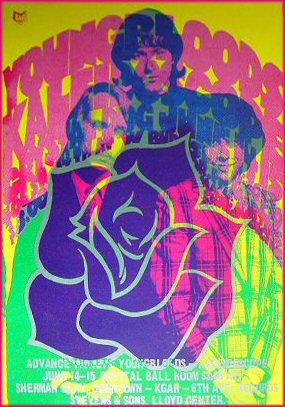
June 14-15, 1968 Crystal Ballroom, Portland, OR Youngbloods/Kaleidoscope
The Youngbloods, originally from New York City and Cambridge, MA, had moved to Marin County in September, 1967. The quartet (singer/bassist Jesse Colin Young, lead guitarist/singer Jerry Corbitt, multi-instrumentalist Lowell “Banana” Levinger and drummer Joe Bauer) had played regularly throughout the Pacific Northwest as well as the rest of the country. The group’s second album (Earth Music, on RCA) had been released in November 1967.

June 21-22, 1968 Crystal Ballroom, Portland, OR Buddy Guy
Buddy Guy was a prominent blues guitarist in Chicago, not well known except to other guitarists. He was starting to make a name for himself on the ballroom circuit.

The city of Portland closed the Crystal Ballroom on or about July of 1968. Tim Hills reprints a headline in The Oregonian (Portland's main daily newspaper) from July 12, 1968 that says "City Closes Dance Hall: Crystal Ballroom Fails Inspection." Unhappy with the congregation of hippies downtown, the city had found a slew of code violations in June, and the operators of the Crystal--whoever they were by Summer 1968 is a bit vague--were unable to respond effectively. According to Hills, a Newsweek article (from May 20, 1968) that said that San Francisco hippies were all going to Portland for the Summer did not help matters.

The exact date of the last show isn't certain, and the venue may have put on shows as late as Saturday, July 6, 1968, but I don't know who might have played. Its known (from Billboard magazine) that Iron Butterfly had to cancel a July date at the Crystal (either 12-13 or 26-27), and according to Hills Big Brother and the Holding Company had to cancel as well, but the end of the psychedelic area came quickly for the Crystal Ballroom.

June 30, 1968 MacArthur Court, U. of Oregon, Eugene, OR The Doors
The Doors were huge by this time. MacArthur Court was the University of Oregon basketball arena. 

July 2, 1968 Memorial Coliseum, Portland, OR Eric Burdon and The Animals/Wailers/Spiral Staircase
Eric Burdon and The Animals was the later, psychedelic lineup that had hits with "Sky Pilot" and other songs. The Wailers, from Tacoma, WA, were later known as The Fabulous Wailers (to distinguish them from Bob Marley's crew).   

July 7, 1968 Armory, Salem, OR Eric Burdon and The Animals
This show was the last one with Vic Briggs on guitar, who was replaced afterwards by no less than future policeman Andy Summers. Briggs (aka Antion Meredith, RIP) recalled that his last gig was a five-concert swing concluding in Salem, so I have assume they played the Armory.

July 10, 1968 Masonic Temple, Portland, OR Kaleidoscope/Crazy World of Arthur Brown
The Masonic Temple was a smaller venue at 1119 SW Park Avenue. The biggest events held there used the 4th floor Grand Ballroom. Although it was regularly used for smaller local events, it appears that activity picked up at the Masonic Temple whenever the Crystal Ballroom was inactive. With the Crystal closed, acts who wanted to play downtown Portland ended up at the Temple. I have always assumed that the Kaleidoscope show was originally scheduled for the Crystal, although I can't be sure.

The Crazy World of Arthur Brown had a fairly wild stage show for a 60s band. They were an interesting trio, with just a singer (Brown), an organist (Vincent Crane) and a drummer (the teenage Carl Palmer). Their big hit was the immortal "Fire."

July 25, 1968 Civic Auditorium, Portland, OR Steppenwolf/The Echoes
The Portland Civic Auditorium, at 222 SW Clay Street (bounded by 2nd and 3rd Avenues and Clay and Market Streets), had been built in 1917 with a capacity of about 4,500. It was closed for substantial remodeling in 1967, and re-opened on May 3, 1968.

Steppenwolf's debut album on ABC-Dunhill had been released in January, 1968. The classic "Born To Be Wild" single was released in May '68 and would reach #2 on the Billboard charts. 

September 9, 1968 Memorial Coliseum, Portland, OR Jimi Hendrix Experience/Eire Apparent/Soft Machine
Ted Scott, proprietor of the Cirque Club, helped promote the next big show at Portland Coliseum. The opening acts, Eire Apparent and Soft Machine, were both very interesting groups managed by Hendrix manager Mike Jeffereys.

September 22, 1968 Lane County Fairgounds, Veneta, OR Country Joe and The Fish/Ian Maddron/Death Sound Blues Band
This is the first major rock show I know of at the Lane County Fairgrounds in Eugene. The Fairgrounds are located at 796 W. 13th Avenue, in the center of Eugene. I do not know whether this was an indoor or outdoor event, as there were and are a variety of facilities at the Fairgrounds. 

October 3, 1968 Memorial Coliseum, Portland, OR Donovan
It is easy to forget today that Donovan was one of the biggest performers of the late 1960s. He played the Coliseum as well, demonstrating that he was as popular as Jimi Hendrix or The Beach Boys. It is possible there was an early and late show as well. Tapes supposedly exist of this concert.

October 26, 1968 Memorial Coliseum, Portland, OR Canned Heat/Professor Morrison's Lollipop/Grass Roots/Deep Purple/Turtles
Apparently this show was called "Survey '68" (thanks to Commenters for figuring this out)

November 15, 1968 Gil Coliseum, Corvallis, OR Grateful Dead/Mint Tattoo/City Blue
Gil Coliseum was the basketball arena for Oregon State University. Corvallis was about 82 miles South of Portland, but still 200 miles North of Ashford and Medford. The Grateful Dead were on their way to Vancouver and Seattle. Elsewhere I have speculated on the possibility that since the Saturday, November 16 show was canceled, it is plausible that the Dead played an unscheduled show somewhere in Oregon or Washington that night (EMU Ballroom at U. of O is a plausible).

Mint Tattoo were a San Francisco band featuring Sacramento musicians Bruce Stephens and Burns Kellogg. They released a self-titled album on Dot, and Stephens and Kellogg ended up joining Blue Cheer. Kellogg went on to a successful career as a producer under the name Ethan James.

November ?, 1968 Memorial Coliseum, Portland, OR Grass Roots/The Turtles/Deep Purple
A Commenter recalls this event, called "Survey 68." The Deep Purple site lists "Portland, OR unknown venue" for this date, so I have made the assumption that these are the same events. Deep Purple "Mk 1" (with Rod Evans and Nick Simper), who had just released their modest hit "Hush," were on their first American tour.

December 29, 1968 Civic Auditorium, Portland, OR Vanilla Fudge/Led Zeppelin
The Portland Civic Auditorium, at 222 SW Clay St, was built in 1917. It was rarely used for rock shows. At this time it had about 4,500 seats, although it has since been remodeled into a smaller venue. Vanilla Fudge was a very popular band, and they were connected to influential concert promoters (Concerts West) who probably had access to venues that smaller promoters did not. No one cares about Vanilla Fudge today, however; what matters was that opening act Led Zeppelin made their Oregon debut.

Led Zeppelin's first album would not even be released for a few more weeks, but the band made their North American debut filling in for some dates that had been booked for the Jeff Beck Group, with whom Zeppelin shared management, opening for Vanilla Fudge. Zeppelin had made their North American debut in Denver on December 26, followed by dates in Seattle (27) and Vancouver (28). Portland Civic Auditorium was Led Zeppelin's fourth North American date. It was also the first where there was any kind of notice at all, as they had been added to the previous shows too late to change the advertising. A Portland newspaper ad promotes "Vanilla Fudge plus special guests Led Zeppilen featuring Jimmy Page." At this time, with no album and no airplay, Zep would have been completely unknown, but Jimmy Page had a certain amount of name recognition based on his career in the Yardbirds.

Vanilla Fudge and Led Zeppelin went on to perform the next night at Gonzaga University in Spokane, WA (where Zep were billed as "Len Zifflin"). The band then had a scary ride through a Northwestern blizzard to the Seattle airport. Once Led Zeppelin landed in sunny Los Angeles to play the Whisky Au Go Go in West Hollywood, they were unknown no more.

Next: Oregon rock concerts, 1969

Saturday, April 17, 2010

Oregon Rock Concerts 1967 (Oregon V)

(A poster of the Jefferson Airplane/Byrds show at Portland Memorial Coliseum from May 28, 1967. h/t Ross for the scan)

Previous posts on the late 1960s in Oregon have focused narrowly on specific venues in Portland, whether high profile like the Crystal Ballroom or less well known ones. However, while Portland had a thriving local rock scene in the 1960s, the signal feature of Portland rock music was geography. Since Portland was on an Interstate Highway midway between San Francisco and Seattle, it made the city an attractive stop on many West Coast rock tours. Portland was not a large city in the 1960s, but its location meant that numerous bands played a show in Portland while heading North and South.

I should emphasize at the outset that my blogs have a very narrow focus towards Fillmore and Avalon style underground ("psychedelic") 60s rock bands. In fact, the whole Pacific Northwest had had a booming live music scene since the early 1960s, and rock bands all over Oregon played weekend shows at armories, rec halls and community centers all around the state, and continued to do so throughout the 1960s. However, my historical focus is on the sort of bands who played the Fillmore and Avalon, or at least aspired to do so.

I am attempting a list of every out-of-state touring rock band who played in Oregon in 1967 (1968 and 1969 will follow). I am not counting regional bands from Washington or Idaho as "out-of-state"-my focus is on bands who were on tour who played a show (or a few) in Oregon. This list is drawn from my own research and the lists of various bands' rock concert history. Within the confines of my interests (i.e.  Fillmore bands), it is as complete as I can make it. I have included shows from my Crystal Ballroom or other lists if they feature touring bands. Anyone with additions, corrections, insights or recovered memories (real or imagined) is encouraged to Comment or email me.

Portland Rock Shows 1965-66: Pre-History
Although there was plenty of live rock music in Oregon prior to 1967, a few shows stand out as harbingers of things to come.

August 22, 1965 Memorial Coliseum, Portland, OR  The Beatles (two shows)
The Portland Memorial Coliseum, at 300 N Winning Street, opened in 1961. It had permanent seats for 9,000, and could include up to 14,000. At the time it was opened, it was the largest multi-use facility in the Pacific Northwest. It served as the major venue in Portland for music and sports until the Rose Garden Arena was opened in 1995. The Coliseum was the original home of the NBA Portland Trailblazers. Initially, it seemed unthinkable that a pop music event could fill such a large arena, but as was often the case The Beatles pointed the way forward.

The Beatles played two shows for 20,000 screaming fans, and members of the Beach Boys (then on tour) attended the show. According to Keith Badman’s definitive tour history of The Beach Boys, Carl Wilson and Mike Love visited with the Beatles between shows.  Paul asked them “where’s Brian?” and Carl replied “Oh, he’s given up touring.  He just stays at home producing and recording our records.”  Paul replied  “That’s a good idea,” presaging the Beatles abandonment of touring a year later.

Late September or Early October, 1965 Reed College, Portland, OR 
Joe McDonald and Barry Melton
At the other end of the spectrum, this obscure event, only barely recalled by Joe McDonald, was the first “tour” by Joe and Barry, planting the seed for Country Joe and The Fish. The pair took the Greyhound Bus, and played in someone’s living room as well as at the very progressive Reed College. This informal trip was one of the first glimmerings of a West Coast underground as a network for rock performances outside of any mainstream radio or television coverage.

January ?, 1966 Beaver Hall, Portland, OR Acid Test
Psychedelia was introduced to Portland without warning, as Ken Kesey and his Merry Pranksters held an Acid Test at tiny Beaver Hall, at 425 NW Glisan St (at NW 5th Avenue). The Grateful Dead were in tow, and Phil Lesh (at least) recalls it, but no one is certain of the exact date. Maybe January 1, or maybe January 14, no one can recall exactly when--but Portland was officially "on the bus."

The Byrds were reputed to have played Beaver Hall in early 1966, and very well may have, but the definitive history of Byrds performances (Chris Hjort's excellent book So You Want To Be A Rock And Roll Star) has not yet uncovered a specific date.

March 6, 1966 McNeal Gymnasium, Southern Oregon State College, Ashland, OR Beach Boys (afternoon concert)
Southern Oregon and upper Northern California were a separate economic entity from the other two states, and in some ways a separate cultural entity as well (google "State Of Jefferson"). While the Beach Boys were hardly as cool as the Beatles or Stones, they were still hugely popular.

July 21, 1966 Memorial Coliseum, Portland, OR Rolling Stones
Although everyone loved The Beatles, Oregon was more inclined to the Rolling Stones side of the British Invasion.

August 20, 1966 Memorial Coliseum, Portland, OR Beach Boys
The Beach Boys were big enough to play Portland Coliseum as well.

September 3, 1966 The Armory, Salem, OR  Yardbirds
British Invasion type bands probably played Oregon all the time--I haven't been tracking them all--but the Yardbirds loom much larger than most. The Yardbirds were on a completely insane West Coast tour, so nutty that lead guitarist Jeff Beck got sick--or fed up--and had quit the tour eight days earlier. So on August 25, 1966, at San Francisco's Carousel Ballroom, bass player Jimmy Page switched to lead guitar (rhythm guitarist Chris Dreja moved over to bass). Thus Page played in his first power trio at the future site of the Fillmore West, one of the key places where Led Zeppelin would reveal themselves to the world in early 1969.

After the Carousel show, the Yardbirds had played San Leandro (26), Santa Barbara (27), San Diego (28), San Jose (30), Pismo Beach (31) and Stockton (Sep 1). After a day's rest, they played the Armory in Salem on September 3, and then went on to Hawaii (!) for the next night's show (Sep 4).

Salem was the state capital. I believe the National Guard Armory was a common site for teen dances. There likely would have been numerous other support acts on the bill.

1967 Portland Rock Concerts
January 20, 1967 Crystal Ballroom, Portland, OR Weeds/Tweedy Bros/Family Tree
The Crystal Ballroom, built in 1914 at 1332 W. Burnside Street, (at SW 14th Ave) had been Portland's premier venue for soul and R&B in the early 1960s. However, promoter Charles Sullivan, who also held the lease at San Francisco's Fillmore Auditorium, retired at the end of 1965. While Bill Graham picked up his lease in San Francisco, the Crystal remained dark until it was taken over in January 1967 by Caffe Espresso booker Coleman "Whitey" Davis and his partner Mike Magaurn. The Crystal immediately became Portland's coolest concert venue again.

The Family Tree were from the Stockton, CA area, and featured lead singer Bob Segarini. They were popular up and down the West Coast, particularly in the Central Valley.

February 3-5, 1967 Crystal Ballroom, Portland, OR Sopwith Camel/Tweedy Bros/Gozero and The Psychedelics (3-4)/Weeds (5)
The Sopwith Camel, an original San Francisco underground band, had also been one of the first to be signed by a record company. Their song "Hello Hello" was a modest hit single, although apparently they were a different sounding band in concert. The Crystal promoters invited them up from San Francisco for a weekend.

February 10-12, 1967 Crystal Ballroom, Portland, OR Family Tree/Gazebo/Warlocks
The Family Tree returned to headline another weekend. I believe the other two groups were from Seattle.

February 19, 1967 Caffe Espresso, Portland, OR  Them Again/Earl Benson
The Caffe Espresso (at 409 SW 13th Ave at W. Burnside St) was right around the corner from the Crystal Ballroom. It had been one of the first venues to regularly book psychedelic rock bands every weekend, but its tiny size mostly confined it to local groups. For some reason or another, however, Them Again played there on Sunday, February 19.

Them Again was almost certainly the Irish group Them with a new lead singer.  Kenny McDowell had replaced Them founder Van Morrison.  There is a story of Them Again playing the Crystal Ballroom, leaving the crowd with the impression they had seen Van Morrison, so perhaps they played the Crystal around this time (although it seems odd that they would also play a coffee shop around the corner as well—see The Crystal Ballroom October 17, 1967). 

March 18-26, 1967 
Buffalo Springfield played several dates in the Pacific Northwes, including some in Oregon.

March 22, 1967 Crystal Ballroom, Portland, OR Buffalo Springfield/Mr. Lucky and The Gamblers/Warlocks/Weeds
This was a Wednesday night show, a rarity for the Crystal.

March 23, 1967 Second City, Corvallis, OR Buffalo Springfield/The Seeds/Paul Revere and The Raiders
Corvallis was the home of Oregon State University, the second largest University in the State (U. of Oregon, in Eugene, was the largest). I don' t know anything about the venue. Paul Revere and The Raiders were huge in Oregon (as in the rest of the country), and The Seeds were popular too, so this must have been a substantial place.

March 30, 1967  [venue], Portland, OR Butterfield Blues Band/Country Joe and The Fish/The Youngbloods
I assume that this show was at one of the standard Portland venues (Crystal, Masonic Temple, etc), but I don't know which one. Mike Bloomfield would have just left the Butterfield band, leaving the guitar chair in the capable hands of Elvin Bishop.

April 14-15, 1967 Crystal Ballroom, Portland, OR Family Tree/Warloks (14)/Redcoats (15)
The Warloks (with a K) were from Tigard, OR, a suburb West of Portland. The Warlocks were a Seattle band, to my knowledge (unless the spellings on previous posters were just wrong).

April 22, 1967  PSC Ballroom, Portland, OR The Heirs/Blue Cheer
This was at Portland State College. The handbill says ‘Blue Cheer—from the Fillmore in San Francisco.’ Blue Cheer were a fairly unknown band at this point, and had only started to play around San Francisco relatively recently.

April 23, 1967 Caffe Espresso, Portland, OR  Blue Cheer
Since Blue Cheer had come up from San Francisco, they played a Sunday night show at Caffe Espresso to go along with their Saturday event. Its likely they were expecting to play shows through the weekend of April 30 (see May 14 below).

April 29, 1967 Ballroom, Portland State College, Portland, OR Sopwith Camel/Redcoat/Warlocks/Epix/US Cadenza

May 14, 1967 Portland Spring Trips Festival Portland Armory, Portland, OR
The Wailers/Blue Cheer/P.H.Phactor Jug Band/Weeds/Red Coats/Courtmen/Tweedy Bros/Impacts/U.S. Cadenza/7th Resemblance/Russo and Brentano/Poverty Five/The Gazebo/The Seventh
This show was  rescheduled from April 30. Based on the billing, it looks like a hitherto typical Northwest "Teen" dance reconfigured under the guise of a "Trips Festival." The Wailers were already legendary in Seattle, but had reconstituted themselves somewhat as a Folk-Rock band, and they were joined by Blue Cheer (if in fact Blue Cheer made the show). The rest of the acts seem to be a mixture of budding folk-rockers and more dance oriented bands, as near as I can tell.

May 28, 1967 Memorial Coliseum, Portland, OR Jefferson Airplane/The Byrds/PH Phactor Jug Band/Magic Fern
The Jefferson Airplane were big stars by this time, and The Byrds had already become big stars, so this was a very high profile event (see the poster up top). The Magic Fern were from Seattle.

May 31, 1967 Crystal Ballroom, Portland, OR Fugs/Family Tree

July 14, 1967 Memorial Coliseum, Portland, OR Herman’s Hermits/The Who/Blues Magoos
The Who started their first American tour by headlining at the Fillmore (June 16-17) and playing the Monterey Pop Festival with Jimi Hendrix and the Grateful Dead (June 18). They spent the rest of the Summer on a mundane British Invasion tour with the poppy Herman's Hermits and New York's Blues Magoos.

July 18, 1967 Masonic Temple, Portland, OR Grateful Dead/Poverty’s People/U.S. Cadenza/Nigells
The Masonic Temple, at 1119 SW Park was a smaller alternative venue to the Crystal Ballroom. The Crystal had a quiet Summer, for a variety of murky reasons, and it appears that the Masonic got some interesting bookings as a result. The Dead were on their way back from a weekend in Seattle and Vancouver, and as a result played a Tuesday night in Portland.

July 26, 1967 Masonic Temple, Portland, OR The Doors
The Doors played a Wednesday night show at The Masonic. Although still an "underground" band, even at this early date The Doors were very popular. Anyone who saw this show was quite lucky, as The Doors would not play any venue in Portland this small ever again.

August 4-5, 1967 Crystal Ballroom, Portland, OR Steve Miller Blues Band
For the murky history of who may or may not have played The Crystal Ballroom in the Summer of 1967, see my post here. I'm fairly certain that the Steve Miller Blues Band actually played, but exactly which weekend in August is currently murky.

August 11, 1967 Masonic Temple, Portland, OR  Moby Grape/Peanut Butter Conspiracy
This date comes from The Peanut Butter Conspiracy list of shows, which refers to a double bill with Moby Grape. The Moby Grape list does not confirm this booking. However, while Moby Grape was billed at The Avalon (August 10 thru 13), on at least one or all of those shows they did not play. Supposedly it was because Skip Spence was unavailable, but perhaps it was because they had a gig in Portland.

October 6, 1967 Crystal Ballroom, Portland, OR Charles Lloyd/Family Tree/Weeds
The Crystal Ballroom came back to life in the Fall of 1967, and a few more shows are known. Charles Lloyd, an established modern jazz player, had found a new audience by regularly playing the psychedelic ballrooms.

October 13-14, 1967 Crystal Ballroom, Portland, OR Country Joe McDonald
Originally the Electric Flag was supposed to play this weekend, but some band members got busted in Los Angeles, and they were replaced by Country Joe and The Fish. But Joe and the rest of the band were squabbling, so Joe ended up headlining the shows as a solo act.

October 17, 1967 Crystal Ballroom, Portland, OR Van Morrison/Daily Flash
Van Morrison was on his first national tour, possible because "Brown Eyed Girl" was a hit in many markets. This was a Tuesday night show. There has been a long history of confusion about Them and Van Morrison appearing in Portland, which I have discussed in detail elsewhere.

October 20-21, 1967 Crystal Ballroom, Portland, OR The Incredible Fish
After Country Joe had played the Crystal--the "Fishless Joe"--the rest of the band played the next weekend--the "Joeless Fish"--as The Incredible Fish (Barry Melton, David Cohen, Bruce Barthol and Chicken Hirsh).

October 28, 1967 Crystal Ballroom, Portland,  OR Electric Prunes

November 11, 1967 Coliseum, Oregon State U., Corvallis, OR The Doors
The Doors were huge, so they played two dates in Oregon, at the basketball arenas of the two biggest Universities in Oregon.

According to Doors drummer John Densmore’s autobiography (Riders On The Storm), former Daily Flash drummer Jon Keliohor substituted for his Laurel Canyon neighbor Densmore at the Eugene and Corvallis shows. Fortunately for Densmore, although Keliohor was a fine drummer, the band didn't like playing with a substitute.

November 12, 1967 MacArthur Court, U. of Oregon, Eugene, OR  The Doors

November 18, 1967 Crystal Ballroom, Portland, OR The Incredible Fish
The Fish appear to have returned for another Saturday night at the Crystal, although I am not yet 100% convinced about this.

December 2, 1967 Memorial Coliseum, Portland, OR The Doors
Just a month after playing two shows at Oregon's biggest Universities, The Doors return to play Oregon's biggest venue (this time with drummer John Densmore). There could be no clearer sign of how huge they were at this time.

December 3, 1967 Crystal Ballroom, Portland, OR BB King
BB King had probably played the Crystal Ballroom a number of times in the early 1960s, when the venue was run by Charles Sullivan. In late 1967, just as had happened at the Fillmore (also run by Sullivan until 1965), BB King played for a mostly white audience and blew them away, building a whole new fan base in the process.

December 29, 1967 Masonic Temple, Portland, OR Family Tree/Gentlemen Wild/Poverty’s People/Sound Vendor/Echoes/Epix  “Grand Opening”
The poster says “Grand Opening”, but its not clear what that means. Perhaps new promoters had taken over. The ubiquitous Family Tree headlined over mostly regional bands.

Next: Oregon rock concerts, 1968.

Saturday, April 10, 2010

Caffe Espresso, Portland, OR Rock Performance List 1966-1967 (Oregon IV)

(A poster for The Thundering Heard at the Caffe Espresso in Portland, OR on January 27-28, 1967. h/t Ross for the scan)

This post is a summary of known rock performances at the Caffe Espresso in Portland, Oregon from late 1966 until mid-1967. The Caffe Espresso was located at 409 SW 13th Avenue (at West Burnside Street), and played a critical role in the development of psychedelic rock in Portland, and thus indirectly on the West Coast as well. It also makes an excellent case study of the mid-60s cultural and musical migration from Folk music to Rock, an event that is paralleled by many similar venues at the same time, such as Berkeley's Jabberwock.

This is part of a series of posts on the Portland rock scene in the late 1960s. For more, see threads here and here.

Portland, Oregon
Portland, Oregon is located on the Willamette River, shortly before it merges with the mighty Columbia River. Although Portland is over 100 miles from the Pacific Ocean, seagoing ships were able to sail upriver to Portland, and in the 19th century Portland was the point of embarkation for timber, agricultural and mining products from the Pacific Northwest. While Portland remained an important commercial city throughout the 20th century, it continued to function in the shadow of larger cities along the West Coast.

In the 1960s, Portland may not have been as liberal or freewheeling as San Francisco, but like most port cities it was comfortable with a wide variety of people and a broader view of the world than other places, so the arts received a friendly welcome. Portland’s location between Seattle and San Francisco made it a regular stop on National tours of all types, and Portland had always been a prominent stop on the folk music circuit. When the Beatles hit, and as music migrated from folk to rock in the middle 1960s, various beatnik and folk music oriented coffee shops in Portland started staging rock shows, usually on weekends. 

The definitive work on the Portland coffee-house music scene in the 1960s is Valerie Brown’s exceptional article in The Oregon Historical Quarterly, “Music On The Cusp: Folk To Acid Rock in Portland Coffeehouses 1967-70”  [Brown, Valerie, Music on the Cusp: From Folk to Acid Rock in Portland Coffeehouses, 1967-1970. Oregon Historical Quarterly 108.2 (2007): 63 pars. 10 May 2009]. Brown’s detailed research and numerous interviews make for an exceptional portrait of how a town reacted to the musical and cultural changes of the 1960s.

Caffe Espresso, Portland, OR 409 SW13th Ave at W. Burnside St
In late 1966, The Caffe Espresso, at  SW 13th and West Burnside (around the corner from the Crystal Ballroom), started promoting rock bands on weekends, complete with light shows and colorful posters.During The Caffe Espresso’s brief foray into rock promotion, they booked mostly regional acts (the definitive resource for almost every rock band in the Pacific Northwest is the great Pacific Northwest Bands site on the Sonics website).

Thanks to Valerie’s Brown exceptional research, the confusing timeline of Portland coffee house music venues can be clarified. There had been an earlier Portland coffee shop named Caffé Espresso, at SW 6th and Harrison, and it was a famous Portland beatnik hangout, but it closed in 1965, when its owner bought out of his lease for an urban renewal. Meanwhile, a popular folk music club called The Folksinger had moved from its original site on SW 10th (across from the Country Library) to 409 SW 13th at W. Burnside. The Folksinger had a capacity of about 100, and in 1966 manager Whitey Davis began to experiment with blues, jazz and rock bookings as well as folk. Davis had worked with Chet Helms and The Family Dog in San Francisco, so he was connected to the underground music scene. At some point in late 1966, the Folksinger changed its name to Caffé Espresso (in part probably to avoid the now somewhat stale “folk” association).

By early 1967, Davis was promoting rock bands, complete with light shows, on weekends at the Caffé Espresso. Weekdays still featured local folk performers, in a variety of styles. A unique factor of the Portland live music market at the time was that clubs that served alcohol were effectively barred from hiring bands (until 1973), so coffee houses did not face competition from conventional rock clubs. The small capacity of Caffé Espresso was frustrating, however, and in January 1967, Whitey Davis found a partner and started to book shows around the corner at the larger Crystal Ballroom. The booking for the Caffe Espresso was taken over by Larry Howard, but given the close proximity to the Crystal, it is likely that there were at least social connections to Whitey Davis.

The Café Espresso booked mostly regional bands throughout the first half of 1967. However, the changing economics of the rock business made it hard to compete with larger venues, and other more hippie-oriented coffee shops like The Charix took away patrons as well. The Café Espresso stopped booking rock shows in mid-1967, although it may have stayed open until 1968.


Caffe Espresso Rock Performance List
Late 1966
While the venue was still called The Folksinger, manager Coleman “Whitey” Davis started booking local bands like The New Tweedy Brothers and The Great Pumpkin, as well as acts like Lightning Hopkins. In one particularly famous incident, a band from Las Vegas called The Weeds, on their way from San Francisco to Vancouver, ran out of gas in Portland during the last week of October. Lead singer Fred Cole fell in love with a girl named Toody Conner, who worked at The Folksinger, and The Weeds stayed in Portland. This allows us to date the name change as no earlier than November 1966 , and more likely December (Fred and Toody are still married, by the way).

After the venue changes its name to Caffé Espresso, some undated posters (see above)—possibly from 1966--exist with bands like The Echoes, Blues Union, Overland Caterpillar and The PH Phactor Jug Band. Whitey Davis took over the lease on the Crystal Ballroom on January 1, 1967 and his first show at the Crystal was January 20. In January, Larry Howard took over the booking at Caffe Espresso, although given that they were only a block from each other, its likely that Whitey Davis still had an informal role in booking acts.

December 13-15, 1966 PH Phactor/Great Pumpkin
December 16, 1966 Laura and The Vipers
December 17, 1966 US Cadenza
December 18,1966 Melodious Funk
Valerie Brown included a very early Cafe Espresso flyer as one of many amazing artifacts.

1967
January 27-28, 1967  The Thundering Heard
The first dated poster that I am aware of (top) is for Friday and Saturday, January 27 and 28, 1967. It appears that folk acts played weeknights, but rock acts started to be featured on weekends.

February 3-4, 1967 U.S. Cadenza
Consider the economics of a club like Caffe Espresso. The cover charge is 75 cents, and the capacity was apparently about 100. Granted, the club assumes a certain amount of turnover throughout the night, and expects to sell some coffee and food throughout the night. Given that the club could not sell beer, wine or liquor however--per Portland law, saloons could not have live bands--the take for refreshments would have to be limited. It seems reasonable that a busy Friday night might have 150 patrons, and assuming a few coffees and the like for each person, the take might be $200 or $300. Just making some broad assumptions about expenses and overhead, assume that the performers got half of that. Now, $100 is a great night for a solo artist with a guitar, at least in 1967. Its very different for a four or five piece band with a van, amplifiers and electronic equipment. On a less successful night, even $25 might be worth it for a solo folk musician, but $25 would hardly be worth it for a band. Although there was clearly a lot of interest in rock music from Portland College and High School students, the economic parameters at a venue like Caffe Espresso were not ultimately in favor of booking rock acts.

February 17, 1967  The Rubber Band
February 18, 1967  U.S. Cadenza
February 19, 1967  Them Again
The Rubber Band were from Boise, ID.

Them Again was almost certainly the Irish group Them with a new lead singer.  Kenny McDowell had replaced Them founder Van Morrison.  There is a story of Them Again playing the Crystal Ballroom, leaving the crowd with the impression they had seen Van Morrison, so perhaps they played the Crystal around this time (although it seems odd that they would also play a coffee shop around the corner as well).  Van Morrison played the Crystal later in 1967 (on October 17), so perhaps some stories about Them and Van Morrison have gotten somewhat conflated.

February 24, 1967   P.H. Phactor Rock Band
February 25, 1967  U.S. Cadenza
February 26, 1967   Melodious Funk
The handbill clearly says “Rock Band” instead of “Jug Band.” Whether PH Phactor was playing as a rock band, with drums, or whether it was just to accommodate the flyer, Café Espresso clearly needed to establish that they were not a folk club on weekends.

Note the solo (and apparently folk) acts advertised throughout the week
March 10-12, 1967  U.S. Cadenza/Rubber Band

March 24, 1967  Thundering Heard
March 25, 1967   U.S. Cadenza

April 21, 1967 Poverty’s People
April 22, 1967 U.S. Cadenza
April 23, 1967 Blue Cheer
The poster says "Blue Cheer-from San Francisco." Blue Cheer turns out to have been the most famous band known to have played Caffe Espresso, although at the time they were an obscure, unrecorded band very low on the San Francisco underground circuit. Blue Cheer was playing Saturday night (April 22) at Portland State College, so an additional night at Caffe Espresso would help to make the 680 mile drive worth the group's time.
May 26, 1967   US Cadenza
May 27, 1967   Poverty’s People
The handbill for the May 26-27 weekend says “Hear the incredible rock sounds of the U.S. Cadenza with their new sound, “ and "Hear the new tunes in Folk-Rock from Seattle’s Poverty’s People, the stars of the Trips Festival.” Poverty’s People, a band from Centralia, WA, had played Portland’s Trips Festival two weeks earlier (May 14, 1967) as The Poverty Five

June 6-8, 1967  Great Pumpkin/P.H. Phactor
A rare weekday rock billing for the Caffe Espresso.

June 9-10, 1967 Poverty’s People

June 11, 1967  Melodious Funk
This is the latest handbill for a Caffe Espresso rock show that I have seen. The Caffe Espresso may have remained open as late as early 1968, and there may even have been rock shows, but at this point the trail grows cold. The Portland hippies had shifted to The Charix, the new shop in town, and the Crystal Ballroom, Portland's leading venue, was just around the corner, so the Espresso was squeezed on all sides.

The Caffe Espresso played a critical role in the founding of the psychedelic rock scene in Portland. Although various promoters used local ballrooms for events, the Caffe Espresso seems to have been the first establishment to book shows every week. Yet the very economics that made coffee houses viable folk venues worked against it as a rock venue, a fate shared by contemporary venues around the country (such as Berkeley's Jabberwock and New York's Cafe Au Go Go, to name a few). As the rock market exploded nationwide, smaller venues like Caffe Espresso fell by the wayside.

update: it was pointed out to me (h/t Doug) that in the same building as the Caffe Espresso, but at 411 West Burnside, was the Northwestern Inc. recording studio. In this modest studio on April6 , 1963, engineer/proprietor Bob Lindhal recorded The Kingsmen's seminal hit "Louie Louie." The Kingsmen's version was not initially as succesful as the one recorded by Paul Revere and The Raiders, but remarkably enough the Raiders version was recorded at Northwestern just a week later, on April 13, 1963. While the early 1960s is a bit outside of my timeline, the World Historical import of "Louie Louie" overrides that concern. I do not know if the studio was still active in 1966-68 when rock bands played at the Caffe Espresso or around the corner at the Crystal Ballroom.

Friday, April 9, 2010

The Crystal Ballroom, 1332 W. Burnside, Portland, OR Performance List January-June 1968 (Oregon III)

(The poster from the February 2-3, 1968 performance by The Grateful Dead and Quicksilver Messenger Service at Portland's Crystal Ballroom)

This post is the third and last part of a series listing the rock performances at the Crystal Ballroom in Portland, Oregon in 1967 and 1968. Also see
Portland, Oregon
Portland, Oregon was a regular stop on the touring circuit for all kinds of entertainment, but in the late 1960s it was not a major or important market. As a result of Portland’s then modest status and a tolerant attitude befitting its status as port city on the West Coast, it became a sort of satellite of the San Francisco scene. 

The Crystal Ballroom, 1332 West Burnside at N.W. 14th Avenue, Portland, OR, 97209
The Crystal Ballroom at 1332 West Burnside (at NW 14th) was built in 1914 as the Cotillion Dancehall.  It was constructed with a mechanical “Floating Dance Floor” (on ball bearings), a concept that was thought to be unique on the West Coast at the time. The building was used for dances, parties and musical performances throughout its history. The complete history of the Crystal, and in effect the entertainment history of downtown Portland, can be found in Tim Hills' book The Many Lives Of The Crystal Ballroom (1997: McMenamins Pubs & Breweries). This book is the principal source of almost all the information currently available on the web about the Crystal, and I have relied on it heavily here for background and facts about both the Crystal and the Portland scene in general.

In the early 1960s, the Crystal became an important stop on the Rhythm and Blues circuit, and many famous R&B acts like James Brown and Ike & Tina Turner had memorable performances at the hall. These shows were booked by one Charles Sullivan, who booked many R&B acts up and down the West Coast. Sullivan controlled the lease on San Francisco’s Fillmore Auditorium (Bill Graham took over the lease when Sullivan retired in 1966), and booked shows not only at the Fillmore and the Crystal but at a string of venues in the Northwest (including the University of Oregon at Eugene, the Salem Armory, the Evergreen Ballroom in Lacey [WA], the Crescent Ballroom in Tacoma and the Encore Ballroom in Seattle). Hills has excellent and detailed recollections of the various soul and R&B shows at the Crystal in the early 60s.

Hills also documents the city of Portland’s uneasiness with the popular shows in the local African American community. When the city put a freeway through the middle of downtown (now Interstate 405), many businesses near the Crystal were demolished. Although the Crystal itself was spared, many of the patrons of the Ballroom had lived in nearby residence hotels that disappeared. With Sullivan on the verge of retirement and the Crystals’ neighborhood crippled, management gave up their lease on the Crystal at the end of 1965, and the building was dormant for all of 1966.

As the “underground” rock market became bigger in the wake of the Fillmore, Whitey Davis, manager of the Caffe Espresso (previously The Folksinger), needed a bigger venue to accommodate larger crowds for bigger bands. Davis had worked at the Avalon Ballroom in San Francisco, so he was both well connected and had some idea of how to proceed. He formed a partnership with friend and Los Angeles club manager Michael Magaurn, and on January 1, 1967 they took over the lease on the then-vacant Crystal Ballroom.

Starting on Friday, January 20, 1967, Davis and Magaurn took over the Crystal Ballroom for weekend dances. Most of the initial acts were local, but by the end of 1967 the Crystal became a regular stop on the West Coast for bands touring the “ballroom circuit” that had developed from San Francisco’s Fillmore and Avalon. There may have been dances on other nights of the week as well, but our information so far has come from surviving posters and handbills, and weeknight shows seem to have been limited to when major acts were passing through Portland.

According to Hills, while the Ballroom was immediately popular with the local counterculture, Davis and Magaurn had trouble making ends meet. As a result, bands were apparently not paid well (compared to other venues), and some of them appear to have had a sour taste about the Crystal.In early 1967, however, the hippie counterculture scene was still exciting and early shows were well attended. This post is the third of a three part history of performances at the Crystal Ballroom in its brief flowering as a psychedelic rock ballroom, from January 1967 through June 1968.

I have taken the best available information from posters, books and reminiscences (cited above and throughout).   This performance list only covers the period from when Whitey Davis took over the booking in 1967 to when the city of Portland forced the closure of the ballroom in July 1968. As our research is mostly from posters, there are substantial gaps in the chronology. We do not know if the Crystal skipped a lot of weekends, or (more likely) whether we simply have not uncovered the dates.

As this remains a work in progress, anyone with corrections, insights, new informations or recovered memories (real or imagined), please Email me or post them in the Comment section. I have made some comments on some of the bands, but for more detailed information, see the fantastic Pacific Northwest Bands site (which includes an alphabetical list of Crystal performers, but not by date). For a sharper picture of the Portland scene, and particularly the move from  based acoustic folk music to electric rock music, see Valerie Brown's exceptional article in the Summer 2007 Oregon Historical Quarterly (From Folk To Acid Rock In Portland Coffeehouses, 1967-70).

This post covers Crystal Ballroom rock performances from January to June 1968 (for January to June 1967, see here; for July to December 1967, see here; for additional Oregon rock history see here and here).

February 2-3, 1968 Grateful Dead/Quicksilver Messenger Service/PH Phactor Jug Band
There were likely other rock shows at the Crystal Ballroom in January 1968, but this show was the first known Crystal event in 1968, by far its most successful event, and the only one memorialized by a recording that was actually released.

In January and February 1968, the Grateful Dead and Quicksilver Messenger Service had a particularly legendary tour of the Pacific Northwest, dubbed “The Quick and The Dead” on posters. Tim Hills writes about the show at some length. The Grateful Dead had played Portland twice before--a January 1966 Acid Test at Portland's tiny Beaver Hall, and on Wednesday, July 18, 1967 at the Masonic Temple in downtown Portland. However, the Dead/QMS bill had already played Eureka, CA, hopscotched over Oregon for a weekend in Seattle, and then played two College shows in Oregon, at Portland State (Jan 29) and at the University of Oregon at Eugene (Jan 30). Thus the word was out when the bands hit the Crystal Ballroom for the weekend of February 2-3.

According to Toody Conner, who was one of the volunteers who helped run the Crystal (per Hills), there were lines around the block, and there was so much money in gate receipts that they had to borrow an equipment case to stuff it into, which she sat on during most of the show. The Crystal had had financial struggles throughout its entire existence as a psychedelic venue, but for this weekend, with the audience primed and the Dead firing on all cylinders--not to mention the formidable Quicksilver Messenger Service--everything happened the way it was supposed to, if only for a weekend.

We know how well the Grateful Dead played, too, because they taped it. The Dead had recorded their Northwest shows so they could use them as part of the sound collage for their second album, Anthem Of The Sun (released June 1968). Partial tapes of Dead sets from both nights survive —the only live tapes I know of from The Crystal—and one track was released on a Grateful Dead vault cd in 2009 (“Dark Star” from 2/2/68, as a bonus track on Road Trips Vol. 2 No. 2: Carousel 2/14/68). 

February 16-17, 1968 Blue Cheer/Nazzare Blues Band
In February 1968, the Crystal Ballroom tried to make amends for its distant location from California by aligning itself with Chet Helms and the Family Dog. At this juncture, Whitey Davis had returned to California to become some sort of manager at the Avalon Ballroom, where he had worked in 1966. The Avalon had been very successful in 1967, but now it was getting squeezed by the increasing size of the rock market on one side and the Bill Graham empire on the other. Helms had the shrewd idea that if he could offer bands a series of West Coast dates, he could compete directly with Graham. This was a very sharp idea, but it was about a year too late.

According to a long circulating story, the Crystal and the Avalon were part of a Family Dog "empire" that included Vancouver and Anchorage, Alaska. While the Dog clearly had some connections in Vancouver, the Anchorage connection seems to have simply been a tall tale (and financially absurd in any case). Helms had opened a Family Dog outpost in Denver in 1967, but it was done in by constant harassment from the Denver police. If Helms had been able to link Denver, Portland and San Francisco, he might have had some clout, but after the financial draining of the Denver debacle, the undercapitalized Portland effort seems to have been a good idea executed too late.

Nonetheless, the "Crystal Dog" began with the rising San Francisco band Blue Cheer. Blue Cheer’s legendarily heavy debut album, Vincebus Eruptum, with its proto metal single ‘Summertime Blues”, had just been released. Blue Cheer was famous for touring with an enormous sound system (with a huge bank of Marshall Stax amplifiers), and was generally the loudest band around.

February 23-24, 1968 The Weeds/PH Martin’s Magic Medicine Show
This was the second Portland Family Dog show. By this time, The Weeds had moved to Los Angeles, where their manager had changed their name to The Lollipop Shoppe, but they would have been better known in Portland as The Weeds.

"P.H. Martin's Magic Medicine Show" was the name of Gary Ewing's light show. By this time, Ewing had probably become a partner in the operation of The Crystal.

March 1-2, 1968 Quicksilver Messenger Service/Nazzare Blues Band
This was the third Portland Family Dog show. Quicksilver were Family Dog regulars. Although they had not yet released their debut album,  they would have been known to locals, having just come through town with the Grateful Dead.


The Nazzare Blues Band, while a local Portland band, were named after the same Lord Buckley monologue ("The Nazz") that the Yardbirds named a song after. Whether the Portland band named themselves after the Yardbirds song (as Todd Rundgren's Philadelphia band The Nazz did) or directly after the joke isn't clear.

March 8-9, 1968 Amazing Charlatans/Alexander’s Timeless Bluesband
This was the fourth and apparently final Portland Family Dog show. At this point, the arrangement seems to end, although the whole story is murky. My assumption is that the financial benefits of a partnership between Chet Helms and The Crystal were not able to be realized. Helms’s bargaining power had been greatly reduced by the Denver debacle, and he may not have had sufficient cash to make the arrangement worthwhile in Portland. Like many of Helms’s ideas, the concept was sound but the execution was spotty.

The Charlatans, of course, had played the very first Family Dog dance in San Francisco on October 16, 1965. By 1968, other groups had passed them by, but they were still an interesting band.

March 29, 1968 Fringe Benefit/Nazz Are Blues Band/Quorem 
March 30, 1968 Fringe Benefit/Nazz Are Blues Band/ Rainy City Spring 
It appears that the Crystal returned to booking local and regional bands.

April 26, 1968 Tweedy Brothers/The Moss
April 27, 1968 Fringe Benefit/The Moss

May 3, 1968 The Fugs/Kaleidoscope
There were apparently regular rock shows at the Crystal Ballroom, probably every weekend, but save for the few listed above, we have no evidence of what they might have been. A brief spurt of national touring acts in May and June suggests that there was still some informal cooperation between the Family Dog in San Francisco and the Crystal.

The poster for the May 4 show in Eugene advertised it as a Family Dog show, paired with the similar bill playing the at the Crystal. Neither show was part of the “official” Family Dog series (in February and March), so its unknown what the relationship was of this show (and the shows on 17-18 May) to the Crystal’s arrangement with the Family Dog. Nonetheless, Whitey Davis was probably still managing the Avalon, so its plausible that an informal arrangement was intact. It was also not unheard of for former associates of The Dog to use The Family Dog logo with at least tacit approval from Chet Helms, for reasons that remain obscure (as happened in February, 1968 in Denver).

Kaleidoscope were a legendary Southern California band who invented “world music” about 20 years before the world was ready for it. The group featured David Lindley, Chester Crill, Solomon Feldthouse and Stuart Brotman (as well as drummer Paul Lagos) on numerous exotic instruments, all played with talent and flair.

May 17-18, 1968 Kaleidoscope/Family Tree
The poster for this show also indicates that it was a Family Dog show, and equally little is known about the use of the logo and any formal connection to Chet Helms or The Dog.

The Family Tree had just released their debut album Miss Butters (on RCA), and they continued to be popular on the live circuit. However, their ambitious album failed to make a dent on the charts, and the group soon broke up. Bob Segarini then formed a group in Los Angeles called Roxy, the next step in a long and fascinating career.

May 24-25, 1968 Junior Wells Blues Band
May 31, June 1, 1968 Junior Wells Blues Band 
Chicago blues bands like Junior Wells were now a regular part of the psychedelic ballroom scene. So many local and national bands covered blues songs that a lot of standard Chicago material was quite well known around the country, even to kids who had never heard the original.

Apparently guitarist Buddy Guy, Junior Wells's sometime partner, was not part of this tour.

June 14-15, 1968 Youngbloods/Kaleidoscope
The Youngbloods, originally from New York City and Cambridge, MA, had moved to Marin County in September, 1967. The quartet (singer/bassist Jesse Colin Young, lead guitarist/singer Jerry Corbitt, multi-instrumentalist Lowell “Banana” Levinger and drummer Joe Bauer) had played regularly throughout the Pacific Northwest as well as the rest of the country. The group’s second album (Earth Music, on RCA) had been released in November 1967.

I assume that the Youngbloods are pictured in the poster, which is odd since they were a quartet, not a trio. Guitarist Jerry Corbitt would leave soon after this, so perhaps this was somehow anticipating the event.

June 21-22, 1968 Buddy Guy
Buddy Guy was a prominent blues guitarist in Chicago, not well known except to other guitarists. He was starting to make a name for himself on the ballroom circuit.


The city of Portland closed the Crystal Ballroom on or about July of 1968. Tim Hills reprints a headline in The Oregonian (Portland's main daily newspaper) from July 12, 1968 that says "City Closes Dance Hall: Crystal Ballroom Fails Inspection." Unhappy with the congregation of hippies downtown, the city had found a slew of code violations in June, and the operators of the Crystal--whoever they were by Summer 1968 is a bit vague--were unable to respond effectively. According to Hills, a Newsweek article (from May 20, 1968) that said that San Francisco hippies were all going to Portland for the Summer did not help matters.

The exact date of the last show isn't certain, and the venue may have put on shows as late as Saturday, July 6, 1968, but I don't know who might have played. Its known (from Billboard magazine) that Iron Butterfly had to cancel a July date at the Crystal (either 12-13 or 26-27), and according to Hills Big Brother and the Holding Company had to cancel as well, but the end of the psychedelic area came quickly for the Crystal Ballroom.


(Outside the Crystal Ballroom at Sw14th Ave and W. Burnside St, Portland, OR in July 2008. photo: me)


Although it closed as a rock venue in July, 1968, The Crystal remained dormant, a beautiful dream left sleeping downtown. Happily, the building was purchased and restored by local entrepreneurs, and the Crystal Ballroom reopened in 1997. Its “Floating Ballroom” was restored as well, and The Crystal Ballroom is once again a popular local attraction and a glamorous tour stop for a wide variety of music.

Apparently the city of Portland is concerned with the liquor license and activities of the venue, again, but as this struggle has been going on since 1873 the Crystal Ballroom is likely to weather this storm as well.

Thursday, April 8, 2010

The Crystal Ballroom, 1332 W. Burnside, Portland, OR Performance List July-December 1967 (Oregon II)

(A poster scan, probably originally in color, for the Charles Lloyd/Family Tree concert at Portland's Crystal Ballroom on October 6, 1967)

This post is the second part of a series listing the rock performances at the Crystal Ballroom in Portland, Oregon in 1967 and 1968. Also see
Portland, Oregon
Portland, Oregon was a regular stop on the touring circuit for all kinds of entertainment, but in the late 1960s it was not a major or important market. As a result of Portland’s then modest status and a tolerant attitude befitting its status as port city on the West Coast, it became a sort of satellite of the San Francisco scene. 

The Crystal Ballroom, 1332 West Burnside at N.W. 14th Avenue, Portland, OR, 97209
The Crystal Ballroom at 1332 West Burnside (at NW 14th) was built in 1914 as the Cotillion Dancehall.  It was constructed with a mechanical “Floating Dance Floor” (on ball bearings), a concept that was thought to be unique on the West Coast at the time. The building was used for dances, parties and musical performances throughout its history. The complete history of the Crystal, and in effect the entertainment history of downtown Portland, can be found in Tim Hills' book The Many Lives Of The Crystal Ballroom (1997: McMenamins Pubs & Breweries). This book is the principal source of almost all the information currently available on the web about the Crystal, and I have relied on it heavily here for background and facts about both the Crystal and the Portland scene in general.

In the early 1960s, the Crystal became an important stop on the Rhythm and Blues circuit, and many famous R&B acts like James Brown and Ike & Tina Turner had memorable performances at the hall. These shows were booked by one Charles Sullivan, who booked many R&B acts up and down the West Coast. Sullivan controlled the lease on San Francisco’s Fillmore Auditorium (Bill Graham took over the lease when Sullivan retired in 1966), and booked shows not only at the Fillmore and the Crystal but at a string of venues in the Northwest (including the University of Oregon at Eugene, the Salem Armory, the Evergreen Ballroom in Lacey [WA], the Crescent Ballroom in Tacoma and the Encore Ballroom in Seattle). Hills has excellent and detailed recollections of the various soul and R&B shows at the Crystal in the early 60s.

Hills also documents the city of Portland’s uneasiness with the popular shows in the local African American community. When the city put a freeway through the middle of downtown (now Interstate 405), many businesses near the Crystal were demolished. Although the Crystal itself was spared, many of the patrons of the Ballroom had lived in nearby residence hotels that disappeared. With Sullivan on the verge of retirement and the Crystals’ neighborhood crippled, management gave up their lease on the Crystal at the end of 1965, and the building was dormant for all of 1966.

As the “underground” rock market became bigger in the wake of the Fillmore, Whitey Davis, manager of the Caffe Espresso (previously The Folksinger), needed a bigger venue to accommodate larger crowds for bigger bands. Davis had worked at the Avalon Ballroom in San Francisco, so he was both well connected and had some idea of how to proceed. He formed a partnership with friend and Los Angeles club manager Michael Magaurn, and on January 1, 1967 they took over the lease on the then-vacant Crystal Ballroom.

Starting on Friday, January 20, 1967, Davis and Magaurn took over the Crystal Ballroom for weekend dances. Most of the initial acts were local, but by the end of 1967 the Crystal became a regular stop on the West Coast for bands touring the “ballroom circuit” that had developed from San Francisco’s Fillmore and Avalon. There may have been dances on other nights of the week as well, but our information so far has come from surviving posters and handbills, and weeknight shows seem to have been limited to when major acts were passing through Portland.

According to Hills, while the Ballroom was immediately popular with the local counterculture, Davis and Magaurn had trouble making ends meet. As a result, bands were apparently not paid well (compared to other venues), and some of them appear to have had a sour taste about the Crystal.In early 1967, however, the hippie counterculture scene was still exciting and early shows were well attended. This post is the second of a three part history of performances at the Crystal Ballroom in its brief flowering as a psychedelic rock ballroom, from January 1967 through June 1968.

I have taken the best available information from posters, books and reminiscences (cited above and throughout).   This performance list only covers the period from when Whitey Davis took over the booking in 1967 to when the city of Portland forced the closure of the ballroom in June 1968. As our research is mostly from posters, there are substantial gaps in the chronology. We do not know if the Crystal skipped a lot of weekends, or (more likely) whether we simply have not uncovered the dates.

As this remains a work in progress, anyone with corrections, insights, new informations or recovered memories (real or imagined), please Email me or post them in the Comment section. I have made some comments on some of the bands, but for more detailed information, see the fantastic Pacific Northwest Bands site (which includes an alphabetical list of Crystal performers, but not by date). For a sharper picture of the Portland scene, and particularly the move from  based acoustic folk music to electric rock music, see Valerie Brown's exceptional article in the Summer 2007 Oregon Historical Quarterly (From Folk To Acid Rock In Portland Coffeehouses, 1967-70).

This post covers Crystal Ballroom rock performances from July to December 1967 (for January to June 1967, see here).

We have no firm information on gigs at the Crystal from June through September 1967. According to Tim Hills' book, the Crystal continued to put on shows, but very little evidence has survived. According to Hills, memories and facts about performances at the Crystal in the Summer of 1967 are very hard to come by. For one thing, co-promoters Michael Magaurn and Whitey Davis were playing a considerably smaller role. Magaurn was focusing on other, more profitable promotions around the Portland area, and Davis was simply “not around” (update: I have since learned that Whitey Davis was scouting bands in North Lake Tahoe, and that he took one of them to New York City, although nothing ever came of it).  Booking was left to Melvin Olsen, the proprietor of the psychedelic shop next door. Since Olsen was not familiar with the rock business, he had fewer connections (and even less financial clout) to bring out of town bands to the Crystal.

It may seem strange that there were not many rock concerts in Portland during the Summer Of Love, but that may have been partially because many Portland hippies had gone to California for the Summer. College students at Portland State and elsewhere were an important part of the Crystal’s paying audience, and they were of course out of school, and likely that many of the hippest ones made a beeline to California. This was not unprecedented in Portland history—an apocryphal story says that when news of the California Gold Rush hit Oregon in 1849, the population of Portland was reduced to three.

Nonetheless, Hills cites some foggy memories of the Steve Miller Blues Band, Moby Grape, the Electric Prunes and possibly even Big Brother and The Holding Company as playing the venue. I find the Steve Miller booking quite likely and Moby Grape plausible. Since the Electric Prunes played in the Fall (see October 28, 1967), that may account for the idea that they played the Summer, although I’m not ruling it out. Big Brother may simply be wishful thinking, but its still within the realm of the possible.

It appears that during 1967 the Crystal stopped using posters for publicity, or at least artistically interesting posters, as it is usually the colorful “psychedelic” posters that endure. Along these lines, it is reasonable to speculate that mostly local or regional groups played the Crystal during this period, since even artistically dull flyers of world famous groups were typically retained as artifacts. The dates we have found for the balance of 1967, from the tour schedules of better known acts, are listed below. Note that most of the dates are single dates, suggesting that the Portland market could not sustain multiple dates of headline acts.

August 4-5, 1967 Steve Miller Blues Band
The Steve Miller Blues Band, with newly-joined rhythm guitarist Boz Scaggs (replacing the ill Curley Cook), had become quite a popular band around the San Francisco Bay Area. I have looked at their touring schedule for the period, and there are some open weekends in August, so I find a Crystal performace by them to be quite likely. I am asserting August 4-5 as a plausible date, but August 19-20 and August 25-26 are just as likely.

October 6, 1967  Charles Lloyd Quartet/Family Tree/Wild Wild Weeds
Charles Lloyd and his excellent quartet (probably featuring Keith Jarrett-piano, Ron McClure-bass and Jack DeJohnette-drums) were an established jazz group, but they were one of the few to regularly play The Fillmore, Avalon and other rock ballrooms. Charles Lloyd had played the Denver Dog the previous weekend. The 6th was a Friday, and I do not know if there was another show on Saturday night.

Note that the poster retains the name "Crystal Ball" for the venue. Also, the top line says "Carol & The Dom Present." I wonder who that was, and if it implies that outside promoters were also booking shows at The Crystal.

October 13-14, 1967  Country Joe McDonald
Electric Flag was the original headliner, but canceled as some members were arrested in Los Angeles.  Country Joe and The Fish were supposed to replace them, but the show featured just Country Joe (solo), as Joe and the rest of the band were squabbling, so they were touring separately. 

unknown 1967 Them
According to Hills, the great Irish band Them played a rocking show at the Crystal Ballroom, and the red-haired Irishman fronting the band brought down the house. It was only later that Portlanders figured out that Van Morrison had left Them the previous year. Since Van played on October 17, I have to presume Them played before that. I am unfamiliar with latterday Them and their touring history, so it could have been considerably earlier in the year.

Hills describes the story slightly differently and implies that Them played around the time of the Van Morrison date, but since the Morrison date is confirmed, this has the distinct sound of a story that has been somewhat embellished in the telling. A related entity called Them Again did play Portland on February 19, 1967 at a coffee house called Caffe Espresso (409 SW 13th Ave), just around the corner from the Crystal, and in early 1967 most fans would not have been aware that Van Morrison had left Them. My own supposition is that Them Again played the Espresso in February, and people did not realize that Van was not in the group, as they had never seen him, and found out otherwise in October when he played the Crystal. Somehow the story got simplified in the telling, even though it was probably fundamentally true.

October 17, 1967 Van Morrison/Daily Flash
After leaving Them at the height of their success, Van Morrison had moved to Cambridge, MA. By late 1967 Morrison was touring the West Coast on his own. He played the Denver Family Dog on October 13-14, 1967 and the Avalon in San Francisco on October 21-23. This show was on a Tuesday night, suggesting a one-off gig for a relatively popular bill, and the initial stirrings of Chet Helms’s strategy of providing multiple dates throughout the West for touring acts. The specific date comes from the extraordinarily well-researched Van Morrison chronology. “Brown-Eyed Girl” was a popular radio hit in many cities at this time.

The Daily Flash were a popular Seattle band who moved to Los Angeles, although they were on their last legs at this time.

October 20-21, 1967 The Incredible Fish
This was the Fish without Country Joe (see October 13-14, 1967)), with lead guitarist Barry Melton fronting the quartet. This was a Saturday night date also.

October 28, 1967 Electric Prunes
The Electric Prunes, thanks to their rather dated name and complex recording history, are unfairly maligned as a sort of bland wannabe psych band. In fact, surviving evidence suggests that the San Fernando Valley based band was a driving psychedelic outfit in concert. This was a Saturday night date.

November 18, 1967 The Incredible Fish
Barry Melton and the rest of the band (David Cohen, Bruce Barthol and Chicken Hirsh) returned. This was a Saturday night date also.

December 1-2, 1967 PH Phactor
The PH Phactor Jug Band were a local Portland folk-rock-jug band (if such a combination exists). Groups like PH Phactor probably played the Crystal on many Friday and Saturday nights, but there is scant evidence of the shows.

December 3, 1967 B.B. King
B.B. King very likely had played the Crystal Ballroom before, when it was on the R&B circuit. Thanks to constant accolades from the likes of Mike Bloomfield and Eric Clapton, BB was now bringing his swinging blues orchestra to white rock audiences. This show was on a Sunday night. Eyewitnesses in Hills book recall King playing an electrifying show on a cold and rainy night, with water leaking onto the stage while the musicians played. 

December ?, 1967 The Fugs
On the December 1-2 poster (above) you can see it says "Fugs-Commin," so I assume they played later in December.

There were certainly many more shows at The Crystal for which we have not yet found a trace. There is every reason to believe that the Crystal put on shows many more weekends, but we are unable to confirm that. Anyone with additional information about Crystal shows during this period should Comment or email me.  

next: Crystal Ballroom rock performances from January to June 1968

Although it closed as a rock venue in June, 1968, The Crystal remained dormant, a beautiful dream left sleeping downtown. Happily, the building was purchased and restored by local entrepreneurs, and the Crystal Ballroom reopened in 1997. Its “Floating Ballroom” was restored as well, and The Crystal Ballroom is once again a popular local attraction and a glamorous tour stop for a wide variety of music.