Underground psychedelic scenes blossomed all over the West Coast, and indeed the world, in 1966 and 1967, but Bill Graham's Fillmore Auditorium set the standard and begat an empire. One of the distinguishing characteristics of the Fillmore was that it not only featured the best of San Francisco and American rock bands, but up and coming English bands as well. Of course, British bands had been touring America behind The Beatles since the so-called British Invasion, but the Fillmore locked up the hippest and coolest English bands as well as the American ones, and that set it apart from all its competitors.
The opening of the Fillmore East on March 8, 1968, and the Fillmore's move to Fillmore West a few months later (July 5, 1968) gave English bands two guaranteed stops on both Coasts, and through the offices of various entities like the Premier Talent Agency, a touring circuit was built up for English rock bands, including the Tea Party in Boston, the Kinetic Playground in Chicago, Eagles Ballroom in Seattle and many other places. But the foundation for English rock bands was Bill Graham's Fillmore.
Up until the Fillmore, English bands were used to playing 30 minute sets on indifferent sound systems, often in venues were selling drinks was one of the primary purposes. Groups like The Who and Cream were stunned to arrive in San Francisco and find not only a light show and state-of-the-art Owsley Stanley designed sound system, but an expectation that they would play two hour long sets (separated by a few other bands) for the same audience. The Who sent their manager to the record store to buy Who albums so they could learn their own songs; Cream extended every number into a Coltrane-style blues jam, thus upending the music industry in the process.
However, the introduction of English rock bands to the Fillmore was a somewhat slower process than most people realize. The Fillmore and its main competitor, Chet Helms Avalon, were constantly looking for new bands to book. Chet Helms had more underground connections on the West Coast, and was generally more of a taste-maker, so Graham needed a source of bands that Helms didn't have access to. It took some time, but England became a great pipeline for the Fillmore.
What Was The First English Rock Band To Play The Fillmore?
It is doubtful that there is a pub or bar that has a Trivia Night contest that would ever ask this question, but the answer is pretty obscure to even the savviest of rock fans.
June 23, 1966 Them/New Tweedy Brothers/Oxford Circle/Sons of Champlin
Them were a classic British Invasion band, tremendously popular in California, who had a legendary tour of the West Coast before their work permits ran out. Graham added a Thursday night show--I think a first--to accommodate them, as The Mothers and Lenny Bruce were playing on the weekend. The Oxford Circle were from Davis, and had just had a shining weekend at the Avalon, so Graham was suddenly anxious to book them. Marin County up-and-comers the Sons of Champlin were the "audition" band, and did not appear on the poster, but they did so well that the Sons were booked to open when Them returned to headline the weekend of July 29-30.
Nonetheless, however Them's enthusiastic California fans may have seen Them as "English," the band themselves quite correctly saw themselves as Irish, so they are not the correct answer to the imaginary trivia question (as phrased).
July 8-9, 1966 The Mindbenders/Chocolate Watch Band
The correct answer to the question "Who was the first English rock band to play The Fillmore" is actually The Mindbenders. The Mindbenders were part of the last wave of the British Invasion. Originally known as Wayne Fontana and The Mindbenders, they had had a hit hit called "Game Of Love" which reached #1 on Billboard on March 27, 1965. Lead singer Fontana had left, however, but the Mindbenders continued on and had a big hit of their own "A Groovy Kind Of Love," which had reached #2 on April 30, 1966. So while The Mindbenders didn't have underground cool, they were a popular band, and bands with names like "Mindbenders" fit in with the Fillmore mystique.
The Mindbenders were lead by guitarist and singer Eric Stewart, who later had success with Hotlegs (what, you've forgotten "Neanderthal Man'?) and 10cc. I have never read a review or heard a description of the band's performance, so I don't know how they went over at the Fillmore. The Mindbenders continued on through 1968, and had some limited success in England, but eventually faded away. Old people may remember them for their lip-synch appearance (backing Lulu) in the movie To Sir, With Love.
The Chocolate Watch Band were the coolest band in San Jose, and probably put on a sensational performance, but for any number of reasons being the coolest band in San Jose has never been a ticket to success in San Francisco, and the group never got their due at the Fillmore.
July 29-30 Them/Sons Of Champlin
According to Bill Champlin, Van and Bill hit it off and got wildly drunk the first night, and Graham did not forgive Champlin for some years.
October 23, 1966 The Yardbirds/Country Joe and The Fish (afternoon show)
This Sunday afternoon show was probably single-handedly responsible for establishing the idea that cool bands came from London. The Yardbirds had just flown in to California in advance of a Los Angeles television appearance, and it was one of Jeff Beck's last appearances with the group. Nonetheless, the Fillmore worked its magic and Jeff Beck and Jimmy Page's twin guitar assault tore down the house. ED Denson reviewed the show in the Berkeley Barb, and called them "probably the best band in the world at this time," or words to that effect.
However, it was eight more months until another English rock band played the Fillmore.
June 16-17, 1967 The Who/Loading Zone
The Who came to San Francisco to start a long tour, and after frantically learning all their old songs to fill out both hour sets, came away mightily impressed with the Fillmore's ambience. The band promptly went to Monterey, where Pete Townshend jammed with the Dead, Eric Burdon and others on a free stage, and The Who played their famous Sunday Night set. The Who spent the rest of the summer touring America on a package show with Herman's Hermits and The Blues Magoos, so when they got back to London, all Townshend could talk about was how great the Fillmore was.
Santana Blues Band debuted at the Fillmore on the opening night, probably preceding the Loading Zone, but they were late and Bill Graham fired them for the second night.
June 20-25, 1967 Jefferson Airplane/Jimi Hendrix Experience/Gabor Szabo
We think of Jimi Hendrix as an American artist now, and rightly so, but at this time he would have been perceived as English. In any case, the implication that a bluesy American guitarist would go to London and come back as Hendrix only made London seem like just as cool as San Francisco, which in the Summer of Love was cool indeed.
The Airplane may not have played every show (this is another topic entirely) and Big Brother filled in one or more nights. Gabor Szabo would have been awesome as well, although I'm not sure anyone noticed.
June 27-July 2, 1967 Chuck Berry/Eric Burdon And The Animals/Miller Blues Band
Eric Burdon, a former British Invasion star himself, practically had a conversion event in August of 1966, and ultimately relocated the Animals to California. We have discussed Burdon's history extensively elsewhere, but suffice to say at this time The Animals were correctly seen as an English band.
The Steve Miller Blues Band backed Chuck Berry, and parts were later released as a Chuck Berry album on Mercury called Live At The Fillmore.
July 25-26-27, 1967 The Yardbirds/James Cotton Blues Band/Richie Havens
The Yardbirds, always popular on the West Coast, returned to The Fillmore. Jimmy Page was on his own as the guitarist, but he seems to have handled that pretty well.
August 22-26, 1967 Butterfield Blues Band/Cream/Southside Sound System
August 29-September 3, 1967 Cream/Electric Flag/Gary Burton Quartet
In a legendary two week stand at The Fillmore, Cream addresses the problem of filling out their sets by letting their improvisational talents out into the open. San Francisco musicians and fans are blown away, and the whole event seems like a merger of two of the biggest trends in rock music. The freedom and openness of San Francisco provides a platform for the discipline and invention of the competitive professionalism of the London music scene, and after the word spreads--and it does--Cream is the hottest band in the country. Cream had muted their on stage jamming in England, but a different dynamic was awaiting them in San Francisco and Cream established themselves as rock's heavyweight champions.
To top it off, Mike Bloomfield's Electric Flag had their first major appearance since Monterey. It was somewhat ragged, and the band even missed a night due to illness in the group. The Gary Burton Quartet, a remarkable electric jazz crossover group in their own right, featuring guitarist Larry Coryell, were in the midst of rehearsing and recording some of their classic albums (Lofty Fake Anagram and Genuine Tong Funeral).
October 27-29, 1967 Eric Burdon and The Animals/Mother Earth/Hour Glass
The Animals returned. The Hour Glass were based in Los Angeles, and featured Duane and Gregg Allman.
November 4, 1967 Big Brother and The Holding Company/Pink Floyd/Richie Havens
Pink Floyd, with a very fragile Syd Barrett still holding down the guitar and vocals as best he can, had begun their American tour. Pink Floyd was booked for a benefit at the Fillmore on October 30, but was unable to play due to visa problems, nor did they make the first two nights of the run (November 2-3). Pink Floyd made their American debut on November 4, actually around the corner from the Fillmore at the much larger Winterland.
November 9-10-11, 1967 Procol Harum/Pink Floyd/H.P. Lovecraft
At this time, Procol Harum was touring behind the huge single "A Whiter Shade Of Pale," and fm airplay on KMPX-fm fo their first album was starting to make a difference as well. The November 9th Fillmore show was the first one where two English bands shared the bill (H.P. Lovecraft were from Chicago).
The November 10 and 11 shows were moved to Winterland, a sign that ticket sales were doing well, but I still find it odd that this weekend bill was moved.
November 16-17-18, 1967 The Doors/Procol Harum/Mt. Rushmore
The Doors were huge by this time, which is why the Friday (17) and Saturday (18) shows were moved to Winterland. Mt. Rushmore was a San Francisco band.
In 1968, when the touring season started again, there were return visits from many of the bands, as well as numerous new arrivals like John Mayall, Traffic and Ten Years After. Once the Fillmore East opened, national tours could be anchored by the two Fillmores and the true British Invasion began.
Appendix: Canadian Corner
Since Canadian bands won't get a post of their own, I will briefly discuss Canadian bands that played the Fillmore:
May 5-6-7, 1967 The Grateful Dead/The Paupers/Collage/Alive
The Paupers were Toronto's hottest band, managed by Albert Grossman, and were supposedly very good live. Although they played Monterey Pop Festival, they never lived up to their promise and broke up relatively soon after.
There were a lot of good bands in Canada, but none of them played the Fillmore, and few of them played The Fillmore West. I am not counting The Sparrow here, because although they were from Toronto they were based in Sausalito, and in any case although they appear on a Fillmore poster (for June 2-3, 1967 with Jim Kweskin), I have a feeling they had broken up by then and moved to Los Angeles to become Steppenwolf. While Steppenwolf was mostly Canadian, they were initially seen as a Los Angeles band.
Does anyone know anything at all about the group Collage? Update: Bruno Ceriotti (of course) pointed out that Collage was a quartet who released a 1967 album on Smash, but nothing else is known except the band members first names. I was unable to find out anything about Alive.
Tuesday, December 1, 2009

Monday, November 30, 2009
The Animals Summer 1966 American Tour (Expanded)

(Note: Joe Mc has modified the dates of the August leg somewhat, and I have changed the post accordingly)
We have written extensively on the touring history of the second incarnation of The Animals, the psychedelic outfit known as Eric Burdon and The Animals. The Animals had been a very successful "British Invasion" style band, but Burdon remade the group into an inventive Fillmore style band. This decision came from his frustration at the limitations on the original Animals, and a trip that Burdon made to San Francisco around August 1966.
A thoughtful correspondent has sent us the dates of the last American tour of the original Animals. The band had already decided to break up in May 1966, but they agreed to do a contracted American tour. They shared a bill with Herman's Hermits, and each stop probably included several local bands. The Animals probably played 20 or 30 minute sets, and only Burdon's vocals would have gone through the house PA, with the band's guitar amps provided the only other amplification. While that sort of sound system could work in a nightclub, it had to sound pretty tinny in a big civic auditorium.
At this point, the Animals were
Eric Burdon-vocals
Hilton Valentine-lead guitar
Dave Rowberry-keyboards
Chas Chandler-bass
Barry Jenkins-drums
Herman's Hermits/Animals US Tour, July 1966 (h/t Joe Mc for the list)
July 1 Honolulu HI HIC Arena
July 2 San Jose CA Civic Auditorium
July 3 Los Angeles CA Sports Arena
July 4 TTG Studios, Hollywood-recording
Bruno Ceriotti points out another historical fact from this tour:
On a day off from the tour the band entered the "T.T.G.Studios" in Los Angeles to recorded with Tom Wilson as producer, Frank Zappa as arranger and Ami Hadani as engineer, two songs titled: "The Other Side Of This Life" (maybe with Zappa on bass?) and "All Night Long" (maybe with Zappa on guitar and/or bass?) with the help of four local sessionmen: William Roberts(guitar), Lawrence “Larry” Knetchel (organ), Carol Kaye (guitar) and John Guerin (drums). Both tracks were released in their US album "Animalism"(November 21, 1966) and the only song "The Other Side Of This Life" is also released as single by Eric Burdon & The Animals: "The Other Side of This Life /It's All Meat" (August 21, 1967).
July 6 Denver CO Bear Stadium, Denver University
July 7 Lubbock TX Coliseum
July 9 Salt Lake City UT Lagoon Terrace Ballroom
July 10 Minneapolis MN Auditorium Convention Hall (afternoon show)
Kansas City KS Memorial Hall (evening show)
July 12 Sioux Falls SD Arena (afternoon show)
Des Moines IA Veterans Memorial Auditorium (evening show)
July 13 Lincoln NE Pershing Auditorium
July 14 Tulsa OK Assembly Center
July 15 Little Rock AR War Memorial Stadium
July 17 Houston TX Sam Houston Coliseum
July 18 Corpus Christi TX Memorial Coliseum
July 19 Jackson MS Civic Auditorium
July 20 Atlanta GA Municpal Auditorium
July 21 Memphis TN Mid-South Coliseum
July 22 Montgomery AL State Coliseum
July 23 Birmingham AL Municipal Auditorium
July 24 New Orleans LA City Park Stadium
July 25 Richmond VA Syria Mosque
July 26 Winston-Salem NC Municipal Auditorium
July 27 Canton OH Municipal Auditorium
July 28 Detroit MI Olympia Stadium
July 29 Montreal QUE unknown venue (probably the Forum)
July 30 Baltimore MD Civic Center
July 31 Chicago IL International Ampitheatre (afternoon show)
July 31 Milwaukee WI Milwaukee Arena (evening show)
August 1 OFF (the Hermits playd three days at Atlantic City NJ Steel Pier
August 2 West Hyannis MA Cape Cod A-Go-Go
Bruno Ceriotti has confirmed that after this show, The Animals fly back to New York City, and Chas Chandler meets Linda Keith (Keith Richard's girlfriend) at a club called Ondine's, and she tells him about a guitarist playing in Greenwich Village.
August 3 New York NY Wollman Rink Central Park
Chandler goes to the Cafe What to hear Jimi Hendrix, playing as Jimmy James and The Blue Flames. Jimi's second guitarist is Los Angeles teenager Randy Wolfe, in Long Island for the Summer, who Jimi has dubbed "Randy California."
August 4 Fort Wayne IN Memorial Coliseum
August 5 Boston MA Boston Arena
August 6 Toronto ONT Maple Leaf Garden
August 7 Pittsburgh PA Civic Arena
August 8 Providence RI Rhode Island Auditorium
Eric Burdon almost certainly went to San Francisco during this break in the tour. After a brief break, the Animals continued playing concerts until early September, finishing on September 5 at Atlantic City NJ Steel Pier. I believe those were their last shows as a band.
At some point, probably after August 9, Eric went to San Francisco, where he experienced that rarest of natural occurrences, the 'Warm San Franciscan Night.' When the Animals tour ended in September, Chas Chandler met again with Jimi Hendrix, and the next chapters for both Burdon's and Chandler's careers begin soon after.
European Tours by West Coast Rock Bands, 1967-68
I have a lengthy post elsewhere about a canceled Grateful Dead European tour that was scheduled for October 1968. The list of early European tours by West Coast bands seemed relevant here, so I am including it as a separate post
1967-68 European Tours by West Coast "Underground" Bands
Rock touring as we know it today was in its infancy. By late 1968, English bands were starting to come over to America in great numbers, but there was very little action going the other way. Here is a brief survey of European tours prior to October 1968.
England, Netherlands, Germany, Sweden, Denmark
Frank Zappa (then on Verve/MGM) seems to have completed the first European tour by an American band from the West Coast.
The Roundhouse, London, GB
Country Joe and The Fish (then on Vanguard) were flown over for two quick shows. They would return for a lengthier tour in November 1968.
England, Denmark, Belgium, Germany, Netherlands, Sweden
The Airplane (on RCA) and The Doors (on Elektra) had an extensive month long tour that included the Isle of Wight Festival. I believe both bands shared the same booking agency.
Canned Heat September 3-September 30, 1968
England, France, Denmark, Sweden, Germany
In a creative arrangement, Canned Heat (on Liberty) borrowed John Mayall's van and road crew for the English and European gigs, while Mayall in turn used the Canned Heat crew in America. Canned Heat worked with the William Morris talent agency in Los Angeles.
Germany, Sweden, Denmark, France, Austria, Netherlands, England
Zappa returns for a larger and more successful tour in 1968.San Francisco's Blue Cheer also did a two week tour of Europe in October 1968, and the San Francisco-based Sir Douglas Quintet toured Europe sometime in the second half of 1968.
Update: I forgot to add a European tour by The Byrds from May 7-16, 1968 (plus a date on June 6 on the way to South Africa). While The Byrds had been to England before, in August 1965, they were still very much a West Coast band. The 1968 lineup featured Gram Parsons and Doug Dillard along with Roger McGuinn, Chris Hillman and Kevin Kelley.
More importantly, I also forgot the November-December 1967 tour by The Electric Prunes, organized by NEMS, Brian Epstein's agency. The Prunes landed at Heeathrow in November and played England and Scotland that month, followed by Amsterdam, France, Denmark and Sweden in December.
The Electric Prunes are often thought to have been from Seattle, because a Seattle dj helped break their first hit, but in fact they were from Los Angeles. They were also a fine live band at the time, immortalized on the Stockholm 67 lp and cd, recorded December 14, 1967 at the Konzerthuset in Stockholm, Sweden for Swedish radio.
Friday, November 27, 2009
The Animals Summer 1966 American Tour

We have written extensively on the touring history of the second incarnation of The Animals, the psychedelic outfit known as Eric Burdon and The Animals. The Animals had been a very successful "British Invasion" style band, but Burdon remade the group into an inventive Fillmore style band. This decision came from his frustration at the limitations on the original Animals, and a trip that Burdon made to San Francisco around August 1966.
A thoughtful correspondent has sent us the dates of the last American tour of the original Animals. The band had already decided to break up in May 1966, but they agreed to do a contracted American tour. They shared a bill with Herman's Hermits, and each stop probably included several local bands. The Animals probably played 20 or 30 minute sets, and only Burdon's vocals would have gone through the house PA, with the band's guitar amps provided the only other amplification. While that sort of sound system could work in a nightclub, it had to sound pretty tinny in a big civic auditorium.
Herman's Hermits/Animals US Tour, July 1966 (h/t Joe Mc for the list)
July 1 Honolulu HI HIC Arena
July 2 San Jose CA Civic Auditorium
July 3 Los Angeles CA Sports Arena
July 6 Denver CO Bear Stadium, Denver University
July 7 Lubbock TX Coliseum
July 9 Salt Lake City UT Lagoon Terrace Ballroom
July 10 Minneapolis MN Auditorium Convention Hall (afternoon show)
Kansas City MO Memorial Auditorium (evening show)
July 12 Sioux Falls SD unknown (afternoon show)
Des Moines IA Veterans Memorial Auditorium (evening show)
July 13 Lincoln NE Pershing Auditorium
July 14 Tulsa OK Assembly Center
July 15 Little Rock AR War Memorial Stadium
Thursday, November 26, 2009
Avalon Ballroom June 17-18, 1966: Captain Beefheart and The Magic Band/Oxford Circle
This post is part of a series analyzing every performance at the Avalon Ballroom
June 17-18, 1966 Captain Beefheart and The Magic Band/Oxford Circle
Captain Beefheart and The Magic Band had supported Love at the Avalon the month before, but they returned in June as headliners. Beefheart was seen as a blues musician with a big voice, rather than the avant-garde experimentalist he would become. The Magic Band at this time would have been Doug Mono and Alex St. Clair on guitars, Jerry Handley on bass and Paul Blakely on drums.
Oxford Circle were making what appears to be their San Francisco debut. The group were from Davis, CA, near Sacramento, just 75 miles Northeast of The Avalon. Davis had a newly-opened (1959) branch of the University of California, and between the college town and Sacramento proper there were a lot of gigs and a lively music scene. The Oxford Circle had originally been a surf band called The Hideaways, but as their music moved towards a British Invasion style, they changed their name to The Oxford Circle, because it sounded more English, and was the name of a woman's dorm at UC Davis. They were one of the most popular bands in the Davis/Sacramento area.
However, unlike other groups popular on the teen dance circuit, the Oxford Circle was starting to do their own thing, so they fit in very well at the Avalon. Their music was modeled more on the harder rocking bands like The Yardbirds and Them, and more and more time was being allotted to lead guitarist Dehner Patten. Lead singer Gary Yoder was starting to write his own songs, and along with the solid foundation of bassist Jim Keylor and drummer Paul Whaley, the experienced Oxford Circle were a powerful live band. Many underground San Francisco groups were made up of folkies still struggling to figure out electric instruments; the Oxford Circle was already made up of rock and roll veterans ripe for something wilder. The band were instant crowd favorites in San Francisco.
San Francisco and the Bay Area has a great sense of self-importance (to be kind about it), and an innate tendency to look down its nose at the surrounding areas. Oxford Circle had been trying to break into Bill Graham's Fillmore for some time, but Graham wanted no part of them. Abruptly, after getting booked by the Avalon, and particularly after rocking the house, Graham invited Oxford Circle to audition for him, so they opened a show for Them at the Fillmore on June 23, and two weeks later were booked with The Turtles (July 5-6). Many San Francisco bands noticed that Bill Graham waited for the hipper Chet Helms to figure out who was right for San Francisco, and then used his financial leverage to get them into the Fillmore.
In the liner notes for their Big Beat cd (see below), Yoder recalls auditioning for Chet Helms and playing on the bill the same night, and being booked for two weeks later. This suggests that Oxford Circle had played a previous show at the Avalon, probably on June 3 or 4 (opening for Grass Roots and Big Brother). It also suggests that many more bands played the Avalon than appeared on the poster, an idea borne out by the number of groups who recall playing at the Avalon and yet don't appear on the poster.
One unique aspect of the June 17-18 weekend of shows is that we have a pretty good idea of how the bands sounded. Recordings from the Avalon in 1966 are few and far between, but there are extant tapes of both Captain Beefheart and Oxford Circle from this period, and they very well have been from one of these nights. Avalon soundman and partner Bob Cohen did tape many Avalon shows, and kept the best of them. In 1997, Big Beat Records released a tremendous cd from Cohen's tapes, The Oxford Circle Live At The Avalon 1966. The exact date of the show is uncertain, as Oxford Circle played the Avalon many times, but at the very least we have a complete and lively document of how the Circle really sounded live. Alec Palao's liner notes give the complete story of The Oxford Circle, along with some great photos as well. The cd is a must-have for any fans of San Francisco bands and good music in general.
A Captain Beefheart tape from the Avalon in 1966 also circulates. It is only about 4 songs long, and hardly of the quality of Bob Cohen's perfectly preserved recording, but it gives a picture of the Captain's 1966 sound. As with many old tapes, there is no way to be certain which night at the Avalon it represents, but this is a rare bill where tapes allow us to know what it must have sounded like in general if not precisely.
Next: June 24-25 Big Brother and The Holding Company/Quicksilver Messenger Service
Sunday, November 22, 2009
June 5, 1968 Fillmore East WBAI-fm Benefit with The Incredible String Band
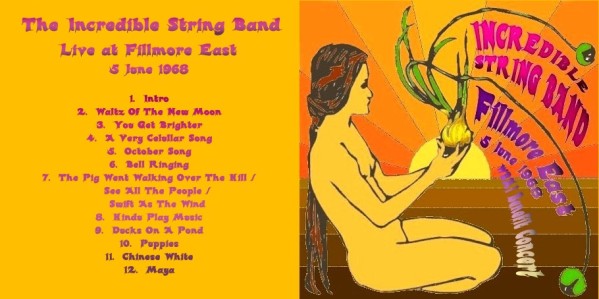
(this post is part of a series analyzing every performance at the Fillmore East. Above is a scan of a bootleg recording from the WBAI broadcast, from the Incredible String Band concert history site)
June 5, 1968 WBAI-fm Benefit with the Incredible String Band
Bill Graham was alert to the promotional value of being a good citizen of his community, so he lent out the Fillmore East on weeknights for appropriate causes. WBAI-fm (99.5) was part of the Pacifica Radio Network (which includes KPFA-fm in Berkeley), and as a result it depended on listener support rather than advertisements. The station held a fundraising benefit at the Fillmore East on Wednesday, June 5. There were probably other performers, probably including some music, but the Incredible String Band were the headliners. More importantly for historians, WBAI taped the performance and broadcast it on March 23, 1969.
The Incredible String Band were a talented folk duo from Scotland. Mike Heron and Robin Williamson wrote nice songs and played numerous instruments, including various middle eastern instruments not typical at the time. In March 1968 Elektra had released their classic 3rd album The Hangman’s Beautiful Daughter, and this was their first trip to America. What had initially been an acoustic folk group (originally a trio with the now-departed Clive Palmer) had become a sophisticated melange of English folk music and instruments from around the world. While the ISB was not to everyone's taste, they were surely one of a kind.
The Incredible String Band was managed by a legendary producer named Joe Boyd. Boyd was from Princeton, NJ but by this time lived in London. Boyd was an incredibly important behind the scenes figure in 1960s music on both sides of the Atlantic, but his story is too detailed to explain here. Suffice to say that Boyd's eloquent and hilarious biography White Bicycles (Serpent's Tail, 2006) is a must read for anyone interested in 60s music. Boyd was well aware that the Incredible String Band were unique, and made sure that they were presented in settings appropriate for their unique sound, as they were not going to succeed by boogieing away in some Municipal Auditorium, second on the bill to Vanilla Fudge.
At this time the Incredible String Band featured Mike Heron and Robin Williamson as co-leaders, co-lead singers and writers of all the songs (though not partners). Their girlfriends, Rose Simpson (bass) and Licorice McKechnie (various instruments and vocals) respectively, supported the band in concert. This show was near the end of the Incredible String Band's first American tour, which had begun a month earlier in the gym at SUNY Stony Brook, opening for The Grateful Dead (on May 4, 1968).
The Incredible String Band were a unique group who were also uniquely promoted in America. They regularly played The Fillmore East on their own nights. I have seen uncertain indications that they played Fillmore East on Sunday May 12, 1968. I cannot confirm this, but it would fit in with their history.
Next: June 7-8, 1968: Electric Flag/Quicksilver Messenger Service/Steppenwolf
Friday, November 20, 2009
The Psychedelic Supermarket, Boston, MA 1967-68 Performance List (Work In Progress)
Boston, Massachusets in the late 1960s had a thriving rock scene, which was not surprising for a major Northeastern city with numerous colleges in the city itself and the nearby suburbs. However, while there are various overviews of the Boston scene available on the web, I know of no complete and accurate chronology of rock shows in the Boston area available in print or on the Web. As a result, performances for many groups have fallen under the radar.
While the famous Boston Tea Party is fairly well represented on the Web, The Psychedelic Supermarket, an obscure and unloved venue on Kenmore Square, remains shrouded in obscurity. There are a variety of impressionistic memories, but this post is an attempt to collect the available information about performances at Boston's Psychedelic Supermarket. This is a work in progress, with a considerable number of gaps, but it is the only attempt I know of to accumulate all the performance dates at the venue. There is considerably more information to be uncovered, but I am hoping to use this post as a starting point.
The Venue
The street address of the Psychedelic Supermarket was 590 Commonwealth Avenue, but actually the venue was in an alley behind Commonwealth Avenue, near Kenmore Square and backing onto Boston University. The "street address" made it easier to find. The venue was a converted parking garage, with acoustic qualities to match, and it was not remembered fondly by bands or patrons. Supermarket Promoter George Popadopolis had run a Boston coffee house called The Unicorn since the early 1960s, and by the mid-60s he was booking electric blues bands as well as folk music.
Boston's first and most famous psychedelic venue was the Boston Tea Party (at 53 Berkeley Street) and the second was The Crosstown Bus at 337 Washington Street in suburban Brighton. The Crosstown Bus ran afoul of the city and the police, however, apparently over licensing (the J. Geils Blues Band managed to get their equipment out just before the place was padlocked), just as the hottest band in the country had a booking there.
The Psychedelic Supermarket appears to have debuted with Cream from September 8-16, 1967. It appears that George Popadopolis seems to have hastily created this venue to facilitate Cream, in order (apparently) to cash in on the dates dropped by the hastily closed Crosstown Bus. Memories of the club's debut suggest that it was not ready. It seems possible that a plan by Popadopolis to create a club was abruptly accelerated to cash in on the availability of Cream. Apparently, the venue was initially a parking garage during the day, and then the lower floor of the garage was converted to a concert facility for the evening. Eyewitnesses recall little more than cold concrete, no amenities and poor sound. There was some suggestion that an effort was made to make the venue more palatable throughout 1968, but it was never a comfortable facility.
The Unicorn, Popadopolis's other club was a coffee house with folk music on 815 Boylston Street (h/t The Funky Judge for the exact address). Now an Apple Store, it was near Boston University and Commonwealth Avenue, just across the Charles River from Cambridge and all its college students. As music evolved, some electric groups started to play The Unicorn as well. A Butterfield Blues Band performance from the Unicorn in 1966 has been widely circulated (for more about Popadopolis and the Cambridge folk scene, see the fine 1979 book Baby Let Me Follow You Down by Eric Von Schmidt and Jim Rooney). Thus Popadopolis's move into rock promotion, while sudden, was consistent with his prior businesses.
The Supermarket does not appear to have had much in the way of collectable or interesting handbills or posters, so the shows are somewhat lost to history. Some handbills are around from the 1967 era, but they seem based on blank format with an inserted photo and dates (a common practice at the time).
A veteran Boston commentator has unfond memories of the venue;
Anyone with corrections, additions or new information, please Comment or email me. There are many blank spots in the schedule. Numerous local and regional bands acknowledge performing there, such as Tangerine Zoo or Crow (with a teenage Donna Summer as lead vocalist), but I have not been able to identify any dates for those groups. The Tom Swift Electric Band was apparently the "house band" and played many of the shows at the Supermarket as an opening act, but that too has been very difficult to pin down. I also do not know if the Supermarket was open only on weekends, like the Boston Tea Party, or all days of the week. I will be appreciative if anyone can comment on the general schedule of the place.
(Thanks to some useful correspondence, I have updated the list since the original post--new or changed dates are shown as added or updated)
September 10-16, 1967 Cream
Cream was on their first American tour, and had just finished an exciting run at San Francisco's Fillmore. While they may not have played all seven nights, they played most of them, and by all accounts Clapton absolutely tore down the house. They apparently played Brandeis University one night (Saturday September 9), and and some eyewitnesses allude to "six nights," so perhaps Cream played from Tuesday September 11 through Saturday September 16. In any case, although the club was not ready for prime time, it was a memorable event (updated).
A photo survives.
October 24-29, 1967 Chuck Berry
The Massachusets Institute of Technology in Cambridge has every surviving copy of its newspaper scanned into an archive, befitting the legacy of a top-flight Engineering school. The Tech is a fantastic resource for the Boston and Cambridge rock scene in the late 1960s. This set of shows was advertised in The Tech. The ad in The Tech (10.24.67) says “for benefit of Multiple Sclerosis.”
Its impossible to know how many shows were actually held at The Psychedelic Supermarket. Were there shows every night, or every weekend? Were there only shows when there was a headline act? I have never found a definitive answer to that question, particularly in the early days.
October 31-November 13, 1967 Electric Flag/Blues Children/The Illuminations
The Electric Flag, Mike Bloomfield's newly minted "American Music Band," after debuting for two weekends at the Fillmore (some with Cream), played two full weeks at the Supermarket. A flyer survives, although I am not entirely certain about the dates. The engagement may have begun on Friday November 1. The J. Geils Blues Band, then a local group, may have opened some of the shows (updated).
November 15-16, 1967 The Yardbirds (CANCELED show)
November ?-, 1967 Procol Harum (updated)
November 24-25, 1967 Mothers of Invention
December 8-9, 1967 Grateful Dead
I have written about the Dead at the Supermarket elsewhere. There is an extant flyer, which has the same format as other flyers. Steve Grant's review of The Dead at the Pscyhedelic Supermarket in the Tuesday, December 12, 1967 edition of The Tech (Volume 87, issue 52, page 6).
December 29-30, 1967 Grateful Dead
It is an apocryphal Dead story that the Dead played Boston on December 30 and flew home to San Francisco the next day, expecting to jam with Quicksilver at Winterland on New Year's Eve. However, a potent batch of brownies--no doubt filled with chocolatey goodness--caused many of the exhausted band members to fall asleep and miss the jam. Regardless of whether you believe the brownie story, it does confirm that the Dead were on the East Coast so I am inclined to believe they played Psychedelic Supermarket two weekends of December 1967.
January 5-6 1968 Moby Grape
January 12-13, 1968 Chuck Berry(added)
January ? 1968 The Fugs
An article in the February 23, 1968 edition of the MIT student newspaper (The Tech) mentions previous gigs at the Supermarket by Moby Grape, The Fugs, Spirit, Procol Harum and Electric Flag, but these could have been at any time from September 67 thru February 68. There is a circulating audience tape of The Fugs at The Psychedelic Supermarket from some time in 1968, so it is probably from one of these shows. Moby Grape was touring the East in January and February 1968 (updated).
Februrary 16-17, 1968 Colwell-Winfield Blues Band
The Colwell-Winfield Blues Band were a progressive blues band featuring two saxophones. The band released a 1968 album on Verve, and broke up in 1970. Horn men Colin Tilton (tenor sax) and Jack Schroer (alto) went on to become Van Morrison’s horn section during the Moondance period.
February 23-24, 1968 Big Brother and The Holding Company/Blood Sweat & Tears
Blood, Sweat & Tears, still featuring founding member Al Kooper, were touring in support of their recently released debut album. A well-recorded audience tape circulates of the band’s first night performance, the only known live tape of the Kooper-led B, S& T.
March 1-2, 1968 Charles Lloyd (added)
March 8-9, 1968 Country Joe and The Fish
The Friday night show (March 8) is reviewed in the Harvard Crimson (March 16, 1968), including an interview with Joe McDonald. Barry Melton is referred to as “lead guitarist Barry Nelson.”
On March 15, 1968, at 10:30 pm, Boston classical music station WBCN-fm begins broadcasting ‘underground’ rock on the overnight shift. WBCN transforms the rock music scene in Boston and the Northeast, as fm rock stations did all over the country. The midnight-7am shift is handled by “The Woofuh Goofuh. ” The Woofuh Goofuh is Hallucinations lead singer Peter Wolf, who handles the overnight shift for the next year (unless he has a gig). He becomes an underground legend as a dj in Boston before he ever becomes famous as singer of The J. Geils Band in the 1970s.
March 15-16, 1968 Psychedelic Supermarket, Boston, MA Eden’s Children (updated)
March 22-23, 1968 Butterfield Blues Band
An audience tape circulates from March 23, featuring guitarist Elvin Bishop and saxophonist David Sanborn.
March ?, 1968 Mothers of Invention
According to the most informed Zappa chronologies, The Mothers played a weekend in March as well as the November, 1967 shows.
April 19-20, 1968 Tim Hardin (added)
May 10-18, 1968 First Annual Boston Pop Festival
This is mentioned in the “Making The Scene” column of The Tech. The “festival” was hosted by the Boston Arts Project, and the acts “include Colwell-Winfield Blues Band, Eden’s Children, Faith and others.”
>May 10, 1968 Listening/Hedge & Donna/Miss Lark/Freeborne
>May 11, 1968 3rd World Rasberry/Dave Morgan/Megan
May 24-25, 1968 Canned Heat (added)
Contributor Adam found an ad for these Canned Heat shows in the paper Boston After Dark.
June 3-6, 1968 Electric Flag (added)
June 25-29, 1968 Walk On Water (added)
July 25-26-27, 1968 The Fugs (added)
September 27-28, 1968 Traffic (added)
October 4-5, 1968 Colwell Winfield Blues Band
An enthusiastic review in The Tech (October 8, 1968) fails to say where the band was playing, but I am inferring it was at the Supermarket.
October 11-12, 1968 Blood, Sweat & Tears/Tom Swift Band
The October 12 (Saturday) show is known from a review in The Tech (Oct 15 '68)), and the Friday night show was confirmed by Billboard magazine. The Tom Swift Electric Band featured guitarist Billy Squier (who had many hits in the 1980s) and keyboard player Barry Flast. The implication seems to be that The Tom Swift Electric Band was performing regularly at the Supermarket through much of its brief lifetime.
Billy Squier has said that The Tom Swift Electric Band was the "house band" at The Psychedelic Supermarket, and opened many shows there, including the Moody Blues and Steve Miller Band. I don't know exactly when Squier's band became regular performers at the venue.
November 1-2, 1968 Moody Blues/Tom Swift Electric Band
There used to be a lengthy and amusing online description of seeing the Moody Blues at the Supermarket, but I can't find it any more.
November 8-9, 1968 Blue Cheer (added)
Blue Cheer had just completed a European tour. Guitarist Randy Holden had replaced Leigh Stephens just before the tour.
November 15-16, 1968 Sly And The Family Stone (added)
November 22-23, 1968 Psychedelic Supermarket, Boston, MA Procol Harum/The Spikes
Reviewed in The Tech (12.6.68).
December 6-7, 1968 Steve Miller Band (added)
January 10-11, 1969 The Unicorn, Boston, MA Iron Butterfly
The Unicorn, also called The Unicorn Coffee House, took over the site of the Psychedelic Supermarket at 590 Commonwealth. The Unicorn had been a smaller, folk-oriented venue in Cambridge that moved to the larger site. I'm not sure if the Unicorn in Cambridge was still open by this time, but since George Papadopolis owned both venues, this would have been a merger of sorts.
March 28-29, 1969 The Unicorn, Boston, MA Joni Mitchell/James Taylor (added)
An eyewitness in the Comments recalls Joni Mitchell being an hour late due to snow, but sounding all the better for it.
Nonetheless, other than the Iron Butterfly poster, I have seen little other evidence of the Unicorn as a post-1969 venue, so I think this was a late effort to lend some credibility to the venue that seems not to have succeeded. As the rock business got bigger after 1968, many small to medium sized venues faced great difficulties, and it is no surprise that a highly competitive market like Boston would have some casualties.
Aftermath
The building later became a movie theater (initially called the Nickelodeon), and was eventually torn down to provide a new science building for Boston University.
I am hoping that enough additional information will arise that I can significantly update this list (thanks to those who have already contributed additional dates and corrections).
While the famous Boston Tea Party is fairly well represented on the Web, The Psychedelic Supermarket, an obscure and unloved venue on Kenmore Square, remains shrouded in obscurity. There are a variety of impressionistic memories, but this post is an attempt to collect the available information about performances at Boston's Psychedelic Supermarket. This is a work in progress, with a considerable number of gaps, but it is the only attempt I know of to accumulate all the performance dates at the venue. There is considerably more information to be uncovered, but I am hoping to use this post as a starting point.
The Venue
The street address of the Psychedelic Supermarket was 590 Commonwealth Avenue, but actually the venue was in an alley behind Commonwealth Avenue, near Kenmore Square and backing onto Boston University. The "street address" made it easier to find. The venue was a converted parking garage, with acoustic qualities to match, and it was not remembered fondly by bands or patrons. Supermarket Promoter George Popadopolis had run a Boston coffee house called The Unicorn since the early 1960s, and by the mid-60s he was booking electric blues bands as well as folk music.
Boston's first and most famous psychedelic venue was the Boston Tea Party (at 53 Berkeley Street) and the second was The Crosstown Bus at 337 Washington Street in suburban Brighton. The Crosstown Bus ran afoul of the city and the police, however, apparently over licensing (the J. Geils Blues Band managed to get their equipment out just before the place was padlocked), just as the hottest band in the country had a booking there.
The Psychedelic Supermarket appears to have debuted with Cream from September 8-16, 1967. It appears that George Popadopolis seems to have hastily created this venue to facilitate Cream, in order (apparently) to cash in on the dates dropped by the hastily closed Crosstown Bus. Memories of the club's debut suggest that it was not ready. It seems possible that a plan by Popadopolis to create a club was abruptly accelerated to cash in on the availability of Cream. Apparently, the venue was initially a parking garage during the day, and then the lower floor of the garage was converted to a concert facility for the evening. Eyewitnesses recall little more than cold concrete, no amenities and poor sound. There was some suggestion that an effort was made to make the venue more palatable throughout 1968, but it was never a comfortable facility.
The Unicorn, Popadopolis's other club was a coffee house with folk music on 815 Boylston Street (h/t The Funky Judge for the exact address). Now an Apple Store, it was near Boston University and Commonwealth Avenue, just across the Charles River from Cambridge and all its college students. As music evolved, some electric groups started to play The Unicorn as well. A Butterfield Blues Band performance from the Unicorn in 1966 has been widely circulated (for more about Popadopolis and the Cambridge folk scene, see the fine 1979 book Baby Let Me Follow You Down by Eric Von Schmidt and Jim Rooney). Thus Popadopolis's move into rock promotion, while sudden, was consistent with his prior businesses.
The Supermarket does not appear to have had much in the way of collectable or interesting handbills or posters, so the shows are somewhat lost to history. Some handbills are around from the 1967 era, but they seem based on blank format with an inserted photo and dates (a common practice at the time).
A veteran Boston commentator has unfond memories of the venue;
“The Psychedelic Supermarket (located where Kix and the Nickelodeon Cinema in Kenmore Square are now) was a blatant attempt by George Popadopolis to cash in on a trend. He had run the Unicorn, a Boston folk club, for some years before deciding to expand in early 1968. Seating of 300 was in the lower tier of a garage that was completely concrete, except for the stage. Cream played a memorable gig there in February '68 (sic—actually September 1967)not to mention Janis Joplin and the Holding Company. Stories of Popadopolis' financial finagling are a legend.. . groups would cancel contracts and leave because they would be paid less for long stands. The exposure was supposed to make up for the lesser pay!! One out of two bands would leave a gig after one set for various reasons and regular club-goers remember him raising ticket prices from $4.50 to $5.50 when he knew that a show was going to sell out.”List of Known Performances at The Psychedelic Supermarket
Anyone with corrections, additions or new information, please Comment or email me. There are many blank spots in the schedule. Numerous local and regional bands acknowledge performing there, such as Tangerine Zoo or Crow (with a teenage Donna Summer as lead vocalist), but I have not been able to identify any dates for those groups. The Tom Swift Electric Band was apparently the "house band" and played many of the shows at the Supermarket as an opening act, but that too has been very difficult to pin down. I also do not know if the Supermarket was open only on weekends, like the Boston Tea Party, or all days of the week. I will be appreciative if anyone can comment on the general schedule of the place.
(Thanks to some useful correspondence, I have updated the list since the original post--new or changed dates are shown as added or updated)
September 10-16, 1967 Cream
Cream was on their first American tour, and had just finished an exciting run at San Francisco's Fillmore. While they may not have played all seven nights, they played most of them, and by all accounts Clapton absolutely tore down the house. They apparently played Brandeis University one night (Saturday September 9), and and some eyewitnesses allude to "six nights," so perhaps Cream played from Tuesday September 11 through Saturday September 16. In any case, although the club was not ready for prime time, it was a memorable event (updated).
A photo survives.
October 24-29, 1967 Chuck Berry
The Massachusets Institute of Technology in Cambridge has every surviving copy of its newspaper scanned into an archive, befitting the legacy of a top-flight Engineering school. The Tech is a fantastic resource for the Boston and Cambridge rock scene in the late 1960s. This set of shows was advertised in The Tech. The ad in The Tech (10.24.67) says “for benefit of Multiple Sclerosis.”
Its impossible to know how many shows were actually held at The Psychedelic Supermarket. Were there shows every night, or every weekend? Were there only shows when there was a headline act? I have never found a definitive answer to that question, particularly in the early days.
October 31-November 13, 1967 Electric Flag/Blues Children/The Illuminations
The Electric Flag, Mike Bloomfield's newly minted "American Music Band," after debuting for two weekends at the Fillmore (some with Cream), played two full weeks at the Supermarket. A flyer survives, although I am not entirely certain about the dates. The engagement may have begun on Friday November 1. The J. Geils Blues Band, then a local group, may have opened some of the shows (updated).
November 15-16, 1967 The Yardbirds (CANCELED show)
November ?-, 1967 Procol Harum (updated)
November 24-25, 1967 Mothers of Invention
December 8-9, 1967 Grateful Dead
I have written about the Dead at the Supermarket elsewhere. There is an extant flyer, which has the same format as other flyers. Steve Grant's review of The Dead at the Pscyhedelic Supermarket in the Tuesday, December 12, 1967 edition of The Tech (Volume 87, issue 52, page 6).
December 29-30, 1967 Grateful Dead
It is an apocryphal Dead story that the Dead played Boston on December 30 and flew home to San Francisco the next day, expecting to jam with Quicksilver at Winterland on New Year's Eve. However, a potent batch of brownies--no doubt filled with chocolatey goodness--caused many of the exhausted band members to fall asleep and miss the jam. Regardless of whether you believe the brownie story, it does confirm that the Dead were on the East Coast so I am inclined to believe they played Psychedelic Supermarket two weekends of December 1967.
January 5-6 1968 Moby Grape
January 12-13, 1968 Chuck Berry(added)
January ? 1968 The Fugs
An article in the February 23, 1968 edition of the MIT student newspaper (The Tech) mentions previous gigs at the Supermarket by Moby Grape, The Fugs, Spirit, Procol Harum and Electric Flag, but these could have been at any time from September 67 thru February 68. There is a circulating audience tape of The Fugs at The Psychedelic Supermarket from some time in 1968, so it is probably from one of these shows. Moby Grape was touring the East in January and February 1968 (updated).
Februrary 16-17, 1968 Colwell-Winfield Blues Band
The Colwell-Winfield Blues Band were a progressive blues band featuring two saxophones. The band released a 1968 album on Verve, and broke up in 1970. Horn men Colin Tilton (tenor sax) and Jack Schroer (alto) went on to become Van Morrison’s horn section during the Moondance period.
February 23-24, 1968 Big Brother and The Holding Company/Blood Sweat & Tears
Blood, Sweat & Tears, still featuring founding member Al Kooper, were touring in support of their recently released debut album. A well-recorded audience tape circulates of the band’s first night performance, the only known live tape of the Kooper-led B, S& T.
March 1-2, 1968 Charles Lloyd (added)
March 8-9, 1968 Country Joe and The Fish
The Friday night show (March 8) is reviewed in the Harvard Crimson (March 16, 1968), including an interview with Joe McDonald. Barry Melton is referred to as “lead guitarist Barry Nelson.”
On March 15, 1968, at 10:30 pm, Boston classical music station WBCN-fm begins broadcasting ‘underground’ rock on the overnight shift. WBCN transforms the rock music scene in Boston and the Northeast, as fm rock stations did all over the country. The midnight-7am shift is handled by “The Woofuh Goofuh. ” The Woofuh Goofuh is Hallucinations lead singer Peter Wolf, who handles the overnight shift for the next year (unless he has a gig). He becomes an underground legend as a dj in Boston before he ever becomes famous as singer of The J. Geils Band in the 1970s.
March 15-16, 1968 Psychedelic Supermarket, Boston, MA Eden’s Children (updated)
March 22-23, 1968 Butterfield Blues Band
An audience tape circulates from March 23, featuring guitarist Elvin Bishop and saxophonist David Sanborn.
March ?, 1968 Mothers of Invention
According to the most informed Zappa chronologies, The Mothers played a weekend in March as well as the November, 1967 shows.
April 19-20, 1968 Tim Hardin (added)
May 10-18, 1968 First Annual Boston Pop Festival
This is mentioned in the “Making The Scene” column of The Tech. The “festival” was hosted by the Boston Arts Project, and the acts “include Colwell-Winfield Blues Band, Eden’s Children, Faith and others.”
>May 10, 1968 Listening/Hedge & Donna/Miss Lark/Freeborne
>May 11, 1968 3rd World Rasberry/Dave Morgan/Megan
May 24-25, 1968 Canned Heat (added)
Contributor Adam found an ad for these Canned Heat shows in the paper Boston After Dark.
June 3-6, 1968 Electric Flag (added)
June 25-29, 1968 Walk On Water (added)
July 25-26-27, 1968 The Fugs (added)
September 27-28, 1968 Traffic (added)
October 4-5, 1968 Colwell Winfield Blues Band
An enthusiastic review in The Tech (October 8, 1968) fails to say where the band was playing, but I am inferring it was at the Supermarket.
October 11-12, 1968 Blood, Sweat & Tears/Tom Swift Band
The October 12 (Saturday) show is known from a review in The Tech (Oct 15 '68)), and the Friday night show was confirmed by Billboard magazine. The Tom Swift Electric Band featured guitarist Billy Squier (who had many hits in the 1980s) and keyboard player Barry Flast. The implication seems to be that The Tom Swift Electric Band was performing regularly at the Supermarket through much of its brief lifetime.
Billy Squier has said that The Tom Swift Electric Band was the "house band" at The Psychedelic Supermarket, and opened many shows there, including the Moody Blues and Steve Miller Band. I don't know exactly when Squier's band became regular performers at the venue.
November 1-2, 1968 Moody Blues/Tom Swift Electric Band
There used to be a lengthy and amusing online description of seeing the Moody Blues at the Supermarket, but I can't find it any more.
November 8-9, 1968 Blue Cheer (added)
Blue Cheer had just completed a European tour. Guitarist Randy Holden had replaced Leigh Stephens just before the tour.
November 15-16, 1968 Sly And The Family Stone (added)
November 22-23, 1968 Psychedelic Supermarket, Boston, MA Procol Harum/The Spikes
Reviewed in The Tech (12.6.68).
December 6-7, 1968 Steve Miller Band (added)
January 10-11, 1969 The Unicorn, Boston, MA Iron Butterfly
The Unicorn, also called The Unicorn Coffee House, took over the site of the Psychedelic Supermarket at 590 Commonwealth. The Unicorn had been a smaller, folk-oriented venue in Cambridge that moved to the larger site. I'm not sure if the Unicorn in Cambridge was still open by this time, but since George Papadopolis owned both venues, this would have been a merger of sorts.
March 28-29, 1969 The Unicorn, Boston, MA Joni Mitchell/James Taylor (added)
An eyewitness in the Comments recalls Joni Mitchell being an hour late due to snow, but sounding all the better for it.
Nonetheless, other than the Iron Butterfly poster, I have seen little other evidence of the Unicorn as a post-1969 venue, so I think this was a late effort to lend some credibility to the venue that seems not to have succeeded. As the rock business got bigger after 1968, many small to medium sized venues faced great difficulties, and it is no surprise that a highly competitive market like Boston would have some casualties.
Aftermath
The building later became a movie theater (initially called the Nickelodeon), and was eventually torn down to provide a new science building for Boston University.
I am hoping that enough additional information will arise that I can significantly update this list (thanks to those who have already contributed additional dates and corrections).
Subscribe to:
Posts (Atom)

 Posts

