Tuesday, November 17, 2009

1859 Geary Blvd, San Francisco: The Geary Temple 1966-68

The Geary Temple is a little-known rock venue on the 1800 block of Geary Boulevard, just two buildings away from the famed Fillmore auditorium. It was used for a number of curious shows in 1966, and once in 1967, and then a series of uses until it achieved infamy as the San Francisco headquarters of Jim Jones notorious Peoples Temple, who sadly committed mass suicide in Jonestown, Guyana on November 18, 1978.

There were three significant buildings on the South (odd numbered) 1800 block of Geary Boulevard. The most famous to rock fans is of course the Fillmore Auditorium at 1805 Geary, on the corner of Fillmore and Geary, built in 1912 (as The Majestic Hall and Dancing Academy) and still operating today. Next door was the former site of the synagogue for Temple Beth Israel, an early Jewish congregation in San Francisco, founded around 1860, which began constructing its fifth building at 1839 Geary in 1905, although its completion was interrupted by the April 1906 earthquake .  Next to the synagogue was the Scottish Rites (Masonic) Temple Building, known as the Alfred Pike Memorial Temple, at 1859 Geary, which dated back to the 19th century. A remarkable photo exists from right after the 1906 San Francisco  earthquake, showing a damaged Beth Israel synagogue and the equally damaged Masonic Temple, with an empty lot where the future Fillmore would be built a few years later. Although there were a number of different addresses on the block, these three buildings were the main structures on the block until the 1980s.

Whatever the exact history of the Scottish Rites Temple, it appears to have been simply another building for rent in the 1960s. The Fillmore district was a neighborhood in transition in the 1960s, and many buildings, including the Fillmore Auditorium, were available for very modest prices to any customer. In 1966, there were a few interesting events at the Geary Temple, and the posters locate the building as "next to the Fillmore." While not technically correct--Temple Beth Israel (at 1839 Geary) was actually next to the Fillmore, between the two structures--for anyone trying to get to the Geary Temple, "next to the Fillmore" sufficed for an accurate direction.

Once Bill Graham had shown that underground rock events could be a commercial success in San Francisco, there was a scramble to find events and venues that filled a need. The first event I am aware of at the Geary Temple is the event presented by 'The Sacred Cow' on April 2, 1966 (above). The listing would be

April 2, 1966 Geary Temple, San Francisco, CA Quicksilver Messenger Service/Big Brother and The Holding Company/PH Phactor Jug Band
Sacred Cow Presents
The name Sacred Cow would turn up again (in Santa Cruz the next year, on March 25, 1967) but its hard to say if there was a connection between the naming. In any case, this seems to be an effort to produce a show independently. Quicksilver Messenger Service had already promoted shows of their own at the Fillmore (for example, on February 18, 1966) and Big Brother was managed by Chet Helms, who had not yet opened the Avalon (it debuted April 22, 1966), so whomever Sacred Cow represented, it promoted bands who were not yet assimilated to working as bands for hire for Bill Graham Presents.

Quicksilver Messenger Service played The Fillmore this same weekend, on Friday April 1 (the day before), opening for Jefferson Airplane. I believe there is a poster showing QMS playing the Fillmore on April 2 as well (I am not a poster expert), but it appears that they were replaced by The Hedds, a popular San Francisco garage band. In any case, with a blossoming underground dance emporium, Bill Graham can not have been pleased at the idea of a hall available to competitors just two doors away.


May 27, 1966 Geary Temple, San Francisco Mira Dasein Presents A Scheer/VDC Benefit
drama/light/sound happening
The Amazing Charlatans/Robbie Basho/Solomon/Spiker/PH Phactor Jug Band/Malachi/Chris Coleman/Perry Lederman

Films by Elias Romero and Ben Van Meter/Open Theater performers/SF Mime Troupe/Merry Pranksters
(two different posters for the Mira Dasein event. Artist unknown to me--scans courtesy of Ross)

I do not know who or what Mira Dasein was. Robert Scheer, however, was a Ramparts magazine writer who was running as the Anti-War candidate in the Democratic primary for Congress in Berkeley. "VDC" stood for "Vietnam Day Committee," the principal organizing umbrella for anti-Vietnam War protests in Berkeley. Whatever Mira Dasein referred to, this was a fundraising event for an Anti-Vietnam War candidate to raise consciousness about opposing the Vietnam War, and there was a distinctly Berkeley tone to the proceedings.. A careful reading of the poster, however, makes it clear that this event is an Acid Test, if not referred to by that name. LSD was still legal in California at the time, so although the police would not have liked it, there was no legal barrier to having an all-night LSD party to raise funds for political purposes.

Although the performers are not world famous, except perhaps for San Francisco's Charlatans, many had Berkeley connections. Solomon Feldthouse would go on to achieve legendary status in the group Kaliedoscope, and performers like Robbie Basho, Perry Lederman and Ken Spiker were well-known at Berkeley's Jabberwock folk club. PH Phactor Jug Band were from the Northwest, but they were well known at folk clubs like Cedar Alley, as was Malachi. The Open Theater was a progressive Berkeley Theater troupe, closed by this time but still locally known (or at least infamous). The Merry Pranksters needed no introduction by this time, and Elias Romero and Ben Van Meter were local underground filmmakers.

This event sounds quite fascinating, but of course other than the posters, no other evidence has surfaced from the event. In any case, anyone who went or participated may not remember it. On top of that, it wasn't even the coolest event on the block--that same night Andy Warhol's Exploding Plastic Inevitable, feauturing the Velvet Underground, appeared at the Fillmore, with The Mothers of Invention on the bill, not to mention the Leaves and the Grass Roots at the Avalon and Van Morrison in San Leandro (at the Rollarena), so it was some weekend for rock fans in the Bay Area.


July 29, 1966 Geary Street Temple Reaktion Harvest--An Experience!
Country Joe and The Fish/Jazz Mice Septet/Perry Lederman/Cyrus Koch/Jamar Colt Jazz Combo
Berkeley Cinematique/Open Theater Artists and Technicians/Glen McKay lights/Improvisational Theater

Although I know nothing of the "Mira Dasein" benefit beyond the poster above, the fact that a similar event was held the next month suggests it must have been some kind of success. This event, entitled "Reaktion Harvest-An Experience" does not appear to be a Benefit at all, but rather a commercial event. While the acts are slightly different than the previous event, there is an even more pronounced Berkeley flavor. Country Joe and The Fish had just "gone electric", and were still mostly playing the Jabberwock. The Jazz Mice Septet were a larger version of the house band at The Open Theater, featuring Open Theater Musical Director Ian Underwood (before he went East and met Frank Zappa) and bassist Tom Glass (aka artist Ned Lamont).

Bill Graham can't have missed the fact that a rival could lease the hall down the block and eat into his audience before he'd even got off the ground. While I do not know the exact timeline of Graham's activities, I do know he had a particularly Bill Graham-like solution: he bought the Geary Temple. A brief article in the May 3, 1969 edition of Music Industry trade magazine Billboard notes that
Bill Graham sold the Geary Temple next to his old Fillmore Auditorium to Western Addition Youth Group, Inc., a self-help for ghetto teenagers for $166,000, although another bidder was willing to pay $175,000
Whether or not the detail about a higher bidder is true--since Graham must have been the one to tip Billboard, he may have had any number of motives for fudging the facts--by 1969 Graham cannot have been too concerned about a competitor near his old site. By that time, Graham had moved from the Fillmore to the Fillmore West, a dozen blocks and a mile and half away.  In any case, the Billboard notice shows that Graham owned the Geary Temple, and that accounts for the abrupt absence of any shows at the Geary Temple from 1966 onwards, with one exception that I will identify.

My general understanding is that the Jefferson Airplane used the Geary Temple as a rehearsal hall for much of the late 1960s. Various stories abound of Jimi Hendrix, Paul McCartney or Mick Taylor hanging out or jamming with the Airplane, and if they were making music it was probably at the Geary Temple. The Airplane's San Francisco base was their "mansion" at 2400 Fulton, near the Haight Ashbury, but while some members lived there, it mainly held offices. There was some room in the Mansion to play music in the basement, but it was not a real rehearsal hall. It was standard practice for touring bands from England to come to San Francisco to play the Fillmore and spend their days jamming with the Dead or the Airplane, depending on who was in town. Any jams with the Airplane would have taken place at the Geary Temple, adding another historic facet to the building.


There was one more musical event that I am aware of at the Geary Temple, on June 25, 1967 (h/t Ross). It was billed as "Jazz Meets Blues: A Benefit For The New Fillmore Theater." The show featured a mixture of rock and jazz acts. The billing looked like this

June 25, 1967   Geary Temple, San Francisco "Jazz Meets Blues: A Benefit For The New Fillmore Theatre"
Mary Stallings/Rene Strange/Sonny Lewis Quintet/Bay Area Quintet/Sonny Donaldson Trio/Dewey Redman Company/Light Sound Dimension
New Salvation Army Band/Morning Glory/Mount Rushmore/Wildflower/Freudian Slips/Black Swans/Miss Cornshucks Loose Troupe
(two shows 2-7pm and 9pm-2am; it appears that the jazz bands played the afternoon and the rock bands the evening, but I can't be certain)

My theory is that Bill Graham already owned the Geary Temple by mid-1967, and that this was a community event. The Fillmore Auditorium itself would not have been available, since Jimi Hendrix and Big Brother were finishing out their week (Big Brother had replaced the Airplane), so I am assuming Graham offered the Geary Temple building instead. The Fillmore District had a lengthy musical history of its own, well told in a fine book called Harlem Of The West by Elizabeth Pepin and Lewis Watts (2006, Chronicle Books), but too extensive to go into here. Suffice to say, the district's musical history was largely African American and Urban Redevelopment was changing the neighborhood. The white hippies who patronized the Fillmore were friendly enough, but they weren't from the local community. Graham always made a point of respecting the fact that his clientele were "visitors" in the neighborhood, so whatever the New Fillmore Theatre might have been, the "Jazz Meets Blues" theme seems to suggest it was a local event.

Following my assumptions, Bill Graham appears to have bought the Geary Temple by 1967, and sold it by early 1969 when he no longer had neither a direct need for it nor active fear of competition. Jim Jones and his "congregation" purchased the property at 1859 Geary in about 1973, paying $122,000. While they played an increasingly important part in San Francisco politics, Jones became increasingly erratic, and eventually left with many of his followers in 1978 for Jonestown, Guyana, where the terrible tragedy occurred.

After the Jonestown event, the building remained empty. It was seriously damaged in the 1989 Loma Prieta earthquake and torn down. It remained a vacant lot for a long time, but has since been replaced by a United States Post Office branch office.

Saturday, November 14, 2009

Fillmore East May 31-June 1, 1968: Moby Grape/The Fugs/Gary Burton

(this post is part of a series analyzing every performance at the Fillmore East)

May 31-June 1, 1968 Moby Grape/The Fugs/Gary Burton

Moby Grape had been hyped as the best band to come out of San Francisco.  That may have been true, as it happened, but the hype did them in.  Moby Grape was made up of 5 experienced musicians, all good singers, performers and writers, and handsome to boot. Their second album Wow! had been released just before this show (Columbia Apr 68). It was a good album, but not as good as their epic first album, and the underground suspicion of anything popular undermined them. They were beset with management problems and other frustrations, and their best songwriter and resident genius Skip Spence started to have serious drug and emotional problems at this time, so the net effect was very difficult for the band. By all accounts, what should have been a triumphant appearance at the Fillmore East was rendered somewhat ragged because Peter Lewis, angry at the band for various reasons, skipped out on the tour and went home early.

Sadly, these Fillmore East shows were Spence's last stand with the Grape for some decades, as shortly after these shows, Skip Spence had an episode where he lost touch with reality, went AWOL for a few days and tended up in the Psych Ward at Bellevue Hospital. In any case, after the Fillmore East Moby Grape were effectively reduced to a four-piece band, albeit a very talented one (guitarists Jerry Miller and Peter Lewis, bassist Bob Mosley and drummer Don Stevenson). Although they still had plenty to offer, they now had to live down their previous success rather than just be themselves. Moby Grape were a great band, and their debut album is a 60s classic, but their entire history is a frustrating tale of what might have been.

The Fugs were often considered as a Greenwich Village version of The Mothers of Invention, although a more accurate comparison might have been Berkeley’s Country Joe and The Fish.  The Fugs were not particularly memorable musically, but they were provocative and exciting. They had been around for some time, and in fact had played the first Bill Graham Mime Troupe Benefit on November 6, 1965. In complete contrast to Zappa, they were very political, but only barely musical, singing songs like “Kill For Peace” and “Coca-Cola Douche.”  People who left the Fugs wrote books (singer Ed Sanders wrote Helter Skelter, about the Manson family), whereas people who left the Mothers joined the Symphony or played jazz  (except Motorhead Sherwood, who got a job in an auto body shop).

At the time of these shows the Fugs would have been supporting their album Tenderness Junction (Reprise, Jan 68). The Fugs released a live album recorded at this show called Golden Filth (Reprise, 1970). At the Fillmore East, The Fugs were supported on stage by various backing musicians.

Gary Burton was a jazz vibraphonist, raised in Nashville and like many young jazz musicians in New York at the time, he liked everything, not just jazz. The original lineup of the groundbreaking Gary Burton Quartet, featuring guitarist Larry Coryell had opened for Cream at San Francisco's Fillmore, among many other rock gigs, and they had released some sensational albums that still sound great today (including Duster and Lofty Fake Anagram on RCA in 1967). The lineup with Coryell (and bassist Steve Swallow and drummer Bob Moses) also recorded two albums in 1967 that were released in 1968, although I am not sure exactly when: Live At Carnegie Hall and Carla Bley's Genuine Tong Funeral. However, by the time of the Fillmore East shows, Coryell had left the group, replaced by the less well-known but still tremendous guitarist Jerry Hahn, formerly with John Handy amongst various others.

June 2, 1968: Bill Cosby/Janis Ian/Frankie Dunlap & Maletta/Jazz Pantomime 
"Salute to Dick Gregory"

Although a Bill Graham produced show, this was a non-rock event. Dick Gregory, a well-known comedian and activist, was running for President on the Peace And Freedom Party ticket that opposed the Vietnam War. While this is an interesting 60s story, it is outside the scope of this blog. At this time, besides being a popular stand up comedian with best selling albums, Bill Cosby had just finished his run starring on the popular NBC series I Spy.

Next: June 5, 1968: Incredible String Band WBAI Benefit

Friday, November 13, 2009

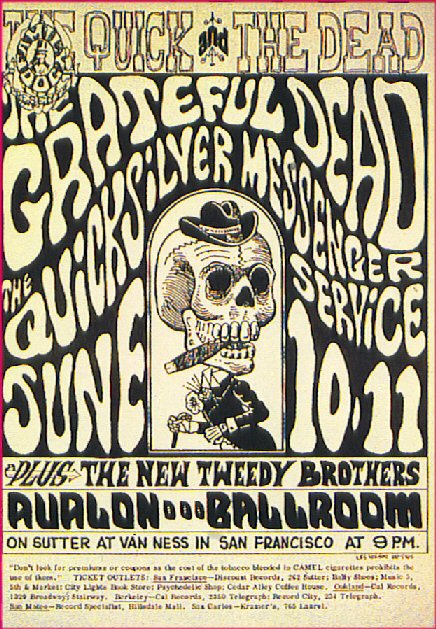
Avalon Ballroom June 10-11, 1966: Grateful Dead/Quicksilver Messenger Service/New Tweedy Brothers


This post is part of a series analyzing every performance at the Avalon Ballroom. Above is the Wes Wilson poster (FD12-thanks to Ross for the scan)

The Dead and Quicksilver Messenger Service had just played the Fillmore together, (June 3-4), and so they played consecutive weekends for Bill Graham and then Chet Helms.  The bands generally preferred playing the Avalon , but made more money at the Fillmore.  Quicksilver and The Dead were ‘summering’ at neighboring ranches in Marin County, across the bay.  The Dead dressed as Indians, and Quicksilver as Cowboys, and the bands and their crews and friends chased each other through the woods until the peace pipe was smoked. Many hippies identified with Native Americans, seeing them as peaceful, resilient people who lived off the land (not all of them did--by late 1966, the manager of Country Joe and The Fish [Ed Denson] would lament  “All this Indian crap.  There are so many fake Indians in Berkeley you wouldn’t believe it”)

In the audience on the previous weekend at The Fillmore was a friend of John Cipollina, a local radio engineer named Dan Healy.  When the Dead’s equipment broke, Cipollina recommended Healy, who promptly fixed the problem.  Healy criticizes the Dead’s vocal sound, and Garcia challenged him to do better.  Healy ended up becoming the Dead’s sound man until the early 1990s and did indeed do better. While he may not have yet been a member of the crew, he was almost certainly present and starting to get involved at this weekend's show.

At the Dead's first appearance at a Family Dog show two weeks earlier (May 28), the band's Owsley Stanley constructed sound system was so large, it blocked Bill Ham's light show. By this show, the band had painted the sound system white, so it became the screen for the light show.

The New Tweedy Brothers were a band from Oregon that had moved to San Francisco in 1966. They had an an obscure single on Dot, and recorded an album. However, their only album, released in 1968 ) on Ridon Records showed definite folk roots, with strummed guitars and nice harmonies, somewhat like The Byrds. In concert, they apparently also did a rock version of “Cold Rain and Snow,” no doubt being familiar with the same obscure Obray Ramsey record that Garcia had heard.

Their album, however, was pressed in a unique, oversize hexagonal sleeve too large to fit in record store racks, thus insuring that the poorly distributed album would sell as few copies as possible. The band returned to Oregon around 1967. Shadoks re-released the album on CD around 2001, retaining a tiny version of the oddly-shaped sleeve.

Next: June 17-18, 1966: Captain Beefheart and The Magic Band/The Oxford Circle

Avalon Ballroom June 3-4, 1966: The Grass Roots/Big Brother and The Holding Company/The Buddha


This post is part of a series analyzing every concert at the Avalon Ballroom. Above is the Victor Moscoso poster (FD-11-thanks to Ross for the scan)

By mid-1966, the Avalon had rapidly become an established venue. Chet Helms usually determined a theme for each weekend, and the poster artists created something that fit in with the theme. This week's theme was "Stone Facade," and Helms probably decorated the stage appropriately, and the light show probably worked within the theme as well. Lacking photos, however, we can only guess exactly what it looked like.

The Grass Roots were back for the second weekend in a row. This was only the 7th weekend that the Avalon had been open, and Big Brother and The Holding Company had played four of those. While it was a distinct advantage to be managed by the promoter of one of the town's exciting venues, and Big Brother's wild, ragged music was getting an enthusiastic response, the band had no good singers. Since the popular groups in town were the Jefferson Airplane and The Great Society (not to mention the We Five), Big Brother decided they needed a "chick singer" to complete their band. This very weekend, Helms sent his friend Travis Rivers to recruit his old friend Janis Joplin, and the two of them would hitchhike back to San Francisco.

The Buddha, billed as The Buddha From Muir Beach, was a local DJ and promoter. I don't know his real name. The Buddha put on a series of parties at Muir Beach Tavern in remote Western Marin, so he was known around the underground as well as a radio personality. However, I think he would have been some sort of emcee, not a performer.

There is some suggestion that the Oxford Circle may have auditioned for Chet Helms on one of these nights, and played so well that he added them to the bill the same night.  Certainly they opened a show after an audition somewhere around this time.

Next: June 10-11, 1966: The Grateful Dead/Quicksilver Messenger Service/New Tweedy Brothers

Thursday, November 12, 2009

May 30, 1967 Winterland, San Francisco HALO Concert--Who Played?


One of the foundations of rock prosopography has been looking at famous old posters to determine which bands played at which events. One famous poster (above) is for this concert

May 30, 1967 Winterland, San Francisco
Benefit for Haight Ashbury Legal Organization (HALO)
Jefferson Airplane/Big Brother and The Holding Company/Quicksilver Messenger Service/The Charlatans/The Grateful Dead plus Head Lights (Light Show)

By May 1967, the underground bands of the year before were rising stars. The Jefferson Airplane's second album (Surrealistic Pillow) was a hit, The Grateful Dead had released their debut on Warner Brothers, and Big Brother had released some singles and recorded enough for an album, although it would not be released until somewhat later. Quicksilver Messenger Service were popular Fillmore headliners who had hitherto refused to sign a record contract. Only The Charlatans, in some ways responsible for founding the scene, had not found new success. The HALO concert (as its now known) was an increasingly rare event where all the bands who regularly headlined at the Fillmore and Avalon shared a bill together, just as they might have done the previous year. Winterland (capacity 5,400) was far larger than the Fillmore, and probably all the star power was needed to sell that many tickets. It was the Tuesday after Memorial Day, so bands did not have competing gigs.

The chronologies of all four of the major bands list the HALO concert on the basis of the poster. The only problem with that analysis is that we can only be certain Quicksilver Messenger Service actually played, and I am fairly certain that one or two of the bands didn't play at all. I am unable to determine which ones those might be, however, so I will speculate on the evidence here. Although it is impossible to say for certain, there are plausible reasons to think that the Grateful Dead were the ones who did not play the show. I am not aware of a review or eyewitness account of the show that positively confirms which bands played.

The Quicksilver Messenger Service set was broadcast on San Francisco's (and the world's) first underground rock station, KMPX-fm, probably on a tape-delayed basis. This may be the first live FM broadcast of a rock concert, an interesting subject in its own right, but not my focus here. As a result of the broadcast, we are fortunate to have a pretty good quality circulating tape (for 1967) of Quicksilver's opening set. KMPX founder Tom Donahue introduces the band by saying "We're going to do it in six sets tonight, all three bands will play twice." He also cryptically refers to a "mystery guest, imported from a far-off land." Donahue's introduction begs the question--who didn't play?

Quicksilver seems to be opening the show, and the entirety of Donahue's remarks seem to be preserved. Its always possible that another MC explained the running order prior to the set, and Donahue is just speaking of specific groups, but he does say "all three bands will be playing twice," not "these three bands" or some phrase that suggests there are other groups. At the time, it was expected at the Fillmore and Avalon that ever act would rotate through twice: the opening band played 1st and 4th, the headliner 3rd and 6th, and so on, so Donahue's remark would have been understood in that context.

We know Quicksilver played, so let's consider the likelihood of the other groups failing to make the show.

The Charlatans
The Charlatans were the least popular of the groups at this show, by a wide margin, so if they were no-shows that would have had the least impact on attendance. Anyone who wanted to see the Charlatans would still be happy to see the rest of the bands, so they could be dropped without fanfare. On the other hand, the perpetually struggling Charlatans needed the gig the most, and were most likely to be free on a Tuesday night, so they are also less likely than the other groups to have had conflicts.

It was not unheard of at the Fillmore to have an "opening act," usually one not on the poster, that would play an a set prior to the tripartite rotation of the headliners (this would mean that the final act would appear both 4th and 7th). Its plausible that the Charlatans played an opening set and did not repeat, so Donahue's reference to "all three bands" implicitly excluded the Charlatans. I think this is the most likely explanation: the Charlatans played a set, and an announcer explained that someone wasn't playing, so that when Tom Donahue said "all three bands" it was understood who that was. It remains to be discussed who that might have been.

Jefferson Airplane
The Airplane had actually been on tour. They had just spent the weekend in the Pacific Northwest, headlining at the Seattle Center Arena on Monday, May 29 (Memorial Day). The Airplane would have had to fly in with their gear to go to Winterland, and might have been delayed. On the other hand, its a short flight from Seattle, and the Airplane were experienced at touring by this time. Its important also to remember that the Airplane were real rock stars at this point, with hit singles, and a considerably bigger draw than any of the other groups. If the Airplane were not playing, it would have had a considerable effect on ticket sale. Given the relative size of Winterland, the finances of the show probably depended a lot on walk-up sales, so a sudden Airplane cancellation would have had the most significant effect on the gate.

There is apparently a circulating Airplane tape dated "May 29, 1967 Winterland," which I have not heard. I have no way of knowing whether this is mislabeled by location (on May 29 the Airplane were in Seattle) or date. We do know that part or all of the show was taped, because of the Quicksilver tape, so its plausible that its a misdated tape of the Airplane HALO set.

Big Brother and The Holding Company
Big Brother were in town and had no other conflicts. This doesn't rule out the possibility of someone getting sick or other problems, but there was no inherent conflict. No tape circulates that I know about.

The Grateful Dead
The Grateful Dead had not played live (per Deadlists) since Saturday, May 20. However, the Dead were about to embark on their first Eastern tour. They not only began a run at Greenwich Village's Cafe Au-Go-Go on June 1 (through June 10), but they apparently introduced themselves to New York by playing for free in Tompkins Square Park in the East Village (on E. 9th St and Avenue A) on June 1 as well. Thus while the Dead had agreed to play a benefit on a Tuesday night, they were playing live in New York City just 36 hours later.

Bands traveled with considerably less equipment in the 1960s than they do now, and the Dead certainly could have flown to New York on Wednesday (May 31) in order to play Thursday. However, unlike Big Brother and The Airplane, the Dead were gearing up to leave, and that increases the likelihood that some member or piece of equipment was not available for the Winterland show. Although the Dead were a popular local group, they were not nearly as popular as the Airplane, and arguably not as popular as Big Brother or Quicksilver either, so their unexpected absence from the bill would not have been as significant to the walk-up sales.

The Grateful Dead had the closest relationship to the actual Haight Ashbury Legal Organization (see below), but as a result they had also done the most for the organization, so they could beg off and make it up later if they needed to.

Paradoxically, the other plausible argument for the Dead not playing the HALO Benefit is the absence of a tape. We know there was taping equipment there, because of the Quicksilver broadcast. There at least appears to be a circulating Airplane tape. There is no Big Brother tape, but while a few Big Brother tapes circulate, neither the band nor their management made a concerted effort to accumulate and store live tapes (more's the pity). The Dead, on the other hand, were archivists from the beginning. If there was recording equipment, the Dead would have used it and would have preserved the tape. Its possible, of course, that the Dead have been squirreling one away all these years, but I doubt it. While not all stored Dead tapes have been heard publicly, most of the old ones are at least documented.

Conclusions

Five bands were booked at the HALO Benefit, but a surviving Quicksilver tape has Tom Donahue saying "all three bands will play twice." Best guess scenarios:

  • The Charlatans--either didn't play, or weren't part of the "all three bands."
  • Jefferson Airplane--returning from San Francisco, but a possible tape endures, and they were the headliners
  • Big Brother--no inherent conflicts, but no confirming evidence
  • Grateful Dead--about to leave on their first Eastern tour, and no taped evidence, contrary to typical Dead practice

While the performance of any band at the HALO Benefit other than Quicksilver has to be treated as "unconfirmed," I feel that existing evidence points towards the Grateful Dead as the most likely of the no-shows. Anyone with other evidence or theories should post them in Comments or email me.

Appendix 1: "Mystery Guest, imported from a Far Off Land"
At the beginning of the Quicksilver tape, Donahue says "all three bands will play twice...and we also have a mystery guest, imported from a far-off land." Since we have no eyewitnesses or reviews (to my knowledge), its impossible to know who this might have been. I will say that being familiar with Tom Donahue's laconic humor from KSAN-fm, the "far off land" was most likely Los Angeles. Assuming that the mystery guest was a musician, as Donahue's introduction implies, and not an actor or public figure, this suggests a brief acoustic set by someone. This hypothesis makes sense particularly if we assume one of the headliners didn't play, as the Mystery Guest would have been a "makeup."

You can speculate for yourself on the mystery guest. Just to pick a name out of thin air, I will note that the Airplane were playing in Seattle with The Byrds, and David Crosby was friends with all the bands, and he would have been an enthusiastic supporter of HALO, but of course its impossible to say without new information.

Appendix 2: The Haight Ashbury Legal Organization
The Haight Ashbury Legal Organization (HALO) was run by two young laywers, Michael Stepanian and Brian Rohan, and their focus was on providing representation for hippies who had been busted for marijuana. Rohan and Stepanian were very effective at throwing out arrests by overzealous cops, and often represented people for free (grateful parents probably paid for the rest). HALO was run out of 715 Ashbury, across the street from the Grateful Dead's house at 710 Ashbury. Don McCoy and other friends of the Dead lived at 715, and its no coincidence that Brian Rohan represented the Grateful Dead (Stepanian ended up representing Hunter Thompson, but that too is another story). With the Summer of Love coming on strong, HALO correctly expected that many naive out-of-towners were at risk for being rousted by the cops, so the San Francisco groups banded together for a benefit to fund HALO for the Summer.

Cross-posted at Lost Live Dead.

Wednesday, November 11, 2009

Fillmore East May 24, 1968 Ravi Shankar/May 25, 1968 Country Joe and The Fish/Blue Cheer/Pigmeat Markham

(This post is part of a series cataloging every performance at The Fillmore East)

May 24, 1968 Ravi Shankar

Famed Indian classical musician Ravi Shankar appeared for a single show at the Fillmore East on Friday, May 24. Normally there was an early and late show at the Fillmore East, but Shankar's performances were typically very long, so a single performance was more appropriate.

Ravi Shankar (born in 1920) had spent time in Europe as a young man, so he was well-equipped to be the ambassador to the world for Indian music. Already renowned as a great Indian musician in the 1950s, he began to play in the United States and Europe in 1956. Shankar befriended record producer Dick Bock, owner of the Pacific Jazz label, and Bock created World Pacific Records to record Shankar. Shankar's tours and World Pacific albums helped spread interest in Indian music. The Byrds (associated with Bock) recorded in the same studio as Shankar, and the Byrds told George Harrison about Shankar. Once Shankar was associated with the Beatles, his star rose immediately. In Shankar's case, however, he was personally prepared and musically worthy of the attention drawn to him by the Beatles.

Although Ravi Shankar continued to play the Indian classical music that he always played, he had become an attraction on the rock circuit. Shankar had played Monterey Pop in June 1967, so he was comfortable with rock audiences. At the time, although Ravi Shankar was the only Indian musician that most Americans had ever heard of, he had a lot of underground credibility for a man nearing 50 years old.

May 25, 1968 Country Joe and The Fish/Blue Cheer/Pigmeat Markham

There was only a single show for the Saturday night performance, as well. I don't quite know why, since the bands were used to playing double shows.

Country Joe and The Fish were seen nationally as a San Francisco band, but really they were a Berkeley band, where overt political sentiments were not just acceptable but expected. The group's first album, Electric Music For The Mind And Body, had been released in April 1967 on Vanguard Records and had been very successful. San Francisco bands were developing a reputation for releasing albums that were inferior to their live performances, but Country Joe and The Fish made one of the earliest and best psychedelic albums.

The band had been founded in Berkeley as a folk duo by Joe McDonald and Barry Melton. "Country Joe" was a reference to Josef Stalin, and "The Fish" was a reference to Mao, obscure references that would have been relevant in Berkeley at the time. Upon seeing the Butterfield Blues Band at the Fillmore in 1966, Joe and Barry decided to "go electric" and put a band together. Nonetheless, it was a sensitive issue amongst band members that "The Fish" were not Joe McDonald's backing band, even if it may have seemed that way at times. After some changes, the 'classic' Country Joe and The Fish lineup which recorded the first two albums and played this night at the Fillmore East was Joe McDonald (vocals, guitar), Barry Melton (lead guitar, vocals), David Cohen (organ, guitar), Bruce Barthol (bass, vocals) and Chicken Hirsh (drums). Country Joe and The Fish were as dramatic and feedback-laden as any of the San Francisco bands, but they were veteran performers who put on an exciting and well-paced show as well, and they always went down extremely well in concert.

By the time of this show, the group had just released their second album, Feel-Like-I'm-Fixin-To-Die (Vanguard, March 68). The title track, Joe's famous "Feel Like I'm Fixin To Die Rag" (with its chorus "1, 2, 3 what are we fighting for?") had in fact been the first song Joe and Barry recorded, releasing it independently in 1965. The song had been re-recorded for the first album, but rejected by Vanguard for being "too political." By 1968, the overt politics of the band were seen as an asset. The album began with the title track, preceded by "The Fish Cheer," in which Joe asked the listener to "Give me an 'F'", and an answering (studio) crowd responded, and then an I, an S and an H, and when Joe asked "what's that spell?" they all responded "FISH." Today few realize that Joe's infamous cheer in the Woodstock movie was originally based on the band's name. The song is a true folk song, sung whenever America engages in unnecessary foreign wars (Joe wrote some new verses in the 1980s, about Iraq and Afghanistan, and they are sadly still serviceable today).

Blue Cheer returned, just a month after playing with Traffic, still touring behind their Phillips album Vincebus Eruptum and the surprise hit single "Summertime Blues."

Pigmeat Markham was a veteran African American comedian, currently popular on the NBC-TV comedy show Laugh-In for a repetitive bit around the catchphrase "Here Comes The Judge."

Next: May 31-June 1, 1968: Moby Grape/The Fugs/Gary Burton Quartet

Sunday, November 8, 2009

The Yellow Brick Road, 37266 Niles Boulevard, Fremont, CA: June 1967-January 1968 (Work In Progress)


(The flyer from June 16-17, 1967 for The Yellow Brick Road, featuring Palo Alto's New Delhi River Band and Fremont's Wakefield Loop. Poster by Paul Johansen)

The underground rock explosion that was ignited at The Red Dog Saloon in Virginia City, NV in the Summer of 1965 spread rapidly when it returned to San Francisco. Although the rest of the United States was just discovering the anticipated Summer of Love, the Bay Area had already reacted to the exciting mixture of loud music, strange colors and long hair that was luring young rock fans to the Fillmore and Avalon. Miniature variations of the psychedelic ballroom scene sprung up around the Bay Area, some only briefly like the ephemeral Outfit in Palo Alto, and some more substantially like The Barn in Scotts Valley. Somewhere in between lies the brief and curious story of The Yellow Brick Road, in the Niles district of Fremont. While I am some ways from competing the story, what I have learned is such an interesting case study in how a culture takes on varying forms that it is worth telling what I have learned so far, not least in the hopes that readers can add to the story and correct any mistakes I have made.

In 1967, Fremont was a prosperous suburb in Southern Alameda County, 35 miles South of Berkeley and 18 miles North of San Jose. Fremont had only been incorporated in 1956 by combining 5 smaller communities. Although part of the central Bay Area, Fremont had a distinctly different flavor, in that its principal employer was the General Motors plant, and the city of Fremont also functioned as the economic center of the agricultural areas just to the East of town. Today, most of Eastern Alameda County is heavily populated, but in the 1960s its primary businesses were auto manufactuing, ranching and agriculture, and Fremont was its hub. The city of Fremont had a lot of Cowboy bars and Western Swing music, and it wasn't an affectation.

San Francisco and the college towns of Berkeley and Palo Alto had grudgingly come to accept long hair and loud music, and whatever the local police thought, they were constrained by local tolerance. The cities and towns nearer to those communities were somewhat accepting of the changes, too, generally in proportion to their proximity to San Francisco or one of the two Universities, and places like San Jose and Santa Cruz were coming around as well. Fremont, however, despite its geographical location remained somewhat separate. Fremont teenagers had been to the Fillmore or other hip places, had the new records and had started to grow their hair. The Fremont Police and Schools, reflecting the city's less urban character, took a hard line against such changes. Male students were threatened with expulsion from school for having anything resembling long hair, and Fremont cops thought nothing of stopping and rousting young hippies, telling them (on some occasions with guns drawn) to "get out of town" even though in fact they lived in Fremont with their parents.

(From the April 11, 1967 edition of The Fremont Argus)

On April 10, 1967 the Fremont city planning commission approved a Use Permit for a "teenage 'pyschedelic' dance club in the Niles District of Fremont." The club was approved to be open on Friday and Saturday nights, and one Sunday afternoon per month. According to one of the owners, Warren Townsend, "it would be patterned after the more successful clubs in San Francisco." A commissioner was concerned about "who would police the 'undesirable element of teenager' who would patronize the establishment," summing up the City's view of hippies. When a hippie friendly coffee-shop (The Nickelodeon, at 3987 Washington Blvd) opened downtown, the City health and safety inspectors immediately had it closed.  When it was re-opened, the police made an active point of harassing the patrons. This wasn't some hippie rumor--this was reported in the Fremont Argus (June 22, 1967) with a picture of a stern looking cop sitting in the coffee shop in front of teenagers playing electric guitars.


(5/6 of Fremont's Wakefield Loop, Summer 1967: (l-r) Dan Garvey (ld gtr), Dave Simpson (vcls), Cheryl Williams (vcls), Denny Mahdik (gtr), Julio Stabin (bass))

The Wakefield Loop were probably Fremont's first avowedly psychedelic band, playing their own music. To the Fremont police they were dangerous hippies, although they hardly looked like hardcore San Francisco freaks, and most of them where still High School students. I have been in direct or indirect contact with a number of members of The Wakefield Loop, and they are the principal sources for this remarkable chronicle. The band was named after a tiny street in Fremont where  drummer Larry Payne lived (later replaced by Don DeAugustine).


The Yellow Brick Road was an old equipment rental facility. A stage was installed in the back of the room, and the venue had its own little parking lot (for a larger version of the photo, see here). The owners were the Townsend family and the Rapp family. Teenager Russ Rapp, still a High School student, was effectively the manager of the venue. Wakefield Loop guitarist Denny Mahdik assisted him with the booking.

June 10, 1967 Wakefield Loop/others?
The venue opened shortly after school ended, and Wakefield Loop members recall that they played opening night, although there may have been other bands. I have assumed that the club decided to have an opening act without an out-of-town headliner, just to make sure everything was running smoothly. June 10 was a Saturday, but that is just speculation on my part--the Loop could have played Friday, and other bands played Saturday (I'm hoping someone who remembers will write in).

Lead singer Dave Simpson recalls the presence of Sopwith Camel manager Yuri Toporov, who soon signed up the Wakefield Loop. Toporov brought along his friend, San Francisco guitarist Carlos Santana, then just another young gun on the scene. 

June 16-17, 1967 New Delhi River Band/Wakefield Loop
Palo Alto-based New Delhi River Band had been the house band at The Barn in Scotts Valley. A hip blues band, their membership included David Nelson and Dave Torbert, both future members of The New Riders of The Purple Sage. Denny Mahdik had been to The Barn a number of times, and in some ways the Yellow Brick Road was similar to The Barn: weekend gigs, no liquor sales that excluded teenagers, hippie friendly. It was appropriate that The Barn's house band were the first out-of-town headliners at Yellow Brick Road.

The New Delhi River Band also headlined Fremont's first free psychedelic happening, on Sunday June 18 at Fremont Central Park. This is an interesting event in its own right, and I have written about it elsewhere. Suffice to say, despite civic resistance, Denny Mahdik organized a successful outdoor event that drew some thousands of people to hear bands in the park, dragging Fremont unwillingly into the 1960s.


June 23-24, 1967 The Garden Of Chaste Refreshment/The Plastic People
June 30-July 1, 1967 Purple Earthquake
July 7-8 Loading Zone/Wakefield Loop

Thanks to this surviving poster, and one other, we know about the initial weekends at Yellow Brick Road. The Garden Of Chaste Refreshment was apparently a Hayward band, and Purple Earthquake were from Berkeley. The Purple Earthquake featured guitarist Robbie Dunbar, then a Berkeley High School student, and they would evolve into the group Earthquake, who had several albums over the years on A&M and Berserkely Records. The Loading Zone were a popular East Bay club band as well, the first hippie group to mix psychedelia with soul, kicking the door open for many others like Sly and The Family Stone and Tower of Power. This early version of the Zone most likely did not have a horn section, and future lead singer Linda Tillery was still in High School in San Francisco. Loading Zone would put out albums in 1968 and 1969 as well (along with one in 2008).


A surviving poster shows Wakefield Loop opening for the Loading Zone, and band members recall helping Loading Zone organist Paul Fauerso get his heavy Hammond B3 organ into the venue. It seems likely that local Fremont bands opened many of the shows, with regional headliners topping the bills. In the Spring, the Fremont Argus had reported on various Fremont "Battle Of The Bands" at different High Schools, the prizes of which were a gig at Yellow Brick Road, so the venue was clearly focusing on local groups as well.

The balance of the Summer of 1967 at Yellow Brick Road remains obscure. The Wakefield Loop started working with Yuri Toporov, playing all over San Francisco and Marin, so they don't recall playing Yellow Brick Road for the balance of the Summer. The group played an exciting week at Muir Beach, despite having their equipment stolen, but at the end of the Summer the group broke up. Some band members recall that The Sons of Champlin played Yellow Brick Road, but whether that was the Summer of Fall of 1967 remains obscure. It does appear that the venue closed at the end of Summer, but I suspect that was as much to accommodate end-of-Summer holidays.


(an article from the September 14, 1967 Fremont Argus, and an ad from the September 15, 1967 Hayward Daily Review)

September 15-16 Rock-A-Day Daisy And The Good Time Band/New Grass Garden (16th only)
The brief article is quite revealing. It says "The Yellow Brick Road, Fremont's teen dance center, re-opens for Friday and Saturday for young adults in the Tri-City Area." After describing the upcoming events, the article ads "Age limits are from 15-20 with a dress code similar to those used by local schools." Its not clear whether the dress code and age limit had been in force in the Summer, but in any case the terms ensure that the relaxed freedom implied by the Fillmore was still just in San Francisco.

Russ Rapp, although just a teenager, must have realized that many acts had a following that included people over 20, and if they were excluded from the audience, nor allowed to dress in jeans (which were not typically allowed at High School dances in Fremont) the potential audience was considerably smaller. Members of The Wakefield Loop speculate also that the constant hassling of hippies by the Fremont police cannot have been appealing to any out-of-towners, not least the bands themselves. Yellow Brick Road seems to have been receding from a cool suburban Fillmore to just another teen dance hall.


(Hayward Daily Review ad September 22, 1967)

September 22-23, 1967 The Blues Bag/St. Matthews Experiment
Both of these groups are unknown to me, but there is a good chance that St. Matthews Experiment was a blues band led by harmonica player Matthew Kelly. Kelly was associated with the New Delhi River Band, and after many permutations would end up leading the band Kingfish, with Bob Weir and Dave Torbert.


(The ad is from the September 29, 1967 Hayward Daily Review; the article is from the "Women's Section" of the September 6, 1967 Fremont Argus)

September 29, 1967 The Collective Works/The S.E.
Fremont, a merger of five smaller communities, was named after an explorer named John C Fremont, known as "The Pathfinder," so Fremont's big celebration was called "Pathfinder Day" (modern knowledge about John Fremont suggests he was not so admirable a role model). On the actual day, September 29, a public dance was held at Yellow Brick Road. The Collective Works were apparently one of Fremont's most popular and successful cover bands, less hip than bands like Wakefield Loop but of course earning considerably more money. For Saturday night, the venue was taken over by the Fremont's Women Club (see article). The event featured a psychedelic light show, a guest appearance by Miss Elizabeth, Australia (Elizabeth, AU was Fremont's sister city) and a 17-piece orchestra for dancing.


(ad from the Hayward Daily Review October 6, 1967)

October 6, 1967 The S.E./The Golden Crank
October 7, 1967 The S.E./Deep Blue Quintet
The Wakefield Loop had reformed by October (lead guitarist Dan Garvey, vocalist Cheryl Williams and drummer Don DeAugustine were joined by bassist Steve Lind and guitarist Mike Swindell). Yet they recall that their hope that the Yellow Brick Road would be their local Fillmore was fading. For one thing, constant police harassment was not an inducement for out-of-town bands to play there. In any case, Fremont did not have a cool reputation in the Bay Area (I can attest to that), so it was quite difficult for Russ Rapp to get "name" bands to play there, and apparently shows mostly featured local bands. For the most part, memories of the last few months of the Yellow Brick Road are fairly vague.


(ad from the Hayward Daily Review, October 26, 1967)

October 27, 1967 The Fish/Collective Works
In October of 1967 Country Joe McDonald temporarily split with Country Joe and The Fish, due to the proverbial "creative differences". Joe McDonald fulfilled some dates as a solo act, and Barry Melton and the rest of the band (organist David Cohen, bassist Bruce Barthol and drummer Chicken Hirsh) played gigs as The Incredible Fish. This "split" lasted about two months. The Fish played Fremont (between Portland, OR on Oct 20-21 and the Fillmore on Oct 30) on Friday October 27. The Wakefield Loop are fairly certain that they opened for The Fish, and do not recall "replacing" The Collective Works (whom they knew), so there is the distinct possibility that The Fish played again in November, with The Wakefield Loop as the openers.

There are some memories of San Francisco's Flamin Groovies playing the Yellow Brick Road, possibly more than once. Denny Mahdik remembers going as a fan, and Dan Garvey recalls Wakefield Loop opening for them, and then being surprised not to be asked back (the Groovies wanted another band), so whatever the exact story the Groovies were definitely around. Other bands must have played there, but memories get foggier, and in any case the rock biz became more about making it big rather than local fun, and Fremont's out-of-the-way status did not help. Although the exact date of the last show at Yellow Brick Road is unknown, it appears to have been January 1968.

Throughout February of 1968, the Fremont Argus reported on efforts of a local businessman to open a sort of "Cowboy Bar" at the site of the Yellow Brick Road. The permit was eventually rejected, as allowing an actual night club in place of a "Teen" hangout was even less appealing to the neighborhood. However, the framing of the various articles (the one here is the final one, from the February 21, 1968 Fremont Argus) suggests that The Yellow Brick Road had closed in January of 1968. The rock business had gotten bigger by 1968, and it was no longer a "teen" phenomenon. By 1969, the Fremont schools backed down on insisting that male students keep their hair short, and the city moved grudgingly into the 1970s. By this time, the rock scene was much more oriented towards larger shows at Fillmore West, Winterland and Oakland Coliseum, so no local Fremont venue really replaced the Yellow Brick Road.
 
By the end of 1968, 37266 Niles Boulevard was an ASCO Appliance Warehouse. The building is still extant, and its most recent client appears to have been a Bar-B-Q joint, although it appears to be currently unoccupied. Nonetheless the peculiar brief story of The Yellow Brick Road, along with the Wakefield Loop and the "Banana At Noon" Be-In make a nice metaphor for the effect of the 60s on music and culture. The long haired Fremont teenagers represented things to come, but they had already graduated and moved on before the town came to see that they were right.

Anyone with additional information, corrections, insights or recovered memories (real or imagined) about The Yellow Brick Road should contact me or mention them in the Comments.