Showing posts with label Fillmore East. Show all posts

Saturday, February 6, 2010

June 21-22, 1968 Fillmore East Vanilla Fudge/Georgie Fame/James Cotton Blues Band/Loading Zone

(this post is part of a series analyzing every show at the Fillmore East)

This weekend at the Fillmore East featured different headliners on Friday and Saturday nights, with the same opening acts in support. Vanilla Fudge headlined both Friday night shows, while Georgie Fame was the Saturday night headliner. The James Cotton Blues Band and San Francisco's Loading Zone opened both nights.

June 21, 1968 Vanilla Fudge/James Cotton Blues Band/Loading Zone
The Vanilla Fudge are now remembered as a kind of joke, and with some justification as their music seems pretentious and heavy-handed.  Nonetheless, they were not only popular but influential in their time.  They were significant influences on Deep Purple, Led Zeppelin and Three Dog Night, and Jeff Beck’s desire to form a band with Fudge members was instrumental in breaking up the original Jeff Beck Group.

The Fudge were from Long Island, where they were one of the house bands at a huge dance hall in Long Beach called The Action House.  They practically invented ‘heavy’ rock, doing songs slow and loud, with plenty of Hammond organ and feedback mixed in with highly emoted R&B style vocals.  Bassist Tim Bogert and drummer Carmine Appice were very well-recorded, and their thunderous attack was transformational for English musicians, particularly for members of the yet-to-be-formed Led Zeppelin.  The Fudge had released a heavy rock version of the Supremes “You Keep Me Hanging On” (the album version of which was 7 minutes long), and the effect was enormous.  In America and England, musicians everywhere realized you could turn one kind of music into another.

The Vanilla Fudge’s only real weakness is that they weren’t ultimately very good.  Nonetheless, they were first, and they sold a ton of records in the meantime.  At this time they were touring behind their third album Renaissance (Atco Jun 68). The early show was reviewed by Billboard magazine critic Fred Kirby, so we have a detailed description of their performance. Kirby was extremely enthusiastic about their performance, showing how what seem like cliches today do not at all seem so when they are invented. Kirby enthusiastically describes heavy covers of "Eleanor Rigby," "You Keep Me Hanging On," Junior Walker's "Shotgun" and Beethoven's "Feur Elise and Moonlight Sonata." Kirby also describes Carmine Appice's virtuouso performance in a 10-minute (!) drum solo, followed by a bass-drum duet where "the two alternated phrases in a style similar to Indian music."

To modern ears--well, my ears, anyway--I have little patience for the idea of Ravi Shankar as a member of Cactus, because I think "been there, done that." While that's true enough, its important to recall that Vanilla Fudge were the ones who went there and did it first. They were among the first groups to become popular by making the rhythm section the instrumental equals of the front line. Cream was certainly the first, and many American rock groups were working in that direction at the time, but they were not yet popular (the Grateful Dead or Blues Image being good examples). Vanilla Fudge were huge, and their influence was correspondingly large, even if their music sounds heavy-handed and dated now. Kirby reported that both shows were well-attended, even if another writer (Richard Kostelanetz) noted that the crowd was "full of drunks."

The James Cotton Blues Band had already played Fillmore East two months earlier, but Kirby enthusiastically reviews his performance. Cotton was supporting his Pure Cotton album on Verve/Forecast. Guitarist Luther Tucker and pianist Albert Gianquinto get the nod for fine playing (Gianquinto was later a sort of adjunct member of Santana).

The Loading Zone were from Oakland, and were on the first (and as it turned out, only) National tour, behind their RCA debut album. Kirby was enthusiastic indeed
Perhaps the surprise of the evening was the debut of the Loading Zone, a West Coast group. Increased in size by the addition of a trumpeter, the RCA unit consisted of eight instrumentalists plus Linda Tillery.
Although the musicians played well, especially the three-man brass section, it was Miss Tillery who raised the performance to an exceptional level. She can belt in a superb soul style, and the young artist particularly established a rapport with the audience which had greeted the group mildly. The crowd was calling for more by the time the set ended....
Organist Paul Fauerso, who also aided in the vocals, stood out among the instrumentalists as he was clearly the most animated member of the unit. More experience should loosen up the rest. 
The Loading Zone had been together since early 1966, one of the first groups to try and merge psychedelia and R&B. Tillery had joined in early 1968, and the band immediately recorded an album of their current set. As a result, despite Tillery's fine voice, the record has the stiff feel of a band still working on figuring themselves out. By mid-Summer, the group was getting rave reviews in concert, no doubt because they had all found their groove and integrated a horn section in with the vocals.

Unfortunately, the star power of Linda Tillery, apparently self-evident in concert, caused CBS to sign her for a solo career that never took off. She recorded an Al Kooper produced a 1969 solo album called Sweet Linda Devine, and Loading Zone continued on without her in a much jazzier direction. In 1970 she rejoined the Zone, but although they remained a popular Bay Area attraction, they never broke out of the regional status they had achieved. Tillery ultimately went on to a successful non-rock career as a performer, and The Loading Zone occasionally reformed for a show or two in the 21st century, albeit without Tillery.

June 22, 1968 Georgie Fame/James Cotton Blues Band/Loading Zone
Headlining the Fillmore East was a profitable gig, but it was also a prestige show. Since Billboard magazine regularly reviewed the shows, an opening act that received a good review (like the Loading Zone or James Cotton) got noticed by promoters and talent agents all over the country. However, for what I assume were deadline reasons, almost all rock critics went to the early Friday night show. Georgie Fame headlined both Saturday night shows, but he didn't get written up in Billboard. That's not to say if he had headlined Friday instead of the Fudge he would have made it big, but the lack of recognition for the talented Fame cannot have helped.

In the early years of the British Invasion era, Georgie Fame and The Blue Flames had been one of the biggest acts in England.  Fame (real name Clive Powell) was a very funky organist and vocalist, and he ruled the roost at England’s best R&B club, the Flamingo. The Flamingo, in London, was where other musicians went after finishing their own gigs on Saturday night, mostly to hear Fame and The Blue Flames.  Fame mixed American Soul sounds with a taste of West Indian Ska sounds to create a sound known as ”Blue Beat.”  Fame’s biggest hit was “Yeh Yeh,” which reached #1 in the UK in 1964.  The song reached #21 on the US singles charts (in July 65), but Fame and The Blue Flames never toured America to capitalize on his talent.  Reputedly, the fact that the Blue Flames were an interracial band was considered too risqué for 1965 American popular music.

By 1967, Fame had broken up the Blue Flames and had gone solo.  Although still a soulful vocalist, he now performed more mainstream popular music.  At this time he had a big hit with the song “The Ballad Of Bonnie & Clyde,” which reached #7.  His current album was The Third Face of Fame (Columbia 1968). I do not know of many other American performances by Fame other than this Fillmore East gig, and it may have been a sort of one-off.

Georgie Fame was a popular English musician who should have made it very big in American music. In recent decades he has often been a bandleader and foil for Van Morrison, and I can vouch for the fact that the guy is a tremendously talented singer and organist.

After this show, there was a month long break in Fillmore East performances, and the next show was not until July 19, 1968. I do not know why there was an extended break during what could have been a lucrative Summer season. I assume that Bill Graham's move on the West Coast from the old Fillmore (on 1805 Geary) to the Fillmore West (the former Carousel Ballroom at 1545 Market) must have had something to do with it. Still, I suspect there was some other reason to keep the Fillmore East dark this month, such as a critical remodeling of the building.

next: July 19-20, 1968: Jefferson Airplane/HP Lovecraft

Thursday, December 24, 2009

June 14-15, 1968 Fillmore East Grateful Dead/Jeff Beck Group/Seventh Sons

(this post is part of a series analyzing every show at the Fillmore East)

June 14-15, 1968 Grateful Dead/Jeff Beck Group/Seventh Sons

Although this was The Grateful Dead’s first weekend at The Fillmore East, they had already played New York numerous times, including twice at this venue when it was still called The Village Theater (December 26-27, 1967).  On the previous trip, the theater was in such poor repair that snow actually came through the roof onto the stage, and the show was not a pleasant experience for anyone involved. A return to Bill Graham's newly refurbished rock palace promised better things for the Dead. Nonetheless, legend has it that for the early show the first night, the then largely unknown Jeff Beck Group blew them away.

Generally, each Fillmore East bill played 4 times, with early and late shows on both Friday and Saturday nights. The first Friday night show was generally the show attended by journalists, industry people and scene makers, so the effect of a good early show on Friday could have powerful implications, even if the late show presented an entirely different picture. The story about the Jeff Beck Group "blowing away" the Grateful Dead at their mutual Fillmore East debuts has been repeated so many times that I don't know the original source of it (I myself read it first in review of a Rod Stewart album in Rolling Stone in the early 1970s).

In June of 1968, The Jeff Beck Group had been touring England for 16 months, but although they had released a few singles their first album (Truth) would not come out for two more months.  Beck was playing the Fillmore on the basis of his Yardbirds status and English live reputation.  Already English managers were seeing how establishing a live reputation in America could set the table for a successful album. The original Jeff Beck Group pretty much laid out the blueprint for heavy English rock, with a bluesy power trio that included a dynamic lead singer and a sensational guitarist over a lively rhythm section. Beck had played America before with the Yardbirds, but for the rest of his band it was not only their American debut but the Fillmore East was the largest room they had ever played in.

The story goes that for a Friday early show heavily populated with industry types, journalists and scenemakers, after an unmemorable opening set by The Seventh Sons (see below), the Jeff Beck Group came out and played searing, powerful blues. Oddly, however, only Beck, bassist Ron Wood and drummer Mickey Waller were visible, while a rich, gravelly voice seemed to emanate from nowhere. Supposedly, it was only after a few numbers and thunderous ovations that a shy, frizzy haired Rod Stewart would step out in front of the amplifiers, relieved that he was going to be a success in big, bad America. The Jeff Beck Group thundered through the rest of their set, and when the Grateful Dead came on, the industry crowd found them to be a big letdown.

How much truth might their be to this delicious story? In the first place, although there has been very little officially released evidence, the original 1968 Jeff Beck Group sound pretty awesome to me even now, and through the exceptional Fillmore East sound system it must have been something indeed. These days, we tend to think of Beck's various jazzy excursions, and Stewart's rather schmaltzy dabbling in popular songs, but we forget that Beck wrote the book on the English Telecaster blues, and Stewart can sing the hell out of anything. While the Yardbirds had many partisan fans inclined to like Beck, they can hardly have had an idea of how exceptional the new group was, because the album had not yet been released.

It is also hard to remember that the heavy-singer-plus-trio was not yet a rock convention. Trios improvised like Cream or Hendrix, and some bands like The Who featured lead singers and three musicians, but no one was doing both at this high of a level. Led Zeppelin would perfect this model, becoming the heaviest of the heavy, mixing memorable songs with wild jamming, but this was six months prior to Zeppelin's descent on American shores, as Jimmy Page had just broken up the Yardbirds a few weeks earlier. Thus New York's rock cognoscenti heard not just a great band, but a whole new style of music and a future popular superstar all in one unexpected blast. Given that in the 1968 configuration the Grateful Dead only played one set each show at the Fillmore East, I don't doubt that as they would have just been shaking the cobwebs off, the Dead were somewhat of an anticlimax after the Jeff Beck Group thunderbolt.

The part of this story I have never quite believed is the business of shy little Rod Stewart hiding behind the amplifiers for the first three numbers, because he had stage fright. Stewart had been a professional singer for at least three years by this time, and even if the Fillmore East was the biggest room he had ever played in, it wasn't Buckingham Palace. Since I don't know the source of this oft-repeated story, I can't say what prompted it, but I have to think it was more along the lines that whoever initially wrote about it had their sightline blocked until Stewart moved around some on stage. I just don't see Rod Stewart as the nervous little wallflower, but its such a good story that even he doesn't want to deny it.

In June 1968, the Grateful Dead were at a peculiar crossroads. They had been underground legends for two years, but they had only released one poorly-received album (their debut on Warner Bros, released in March 1967).  Over a year between albums was simply unheard of in the 1960s; in 1967, for example The Beatles released two albums. The band had been struggling with the ground-breaking mixture of live and studio recordings that would make up their next album, Anthem Of The Sun, released in July 1968, but no one knew that at the time.

For all the revisionist history that makes the Dead and Bill Graham seem like allies from the beginning, in fact the band and Graham had a complex, contested relationship. The Dead had spent most of 1968 operating the Carousel Ballroom in San Francisco as a direct competitor to Graham's Fillmore operation. Around the month of June, Graham had flown to Ireland to negotiate directly with the owner of the Carousel, and he managed to effectively steal the lease out from under The Dead. Graham was taking over the financially ailing Carousel to rename it the Fillmore West, undoing the Dead's plans for financial independence, and yet here was Graham booking the Dead in New York City. Fortunately, however much certain financial matters intervened, the Dead and Graham had always gotten along personally, so the finances didn't interfere with a high profile booking at Fillmore East.

Ironically, I believe the winners in this little story are those who attended Friday's late show. Since it was not the "industry" show, there are no eyewitness accounts that I am aware of. There is, however, a well recorded audience tape of the Grateful Dead's late show performance, and it is absolutely scorching. People forget that the affable and generous Jerry Garcia was a ferociously competitive and ambitious man with a guitar in his hands. Garcia has always acknowledged being a Beck fan, and he can not have missed the Jeff Beck Group's sensational performance. After a flat opening set by the Dead, and after what was no doubt another monster set by Beck in the late show, Garcia was not going to let it go unchallenged. After some roaring feedback, the Dead opened with a high-energy version of their most difficult song, "The Eleven" followed by a wild psychedelic medley ("St. Stephen">"Alligator">"Turn On Your Lovelight">"Caution"), and the train never stops rolling. Now that must have been some show: Jeff Beck revising heavy rock music, and The Dead showing Manhattan they hadn't been resting on their laurels the previous year.

There are almost no accounts of either Beck's or The Dead's performances on Saturday night. The one interesting tidbit comes from a memory that the Dead introduced "Dark Star" to New York on Saturday night, with Weir dedicating the song to jazz guitarist Wes Montgomery, who had died earlier that day (June 15). It is outside of the scope of this blog to discuss Wes Montgomery's greatness as an electric guitar player, but there would be no Bob Weir without him, and it is appropriate that the only known "dedication" of the Dead's signature song was to such a great musician on the night of his death.

Appendix: The Seventh Sons
The Seventh Sons were a Greenwich Village based band featuring guitarist Buzzy Linhart. Linhart was well-regarded by other musicians, and released a few little known albums, but I don't know what the Seventh Sons sounded like. I believe that the Friday early show usually featured an "audition" band, generally a local group, who did not perform the other shows. I think the Seventh Sons are only known to have played due to the widespread story of Rod Stewart's American debut, and I doubt their name appeared on the marquee.

Next: June 21-22, 1968 Vanilla Fudge (21)/Georgie Fame (22)/James Cotton Blues Band/The Loading Zone

Wednesday, December 16, 2009

June 7-8 Fillmore East Electric Flag/Quicksilver Messenger Service/Steppenwolf

(this post is part of a series analyzing every performance at the Fillmore East)

June 7-8, 1968 Electric Flag/Quicksilver Messenger Service/Steppenwolf

Electric Flag had been formed behind enormous hype in Spring 1967.  The band featured former Butterfield Blues Band guitarist Mike Bloomfield, along with lead vocalists Nick Gravenites and Buddy Miles (who was also the drummer).  The concept of Electric Flag was to merge blues, soul and rock, and they had the skill and charisma to do it.  They debuted at the Monterey Pop Festival in June 1967, and they had released one fine album A Long Time Comin’ (Columbia Mar 68).  Live tapes from this period indicate a band capable of being sensationally good since they had been playing since Summer 67. 

The original expectations for The Electric Flag had been extraordinarily high. The original Butterfield Blues Band had had a huge impact, and Bloomfield was America's first rock guitar hero. Bloomfield had quit the Butterfield band for many reasons, not least his own anxiety towards stardom, but when he formed the Electric Flag he had the backing of super-manager Albert Grossman, who was also the manager of Paul Butterfield, Bob Dylan and Big Brother, and one of the financial backers of the Fillmore East. Despite or perhaps because of the high expectations for the band, while Electric Flag had its moments in concert, they had been eclipsed musically and professionally by the likes of Cream.

The Flag had gone through a variety of personnel changes, and drummer Buddy Miles was the de facto band leader. Bloomfield's reservations about stardom arose again, and along with his own personal demons he was determined to step away from the Flag just as he had with Butterfield. Ironically, Bloomfield had just recorded his part in Al Kooper's Super Session album the previous month, that would make him an even bigger star, but at this time it was widely known that Bloomfield was leaving Electric Flag. Nonetheless, even Bloomfield could not dismiss a high profile gig at Fillmore East, so he flew the Electric Flag for the last time on this weekend.

According to various descriptions, Bloomfield was somewhat distracted, and there was a second guitarist on stage the whole night, presumably his replacement Hoshal Wright. The rest of Electric Flag at this time was Miles (drums, vocals), Nick Gravenites (vocals), Herbie Rich (organ), Harvey Brooks (bass) and a horn section (Stemzie Hunter and Peter Strazza (saxes), Marcus Doubleday (trumpet)). At one of the late shows, Jimi Hendrix came on stage to jam with the Flag for the encore, as he was good friends with Buddy Miles and Herbie Rich, but by all accounts Bloomfield had left the stage by that time.

The Fillmore East shows were Mike Bloomfield's last with the original Electric Flag. He took part in occasional reunions and guest appearances over the years, but he was never comfortable living up to the excitement that was caused by his amazing talents.

Considerably more memorable for New Yorkers was San Francisco's Quicksilver Messenger Service. This show featured the “classic” four-piece Quicksilver Messenger Service, with John Cippolina/Gary Duncan/David Freiberg/Greg Elmore. Although Quicksilver had been SF ballroom legends, their first album had only been released in May 1968 (Capitol), so the rest of the country had only heard rumors. Electric Flag lead vocalist Nick Gravenites was Quicksilver’s producer. Unlike many ballroom bands, who were much more experimental, the Quick had been pretty much working over the same material since 1966 and were now an absolutely killer live band.  Many people  outside of San Francisco who saw all the Fillmore bands only after they started touring beyond California were more impressed with Quicksilver than with the Dead, the Airplane or any others.

Steppenwolf would break later in the summer when "Born To Be Wild" became a hit in the Fall of 1968. They had just released their first album (Dunhill May 68). This weekend featured the original lineup, with John Kay on vocals (along with Michael Monarch on guitar, Goldy McJohn on organ, Rushton Moreve on bass and Jerry  Edmonton on drums). John Kay and some other members of the group had moved from Toronto to San Francisco, where they were called the Sparrow.  The Sparrow fell apart, and the remaining members moved to Los Angeles and formed Steppenwolf. “Born To Be Wild” had been written by former Sparrow guitarist Dennis Edmonton (the drummer’s brother), and although he had left the group they recorded his song.  Subsequently, Dennis Edmonton starting calling himself Mars Bonfire.

next: June 14-15, 1968 Grateful Dead/Jeff Beck/Seventh Sons

Sunday, November 22, 2009

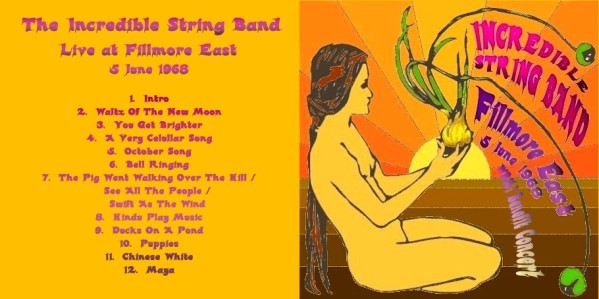
June 5, 1968 Fillmore East WBAI-fm Benefit with The Incredible String Band


(this post is part of a series analyzing every performance at the Fillmore East. Above is a scan of a bootleg recording from the WBAI broadcast, from the Incredible String Band concert history site)

June 5, 1968 WBAI-fm Benefit with the Incredible String Band

Bill Graham was alert to the promotional value of being a good citizen of his community, so he lent out the Fillmore East on weeknights for appropriate causes. WBAI-fm (99.5) was part of the Pacifica Radio Network (which includes KPFA-fm in Berkeley), and as a result it depended on listener support rather than advertisements. The station held a fundraising benefit at the Fillmore East on Wednesday, June 5. There were probably other performers, probably including some music, but the Incredible String Band were the headliners. More importantly for historians, WBAI taped the performance and broadcast it on March 23, 1969.

The Incredible String Band were a talented folk duo from Scotland.  Mike Heron and Robin Williamson wrote nice songs and played numerous instruments, including various middle eastern instruments not typical at the time.  In March 1968 Elektra had released their classic 3rd album The Hangman’s Beautiful Daughter, and this was their first trip to America. What had initially been an acoustic folk group (originally a trio with the now-departed Clive Palmer) had become a sophisticated melange of English folk music and instruments from around the world. While the ISB was not to everyone's taste, they were surely one of a kind.

The Incredible String Band was managed by a legendary producer named Joe Boyd. Boyd was from Princeton, NJ but by this time lived in London. Boyd was an incredibly important behind the scenes figure in 1960s music on both sides of the Atlantic, but his story is too detailed to explain here. Suffice to say that Boyd's eloquent and hilarious biography White Bicycles (Serpent's Tail, 2006) is a must read for anyone interested in 60s music. Boyd was well aware that the Incredible String Band were unique, and made sure that they were presented in settings appropriate for their unique sound, as they were not going to succeed by boogieing away in some Municipal Auditorium, second on the bill to Vanilla Fudge.

At this time the Incredible String Band featured Mike Heron and Robin Williamson as co-leaders, co-lead singers and writers of all the songs (though not partners). Their girlfriends, Rose Simpson (bass) and Licorice McKechnie (various instruments and vocals) respectively, supported the band in concert. This show was near the end of the Incredible String Band's first American tour, which had begun a month earlier in the gym at SUNY Stony Brook, opening for The Grateful Dead (on May 4, 1968).

The Incredible String Band were a unique group who were also uniquely promoted in America. They regularly played The Fillmore East on their own nights. I have seen uncertain indications that they played Fillmore East on Sunday May 12, 1968. I cannot confirm this, but it would fit in with their history.

Next: June 7-8, 1968: Electric Flag/Quicksilver Messenger Service/Steppenwolf

Saturday, November 14, 2009

Fillmore East May 31-June 1, 1968: Moby Grape/The Fugs/Gary Burton

(this post is part of a series analyzing every performance at the Fillmore East)

May 31-June 1, 1968 Moby Grape/The Fugs/Gary Burton

Moby Grape had been hyped as the best band to come out of San Francisco.  That may have been true, as it happened, but the hype did them in.  Moby Grape was made up of 5 experienced musicians, all good singers, performers and writers, and handsome to boot. Their second album Wow! had been released just before this show (Columbia Apr 68). It was a good album, but not as good as their epic first album, and the underground suspicion of anything popular undermined them. They were beset with management problems and other frustrations, and their best songwriter and resident genius Skip Spence started to have serious drug and emotional problems at this time, so the net effect was very difficult for the band. By all accounts, what should have been a triumphant appearance at the Fillmore East was rendered somewhat ragged because Peter Lewis, angry at the band for various reasons, skipped out on the tour and went home early.

Sadly, these Fillmore East shows were Spence's last stand with the Grape for some decades, as shortly after these shows, Skip Spence had an episode where he lost touch with reality, went AWOL for a few days and tended up in the Psych Ward at Bellevue Hospital. In any case, after the Fillmore East Moby Grape were effectively reduced to a four-piece band, albeit a very talented one (guitarists Jerry Miller and Peter Lewis, bassist Bob Mosley and drummer Don Stevenson). Although they still had plenty to offer, they now had to live down their previous success rather than just be themselves. Moby Grape were a great band, and their debut album is a 60s classic, but their entire history is a frustrating tale of what might have been.

The Fugs were often considered as a Greenwich Village version of The Mothers of Invention, although a more accurate comparison might have been Berkeley’s Country Joe and The Fish.  The Fugs were not particularly memorable musically, but they were provocative and exciting. They had been around for some time, and in fact had played the first Bill Graham Mime Troupe Benefit on November 6, 1965. In complete contrast to Zappa, they were very political, but only barely musical, singing songs like “Kill For Peace” and “Coca-Cola Douche.”  People who left the Fugs wrote books (singer Ed Sanders wrote Helter Skelter, about the Manson family), whereas people who left the Mothers joined the Symphony or played jazz  (except Motorhead Sherwood, who got a job in an auto body shop).

At the time of these shows the Fugs would have been supporting their album Tenderness Junction (Reprise, Jan 68). The Fugs released a live album recorded at this show called Golden Filth (Reprise, 1970). At the Fillmore East, The Fugs were supported on stage by various backing musicians.

Gary Burton was a jazz vibraphonist, raised in Nashville and like many young jazz musicians in New York at the time, he liked everything, not just jazz. The original lineup of the groundbreaking Gary Burton Quartet, featuring guitarist Larry Coryell had opened for Cream at San Francisco's Fillmore, among many other rock gigs, and they had released some sensational albums that still sound great today (including Duster and Lofty Fake Anagram on RCA in 1967). The lineup with Coryell (and bassist Steve Swallow and drummer Bob Moses) also recorded two albums in 1967 that were released in 1968, although I am not sure exactly when: Live At Carnegie Hall and Carla Bley's Genuine Tong Funeral. However, by the time of the Fillmore East shows, Coryell had left the group, replaced by the less well-known but still tremendous guitarist Jerry Hahn, formerly with John Handy amongst various others.

June 2, 1968: Bill Cosby/Janis Ian/Frankie Dunlap & Maletta/Jazz Pantomime 
"Salute to Dick Gregory"

Although a Bill Graham produced show, this was a non-rock event. Dick Gregory, a well-known comedian and activist, was running for President on the Peace And Freedom Party ticket that opposed the Vietnam War. While this is an interesting 60s story, it is outside the scope of this blog. At this time, besides being a popular stand up comedian with best selling albums, Bill Cosby had just finished his run starring on the popular NBC series I Spy.

Next: June 5, 1968: Incredible String Band WBAI Benefit

Wednesday, November 11, 2009

Fillmore East May 24, 1968 Ravi Shankar/May 25, 1968 Country Joe and The Fish/Blue Cheer/Pigmeat Markham

(This post is part of a series cataloging every performance at The Fillmore East)

May 24, 1968 Ravi Shankar

Famed Indian classical musician Ravi Shankar appeared for a single show at the Fillmore East on Friday, May 24. Normally there was an early and late show at the Fillmore East, but Shankar's performances were typically very long, so a single performance was more appropriate.

Ravi Shankar (born in 1920) had spent time in Europe as a young man, so he was well-equipped to be the ambassador to the world for Indian music. Already renowned as a great Indian musician in the 1950s, he began to play in the United States and Europe in 1956. Shankar befriended record producer Dick Bock, owner of the Pacific Jazz label, and Bock created World Pacific Records to record Shankar. Shankar's tours and World Pacific albums helped spread interest in Indian music. The Byrds (associated with Bock) recorded in the same studio as Shankar, and the Byrds told George Harrison about Shankar. Once Shankar was associated with the Beatles, his star rose immediately. In Shankar's case, however, he was personally prepared and musically worthy of the attention drawn to him by the Beatles.

Although Ravi Shankar continued to play the Indian classical music that he always played, he had become an attraction on the rock circuit. Shankar had played Monterey Pop in June 1967, so he was comfortable with rock audiences. At the time, although Ravi Shankar was the only Indian musician that most Americans had ever heard of, he had a lot of underground credibility for a man nearing 50 years old.

May 25, 1968 Country Joe and The Fish/Blue Cheer/Pigmeat Markham

There was only a single show for the Saturday night performance, as well. I don't quite know why, since the bands were used to playing double shows.

Country Joe and The Fish were seen nationally as a San Francisco band, but really they were a Berkeley band, where overt political sentiments were not just acceptable but expected. The group's first album, Electric Music For The Mind And Body, had been released in April 1967 on Vanguard Records and had been very successful. San Francisco bands were developing a reputation for releasing albums that were inferior to their live performances, but Country Joe and The Fish made one of the earliest and best psychedelic albums.

The band had been founded in Berkeley as a folk duo by Joe McDonald and Barry Melton. "Country Joe" was a reference to Josef Stalin, and "The Fish" was a reference to Mao, obscure references that would have been relevant in Berkeley at the time. Upon seeing the Butterfield Blues Band at the Fillmore in 1966, Joe and Barry decided to "go electric" and put a band together. Nonetheless, it was a sensitive issue amongst band members that "The Fish" were not Joe McDonald's backing band, even if it may have seemed that way at times. After some changes, the 'classic' Country Joe and The Fish lineup which recorded the first two albums and played this night at the Fillmore East was Joe McDonald (vocals, guitar), Barry Melton (lead guitar, vocals), David Cohen (organ, guitar), Bruce Barthol (bass, vocals) and Chicken Hirsh (drums). Country Joe and The Fish were as dramatic and feedback-laden as any of the San Francisco bands, but they were veteran performers who put on an exciting and well-paced show as well, and they always went down extremely well in concert.

By the time of this show, the group had just released their second album, Feel-Like-I'm-Fixin-To-Die (Vanguard, March 68). The title track, Joe's famous "Feel Like I'm Fixin To Die Rag" (with its chorus "1, 2, 3 what are we fighting for?") had in fact been the first song Joe and Barry recorded, releasing it independently in 1965. The song had been re-recorded for the first album, but rejected by Vanguard for being "too political." By 1968, the overt politics of the band were seen as an asset. The album began with the title track, preceded by "The Fish Cheer," in which Joe asked the listener to "Give me an 'F'", and an answering (studio) crowd responded, and then an I, an S and an H, and when Joe asked "what's that spell?" they all responded "FISH." Today few realize that Joe's infamous cheer in the Woodstock movie was originally based on the band's name. The song is a true folk song, sung whenever America engages in unnecessary foreign wars (Joe wrote some new verses in the 1980s, about Iraq and Afghanistan, and they are sadly still serviceable today).

Blue Cheer returned, just a month after playing with Traffic, still touring behind their Phillips album Vincebus Eruptum and the surprise hit single "Summertime Blues."

Pigmeat Markham was a veteran African American comedian, currently popular on the NBC-TV comedy show Laugh-In for a repetitive bit around the catchphrase "Here Comes The Judge."

Next: May 31-June 1, 1968: Moby Grape/The Fugs/Gary Burton Quartet

Sunday, November 1, 2009

February 1, 1966 Fillmore Auditorium Grateful Dead/Great Society/Loading Zone (audition-revised: was Jan 4)

My initial version of this post posited that the Grateful Dead Fillmore audition was on Tuesday, January 4, 1966. However, thanks to an eloquent argument in the comments from Ross, I have changed my view and believe the audition to have been on Tuesday February 1. I have  revised the post considerably as a result.

 In the 1960s, recording studio time was hard to come by,  and portable tape recorders were too lo-fi to effectively record amplified music. As a result, newly formed bands, or bands that were new to an area, had little choice but to audition for club owners. This ritual has been fairly unknown for some decades, as once quality cassette decks became available, even an unsophisticated band could make a tape of their rehearsal so that a club owner could at least know their basic sound. Bands from the 1960s, however, are rife with tales of dragging their equipment down to an empty club on an afternoon or an off night, playing for free so the club owner (or booking agent) could hear what they sounded like.

Bill Graham's Fillmore West and Fillmore East made a business of this, and almost every Tuesday night from late 1968 onwards was devoted to local bands, some newly formed or newly arrived in the area. This slice of Fillmore history is largely forgotten, although I have attempted to accumulate what little is known about those shows. Both Fillmores East and West were substantial venues, so the Tuesday night gigs were also low-key nights with actual audiences, if less of of the electricity of a weekend show. However, an Italian correspondent has recently reminded me of a little remembered reference to a much earlier Fillmore audition.

Soon after Jerry Garcia died, author Robert Greenfield put together an "Oral History" of Jerry Garcia's life (Dark Star, William Morrow Books, 1996). Greenfield threaded together numerous interviews with various people who knew Garcia and The Dead into a portrait of the guitarist and his times. The book was intended as more impressionistic than encyclopedic, as Blair Jackson's later work Garcia: An American Life (Penguin Books, 1999) provided the definitive history of Garcia and his place in American music. Ironically, as a result of Jackson's excellent work, less attention is now paid to Greenfield, and as a result I forgot one of the most interesting references.

Greenfield quotes past and future Garcia bandmate David Nelson about the transition of The Warlocks in 1965 into the Grateful Dead in 1966
I went up to their Tuesday night audition at the Fillmore. The other bands that were auditioning that same night were The Great Society and The Loading Zone. I remember I took acid that night, too. I walked in real early and nobody was even there. Bill Graham used to put a barrel of apples out. I saw the apples. I thought "Hmm. Probably for somebody private or something." I said "I'm hungry. I'll steal one anyway." So I took an apple and was just biting into it when Bill Graham walked in. I didn't know who he was. I thought "I hope he's just a janitor." I just started cooling it and then he walked by and I looked at him and nodded. He looked and nodded and then he did one of those Bill things. He stopped, did a slow double take and said "Who are you? Who are you with?" I said "Warlocks." I knew this would make him know I really was with them. Because this was the first night they were auditioning as The Grateful Dead (p.68-69).
I am not aware of any discussion of this Fillmore audition elsewhere. David Nelson is renowned as a man with an exceptional memory, so acid or no there is good reason to accept most of this story at face value. Of course, I have had to speculate on the date, and assuming that it was a Tuesday night, and considering the information provided by Ross in the comments (at Lost Live Dead), I think that February 1, 1966 is the most likely date.

Bill Graham first discovered the Fillmore Auditorium for the second Mime Troupe Benefit, which took place on December 10, 1965. The Jefferson Airplane and The Warlocks played the show, among others. Apparently Bill Kreutzmann, effectively the Warlocks manager, called The Mime Troupe and managed to get the Warlocks on the bill. The third and final Mime Troupe Benefit was at the Fillmore on January 14, 1966, featuring the Great Society, The Mystery Trend, The Grateful Dead and The Gentleman's Band. Once Graham discovered that the lease on the Fillmore was available starting February 1, he made a substantial effort to provide assurances that he was equipped to manage the building. Graham began his run of Fillmore productions on February 4-5-6 with Jefferson Airplane, Mystery Trend and Quicksilver.

Although Graham had been the business manager of The Mime Troupe, and had entertainment experience, he did not know the local bands on the scene. It makes sense he would hold an audition for potential performers, and Tuesday February 1 was the first day the venue would have been available to him. The Warlocks had played the first Fillmore Mime Troupe Benefit (December 10), and the Grateful Dead the second (January 14). However, Jerry Garcia has an oft-told story of having first met Bill Graham when Bill was trying to fix Jerry's guitar at The Trips Festival on January 22. This means that Graham and the Dead had had relatively little contact even though the band had played for him twice. Graham was hardly a rock fan at this point (he liked Latin Jazz), and by all evidence the Grateful Dead were a strange, ragged band in person, both musically and in the flesh.

The Great Society missed The Trips Festival because they had a poorly attended gig at The Gate Theater in Sausalito (poorly attended because the potential audience was at The Trips Festival). Nonetheless they appeared to have succeeded at their audition, since they played the second Fillmore weekend on February 12. Even the Great Society subsequently admitted they were not a very good band at the point, so one has to think that Grace Slick's natural star power went a long way in convincing Graham they were worth booking.

It is more problematic to judge the results of The Dead's audition. The Dead were probably in San Francisco because they had played the Matrix over the weekend (January 28-29), and joined in on an Acid Test early Sunday morning. However, other than David Nelson's quote 30 years after the fact, neither Bill Graham nor Jerry Garcia has ever mentioned this, despite numerous interviews over the years (nor has Lesh, Weir or anyone else). Given the tendency of both Graham and the Dead to recite stories from their storied past over and over (often in response to the same questions over and over), it seems surprising that this event was simply forgotten. I cannot help but think it was because the Dead did poorly at the audition, and given the subsequent comfortable history of Graham and the Dead, everybody involved just preferred to forget about it.

Soon after the Fillmore auditions, The Dead  moved South to Los Angeles with Owsley. Nonetheless, while Owsley was their patron, if Graham had offered the Dead some bookings in early February they very likely would have stayed in town, at least briefly. Thus it is hard not to conclude that Graham either did not offer the Dead a booking, or at least did not offer them a well paying enough one to stick around. The Grateful Dead did not in fact play the Fillmore again until June 3. Given that the band crawled back to San Francisco in April, dead broke and happy to be home, Graham must have been in no hurry to hire them, a fact presumably everyone involved prefers to forget.

The Loading Zone also appear to have not succeeded at the audition, and did not play the Fillmore until they opened for a Grateful Dead show on October 21, 1966. The Zone played with the Dead many times in 1966, not least at The Trips Festival, but this audition shows the connection went back farther than I realized. While Loading Zone did not play the Mime Troupe Benefit, they did play the smaller if similarly legendary Open Theater Benefit in Berkeley on the same night.

Although its known that The Warlocks auditioned various times, I know of no other instance where The Grateful Dead had to audition. Thanks to Ken Kesey, Owsley and fate, the band became legendary before most people had heard them, and they never lacked for an audience after this. Its appropriate that their only apparent audition was at Ground Zero for the San Francisco scene. The most remarkable aspect of the audition remains left to the imagination: the newly-christened Grateful Dead, playing in an unadorned Fillmore Auditorium, Grace Slick, David Nelson and a few others standing around, Bill Graham frowning in thought.

Cross posted on Lost Live Dead.

Tuesday, October 20, 2009

Fillmore East May 17-18, 1968 The Byrds/Tim Buckley/The Foundations

(this post is part of a series cataloging every performance at The Fillmore East)

May 17-18, 1968 The Byrds/Tim Buckley/The Foundations

The Byrds had been major rock stars since 1965. They had even played the venue in its previous incarnation, The Village Theater (on July 22, 1967, supported by The Seeds and Vanilla Fudge). By 1968, however, while still popular, The Byrds had been through numerous personal and musical changes, and were not as highly ranked in the firmament as before.

The Byrds current album at this time was Notorious Byrd Brothers (Columbia Jan 68), but the band had already moved on. The May 1968 lineup of The Byrds featured Roger McGuinn, Gram Parsons, Chris Hillman and Kevin Kelley, and banjoist Doug Dillard (Dillard was not actually a member of the group, just an additional musician). The Byrds had just finished recording Sweetheart of The Rodeo, although that album would not be released until August.  The country sounds of the Gram Parsons-era Byrds would have been completely unprecedented to a New York Fillmore East audience, as Gram Parsons was crucial in legitimizing the concept of country rock (although he himself did not like the term).  According to the June 1 Billboard review (quoted in Christopher Hjort's fine Byrds chronology So You Want To Be A Rock And Roll Star), however, the Byrds country material was quite well received by the audience.

The review in Billboard magazine was a crucial element of Fillmore East's importance. Billboard was the leading music industry trade journal, and in many ways the only source of information about bands on tour. One of the weekend performances in Fillmore East was always reviewed in each week's Billboard, so that meant that all three bands on the bill got National exposure. Managers, particularly of English bands, liked to start tours at the Fillmore East because a good review in Billboard could go a long way towards creating interest in their group amongst booking agents and promoters.

The Foundations are mainly known for their 1968 hit  “Build Me Up Buttercup.” Much to the surprise of everyone who recalls the song, they were actually an English group (with some West Indians and a Sri Lankan thrown in for good measure). The Foundations were one of the few English groups to have success playing in a soul style. They had plenty of live experience in England, and they were probably a pretty good live band. In Hjort's book, Foundations bassist Peter Macbeth recalled that their equipment was stolen and that the Byrds wouldn't let them borrow theirs. Equipment hassles were particularly critical at the Fillmore East, since bands rightly felt the pressure of needing to have a great performance there in order to have a successful tour.

Tim Buckley had played Fillmore East the first night it opened (March 8, 1968), and returned for another engagement.

May 20, 1968 Black Theater for The Black Panthers
Benefit for Eldridge Cleaver with LeRoi Jones, Marlon Brando and others.

Eldridge Cleaver was running for President on the Peace And Freedom Party ticket. Cleaver was also Minister Of Information for Oakland's Black Panthers. This event was held on a Monday night, and the poster lists various speakers and writers, but no musicians. The history of The Peace And Freedom Party (and for that matter The Black Panthers) is an interesting 60s story, but outside the scope of this blog. Suffice to say that Bill Graham was very alert to the virtues of allowing local benefits for various popular causes at his venues on off nights.

next: May 24, 1968: Ravi Shankar with Alla Rakha//May 25, 1968 Country Joe and The Fish/Pigmeat Markham

Friday, October 16, 2009

Fillmore East May 10, 1968 Jimi Hendrix Experience/Sly And The Family Stone

(this post is part of a series cataloging every performance at the Fillmore East)

The second weekend in May of 1968 had an atypical billing, as their were completely different shows on Friday May 10 and Saturday May 11.

May 10, 1968    Jimi Hendrix Experience/Sly and The Family Stone
The Friday night bill at Fillmore East was a rock bill for the ages, featuring one of the biggest rock acts in the world, supported by a group that would soon join Hendrix at the mountaintop. Jimi Hendrix Experience were big and getting bigger, but Bill Graham always excelled at persuading bands and their management that performing at his showcases in San Francisco and New York always paid more dividends than playing a larger place.

The current Experience album was Axis: Bold As Love (Reprise Feb 68). These shows featured the original Experience, with Noel Redding on bass and Mitch Mitchell on drums.One of Hendrix's shows featured a 17-minute performance of “Red House,” and the lucky patrons who caught either the early or late show never forgot it. 
  
San Francisco's Sly And The Family Stone were not just electrifying but groundbreaking. Vocalist/organist/guitarist Sly Stone (Sylvester Stewart) was from Vallejo, CA and Sly and The Family Stone (including brother Freddie Stone on guitar, sister Rose on vocals, cousin Larry Graham on bass, Cynthia Robinson on trumpet and ‘white guys’ Jerry Martini on sax and Gregg Errico on drums) wore way out hippie clothes, sang about peace and love and were absolutely the funkiest band around. Sly’s addition of rock elements to soul music was so influential that his approach is taken for granted today, but an inter-racial band adding rock guitar on top of James Brown licks, along with the thumb-popping bass of Larry Graham was unthinkable before Sly.  Biographer Joel Selvin correctly observed that in Black Music, there is 'before Sly' and 'after Sly.'

In Fall 1967, Sly And The Family Stone had an extensive, successful residency at a dance club at 19 St. Marks Place, between 2nd and 3rd Street (in Greenwich Village, not far from Fillmore East) called The Electric Circus, so they were somewhat known in hip New York. The band's current album was still their first, A Whole New Thing (Epic 1967). However, the song “Dance To The Music”, from their next lp, had already been released as a single and it was a hit on AM pop charts as well as soul radio.

Sly and The Family Stone were truly electrifying performers, and in Joel Selvin’s  biography of the reports that their set culminated with Sly, Freddie and Larry Graham dancing into the aisles and leading the crowd out into the street, while Gregg Errico and the horn section wailed away. They absolutely killed the house, and that was before Hendrix came in and shattered the place, and they did it all over at the late show. Truly a night to remember at Fillmore East.

The Jimi Hendrix Experience never played the Fillmore East again, although Band Of Gypsies did play there (in 1970). However, Hendrix hung out regularly at Fillmore East, when he could, and was a familiar figure backstage.

May 11, 1968 Autosalvage/Group Therapy/Joyfull Noise

In contrast to the Friday night show with two of rock's most legendary acts at the height of their powers, Saturday's show featured three acts on RCA Records that are largely forgotten.  Bills full of unknowns were common in the early days of the San Francisco Fillmore, but that was a very localized ‘scene’ and was driven by a different dynamic. Given the obscurity of these performers, I have to assume that RCA footed the bill for this booking.

Autosalvage was a jug band who had "gone electric".  Supposedly they were discovered by Frank Zappa in New York (presumably in 1967).  Autosalvage had a self-titled album (RCA 1968).  Their music was very eclectic, typical of a lot of jug bands at the time.  Members included bassist Skip Boone (brother of a member of The Lovin Spoonful) and guitarist Rick Turner, later to become famous as a guitar builder for Alembic instruments.

There were several sixties bands named Group Therapy, but this was likely the Northeastern variant featuring vocalist Ray Kennedy (who worked with the Beach Boys and Mike Bloomfield in the 1970s).  There music was of the heavy Vanilla Fudge variety, and not apparently memorable.  They would have been supporting their album People Get Ready For Group Therapy (RCA 1968).

Joyfull Noise was a soft-rock band from the Northeast, also on RCA, also supporting their self-titled first album. 

next: May 17-18, 1968: The Byrds/Tim Buckley/The Foundations

Thursday, October 15, 2009

Fillmore East May 3-4, 1968: Jefferson Airplane/Crazy World Of Arthur Brown

(this post is part of a series cataloging every performance at The Fillmore East)

The first appearance of the Jefferson Airplane at the Fillmore East featured the classic Airplane with Grace Slick and Marty Balin (along with Kaukonen/Kantner/Casady/Dryden), the flagship of San Francisco’s  Summer of Love.  The current album was After Bathing At Baxter’s (RCA Dec 67). “Somebody To Love” and “White Rabbit” had been big hits in the summer of 1967. Unlike almost every other band at Fillmore East, the Airplane did not use the Joshua Light Show, but their own light show (Glenn McKay’s Head Lights).  For the encore on Saturday night (presumbably the late show), Kostelanetz reports various drummers sat in for Spencer Dryden, the first being Mitch Mitchell (of the Jimi Hendrix Experience).

All four sets of the Airplane were casually recorded by Fillmore East soundman John Chester.  The officially released 2002 cd Jefferson Airplane Live At Fillmore East (BMG) is a sort of “best-of” the four nights.  The Airplane are ragged but exciting, with difficult arrangements and interesting songwriting mixed with erratic execution.

Crazy World of Arthur Brown’s big hit was “Fire.”  They had a notorious stage show in which Brown was hung up on a cross. “Fire” was not yet a hit, and neither the single or album of “Fire" had been released in the US. The single and album would go on to become huge hits. Various commentators report Brown entering the stage by being carried down the aisle by four men (in a coffin or throne, or some conveyance), wearing a mask that is on fire.  Organist Vincent Crane (later in Atomic Rooster) was the primary musician in the band, with drummer Drachen Theaker the only other member of the trio.

Next: May 10, 1968: Jimi Hendrix Experience/Sly and The Family Stone

Sunday, October 11, 2009

Fillmore East April 26-27, 1968: Traffic/Blue Cheer/Iron Butterfly

(this post is part of a series cataloging every performance at the Fillmore East)

This was Traffic’s first American tour, which began on March 14 in San Francisco at The Fillmore. The group was originally a quartet, with Steve Winwood, Jim Capaldi, Chris Wood and Dave Mason.  However, the mercurial Mason quit and rejoined the group regularly, and he had apparently left the group prior to their American tour, which had begun in March. Traffic’s current album was Mr Fantasy (UA Dec 67).

Traffic was one of the first groups to emphasize overdubbing as a means of creating different sounds on different songs.  Winwood, Mason and Wood played numerous instruments, and clever use of the studio meant that Traffic songs could be anything from frothy pop ballads with flute and sitar to heavy rock with twin lead guitars and organ. Live, however, Traffic’s sound was very different, as it depended on Winwood’s versatile organ playing (including the bass pedals), and they were more like a typical (if excellent) British R&B combo. For whatever reasons, Dave Mason reappeared in New York and joined the group onstage for at least one of the four performances. He would rejoin the group for the recording of their next album.

Blue Cheer were an SF power trio, backed by LSD king Owsley Stanley, and named after a brand of his acid. Owsley bought the band tons of equipment (supposedly Blue Cheer had 12 Marshall Stacks, 6 each for bass and guitar), and they were famously loud.  Unlike other peace-and-love SF bands, Blue Cheer had a noisy, nasty sound and demeanor.  Their quasi-hit, a remake of Eddie Cochran’s “Summertime Blues” is a precursor to Heavy Metal.  Their first album (Philips Mar 68) was called Vincebus Eruptum (the underground buzz at the time was that it was Latin for “Throw Up And Live“, although actually it meant nothing). Amazingly, their single got to number 14, and for many out in the hinterlands, it was a hint of something darker and wilder in the world.

Although Blue Cheer is fondly remembered for being ahead of their time as masters of sonic assault, even their fans concede that they weren’t particularly disciplined. This show would have been with the original trio, with Leigh Stephens on guitar, Dickie Petersen on bass and vocals, and Paul Whaley on drums.    

Iron Butterfly were originally from San Diego, and had relocated to Los Angeles in late 1966.  They were touring behind their first album Heavy (Atco Jan 68). However, the album had been recorded in late Summer 1967, and by the time Atco released the album, the band's lineup was somewhat different. Bassist Jerry Penrod had been replaced by Lee Dorman, and singer Darryl DeLoach had departed also, with vocals shared amongst the band. Erik Brann (sometimes spelled Braun) played guitar  along with Doug Ingle on organ and Ron Bushy on drums. According to an internet commentator, Iron Butterfly’s equipment had not yet arrived and they used Blue Cheer’s amps. At this point, the Butterfly were just another psychedelic group from California.

Next: May 3-4, 1968 Jefferson Airplane/Crazy World Of Arthur Brown

Monday, October 5, 2009

Fillmore East April 19-20, 1968: Mothers Of Invention/James Cotton Blues Band

(this post is part of a series cataloging every performance at the Fillmore East)

Although the iconoclastic Mothers of Invention are rightly remembered as an underground Los Angeles band, in fact they had spent the fall of 1967 based in New York City, with residencies in Greenwich Village at the Café Au Go Go and Garrick Theater.  Their revue at the Garrick was called Absolutely Free.  Out of town visitors from, say, Piscataway,  New Jersey were surprised not only to discover that show was not, in fact, free, but that the opening number consisted of surprisingly ugly men with beards, wearing dresses, doing a Supremes medley as a prelude to crazy avant-garde music. 

 The Mothers lineup for this show would have been FZ, Don Preston (organ), Ian Underwood (keyboards, reeds), Bunk Gardner (reeds), Motorhead Sherwood (baritone sax), Roy Estrada (bass, vocals), Jimmy Carl Black (Indian of the group, drums) and Artie Tripp (drums, percussion).  Ray Collins (sometime lead vocalist) had an ambiguous status and may or may not have appeared. Sandy Hurvitz (later known as Essra Mohawk) may have appeared as vocalist, as she often sang at New York appearances.

The Mothers were confusing to follow since Zappa’s complicated sonic productions had little to do with his stage band at any given time.  The current Mothers of Invention album would have been the immortal We're Only In It For The Money (Verve February 68). Albums such as Cruising With Ruben and The Jets and Uncle Meat had largely been recorded, but they would be released until later in the year.

Harmonica master James Cotton had replaced Little Walter in Muddy Water’s band in the late 1950s, and now led his own group, probably featuring Luther Tucker on guitar (Matt ‘Guitar’ Murphy, later in The Blues Brothers movie, subsequently replaced Tucker), Albert Gianquinto on piano (who later wrote some songs for Santana), and Francis Clay on drums.  Cotton was already a regular at the San Francisco Fillmore. His mixture of blues classics and bluesy version of R&B hits (like "Turn On Your Lovelight") always went over well.

Some live material recorded in Montreal in 1967, released many years later, gives a good idea of Cotton's sound at the time. To fans at the Fillmore East his current album was probably Cotton In Your Ears (Verve 1967). He did release a 1968 album on Verve, Pure Cotton, but I do not know the exact release date.

Next: April 26-27, 1968: Traffic/Blue Cheer/Iron Butterfly

Tuesday, September 29, 2009

Fillmore East April 12-13, 1968: Butterfield Blues Band/Charles Lloyd/Tom Rush

 (this post is part of a series cataloging every show at The Fillmore East)

April 12-13, 1968  Butterfield Blues Band/Charles Lloyd/Tom Rush

The Butterfield Blues Band had come out of Chicago in late 1965 as America’s premier white blues band.  They featured guitarists Mike Bloomfield and Elvin Bishop.  Bloomfield had moved to San Francisco and started the Electric Flag by this time, but Bishop was still in Butterfield’s group. The group had just released The Resurrection of Pigboy Crabshaw (Elektra Feb 68) heralding Bishop’s newly-prominent role. However, rather than the guitar-oriented Chicago style blues of the first two albums, Butterfield’s new sound was closer to soul, with a three-piece horn section.

Elvin Bishop would leave the Butterfield band within two months of this show, and he too would move to the Bay Area and start his own band. Mark Naftalin, the group's original keyboard player, was also still with the band, but he too would leave shortly after this and move to the Bay Area. The other members of the group were probably Bugsy Maugh on bass, Philip Wilson on drums and Gene Dinwiddie (tenor sax) and Keith Johnson (trumpet) on horns, possibly with Dave Sanborn (alto). Sanborn had toured with the group in late 1967 and early 1968, but I don't know how long he stayed.


The Butterfield Blues Band already had a lengthy and fruitful relationship with Bill Graham at the Fillmore, but it is worth noting that this is the third act managed by Albert Grossman that headlined the theater in  its first six weeks of operation. That being said, the original powerhouse Butterfield Blues Band, with Mike Bloomfield in his prime, had played some seminal shows at the original Fillmore, helping to make both the venue and the band, so they were a great choice to help establish the Fillmore East.

Charles Lloyd, a tenor sax player, was a regular at the SF Fillmore.  His group, playing undiluted modern jazz in the style of Miles Davis, may still have included Keith Jarrett, Ron McClure and Jack DeJohnette. Lloyd was the first jazz act to become a regular in the hippie ballrooms around the country, and while his jazz remain undiminished he found himself a whole new audience that served him well. He even recorded an album at The Fillmore, a fine record called Love-In, released in January 1967. His current album was In Europe (Atlantic 1968).

Tom Rush was a popular Cambridge, MA folkie.  He had signed to Elektra and started to make folk-rock albums  His 6th album, The Circle Game (Elektra 1968) featured two songs by Joni Mitchell as well as songs by then-unknowns Jackson Browne and James Taylor.  Although he is largely forgotten today, Rush was instrumental in bringing attention to these writers. Kostelanetz reports that the light show was halted for ‘serious’ folk performers like Tom Rush or Richie Havens.

next: April 19-20, Mothers of Invention/James Cotton Blues Band

Monday, September 28, 2009

Fillmore East April 4-5, 1968: The Who/Buddy Guy/Free Spirits

(this post is part of a series cataloging every performance at The Fillmore East)

The Fillmore East generally planned to have an early (8:00pm) and late (11:30pm) show for both Friday and Saturday night for each engagement. However, Martin Luther King had been assassinated on April 4th, and many New York nightspots were closed.  The Fillmore East remained open, but instead staged one long show each night.

The Who had been a hugely popular Mod group in England, but had never been particularly successful in America.  However, their performance at the Monterey Pop Festival and the SF Fillmore suggested that the Who were merely ahead of their time.  The Who had already headlined the SF Fillmore in June 67 and February 68. Their booking agent was Frank Barsalona of Premier Talent (about whom more later). The Who’s current album was The Who Sell Out (Decca Jan 68). The Who had played at the venue in its prior incarnation as the Village Theater (November 25-26, 1967), and had mentioned from the stage that at that time, prior to Graham’s refurbishment, the venue was a “pisshole.”

Both nights were recorded for a possible live album, and many rarely performed numbers were played. A professional recording of The Who’s April 6  show was widely bootlegged.  Most famously, it was on a TMOQ (Trademark of Quality) bootleg lp, usually called Fillmore East.  It features a driving 60-minute set that includes the complete “A Quick One While He’s Away” and a tough cover of “Fortune Teller.” Kostelanetz’s glowing review mentions how since many in the crowd had seen the Monterey Pop movie, they expected The Who to smash their equipment, but when they did it was still stunningly theatrical to watch.

Buddy Guy was the sensational Chicago blues guitarist, who had often toured with harmonica player Junior Wells.  Guy had been on Chess Records for years, but had recently changed record companies, as rock labels were trying to capitalize on the new popularity of bluesmen. Buddy Guy’s current album was A Man And The Blues (Vanguard Feb 68). For at least one of these shows, Buddy Guy came on after The Who, and it was apparently an anticlimax. In the earlier years, Fillmore East shows were less rigid about headliners appearing in the correct order.  Travel schedules and other factors often caused bands to be presented in a different order than the one they were billed. On the first night, B.B.King sat in with Buddy Guy for two numbers. B.B. was probably playing another club in the area (such as The Generation).

Free Spirits was an attempt by producer Bob Thiele to have jazz musicians play rock.  Their album Out of Sight Out of Mind (ABC 1967) was interesting, but they had no real songs. Guitarist Larry Coryell, who played on the album, had left the group by this time.

Next: April 12-13, 1968: Butterfield Blues Band/Charles Lloyd/Tom Rush

Sunday, September 27, 2009

Fillmore East March 29-30, 1968: Richie Havens/The Troggs/United States Of America

(this post is part of a series cataloging every performance at The Fillmore East)

Richie Havens was a popular East Village folkie, with a unique style of singing.  His free form covers of songs, accompanied by endless strumming, do not hold up particularly well today, but Havens was well-regarded at the time.  His current album was Something Else Again (Verve/Folkways Feb 68). According to Kostelanetz, Havens, who was managed by Albert Grossman, was heavily promoted during this period.  The Joshua Light Show limited its activity when he performed, possibly as a mark of Haven’s perceived seriousness as a performer.  Still, the Friday late show that Kostelanetz attended was only half-full.

The Troggs were an English band ahead of their time.  They had the original hit with "Wild Thing", among others.  The Troggs were a sort of British Invasion proto-AC/DC (good natured macho hard rockers) but they were too daring for AM and too uncool for FM.  Their album Love Is All Around (Fontana May 68) would come out somewhat later.

The United States of America had one album on CBS (Mar 68).  They featured the academically trained composer Joseph Byrd and lead singer Dorothy Moskowitz, and their music was self-consciously avant-garde.  Apparently their live performances were rare and poorly received, except by Richard Kostelanetz, who really liked them. Dorothy Moskowitz ended up playing with Country Joe McDonald in the early 1970s. In an interview in 2003, she said that Troggs fans were particularly unimpressed with the oblique compositions of the USA, and heckled the band. The USA broke up a few weeks after these dates. Dorothy Moskowitz led a different version of the group (without Byrd) through a few dates later in the Summer, but that lineup had folded by Labor Day.

next: April 5-6, 1968: The Who/Buddy Guy/Free Spirits

Saturday, September 26, 2009

Fillmore East March 22-23, 1968: The Doors/ARS Nova/Crome Syrcus

(this post is part of a series cataloging every performance at The Fillmore East)

Two weeks after a single show with Big Brother on Friday, March 8, to inaugurate the venue, the Fillmore East featured The Doors for two shows on both Friday and Saturday. This initiated an almost continuous run of weekend shows through June of 1971.

The Doors had already had a huge hit with "Light My Fire" (Summer 67) and their first two albums were big hits. Strange Days, The Doors second album had been released by Elektra in November 1967.  The Doors were one of the first bands who had to choose between ‘AM’ stardom (16 Magazine) and ‘FM’ stardom (Rolling Stone).  The Doors rapidly moved on to venues larger than the Fillmore East.  Kostelanetz reports that the late show on Saturday went on until 3:45 am.  He called the band “at the time, the greatest rock performers I have ever seen.”

Free-form ‘underground’ FM radio had started in San Francisco in spring 1967, and rapidly spread to every major city. Suddenly album cuts were being played in their entirety, and if a DJ liked a band he could make a band popular by himself.  Since there were very few underground rock stations, the individual stations themselves (such as WNEW in New York) were very influential.  Not only did the stations help determine who was popular, not playing a band on underground radio made them ‘uncool.’  Even universally popular bands like the Beatles and Stones did not typically have their AM singles played on FM, as that was ‘uncool.’

Ars Nova was a six-piece ‘baroque rock’ group, with a two-piece brass section.  They had an album on Elektra (1968). 

Crome Syrcus (often mis-billed as Chrome Syrcus, or Chrome Circus) was originally from Seattle, and they had one album on the obscure Command label (1968). They had been commissioned to write the music for a Joffrey Ballet show (“Astarte”) and received a lot of national press coverage as a result. They were in New York at the time, performing regularly with the ballet.  They apparently performed at the ballet, uptown, between the early and late Fillmore East shows.


next: March 29-30, 1968 Richie Havens/The Troggs/United States of America

Fillmore East March 8, 1968: Big Brother and The Holding Company/Tim Buckley/Albert King

(This post begins a series cataloging every performance at The Fillmore East)

The Fillmore East was an old Greenwich Village venue that was originally a Loew’s Commodore movie theater. By 1967 it was known as The Village Theatre, and had featured a number of rock shows.  It was located on 105 2nd Avenue at 6th Street in the East Village.  Bill Graham, with a very successful operation in San Francisco with the Fillmore Auditorium, was looking to go bi-coastal and renamed the 2500-seat Village Theatre the Fillmore East. Unlike the Fillmore or Fillmore West, the Fillmore East had theatre seats and a balcony. Whereas the West Coast Fillmore was more of an environmental ‘happening’, the Fillmore East was more of a theatrical event.  The spectacular sound system and house light show were used to maximum effect to bring out the best every band had to offer.

The Fillmore East bills generally played Friday and Saturday, with two shows each night at 8:00 and 11:30 pm, although most recollections do not indicate whether they attended an early or late show.  However, this very first Fillmore East show was only presented on a Friday night. The next show was not until two weeks later, after which the venue put on shows just about every weeekend, so I assume this first gig was a sort of "Technical Rehearsal" for the venue.

Big Brother and The Holding Company, featuring Janis Joplin, were stalwarts of the San Francisco scene. Their most recent album was the terrible first album on Mainstream (Aug 67), all recorded in 1966.  Cheap Thrills would not come out until late July 1968, so to some extent Big Brother were headliners as much on the basis of being underground legends as anything else. They had played New York as recently as the previous month (Anderson Theater, Feb 17, 1968). Big Brother’s manager was Albert Grossman, also the manager of Bob Dylan and others.  Grossman had helped finance the Fillmore East for Graham, so it is not surprising that one of his acts opened the venue.  

Tim Buckley was a unique jazz/rock singer/songwriter with a remarkable voice.  He was from LA, and he shared management with Frank Zappa. In 1968 he was supporting his well-regarded second album Goodbye And Hello (Elektra Sep 67). Tim Buckley died young in 1975, and he was the father of unique singer Jeff Buckley, who also died young. 

Albert King was the legendary left-handed blues guitarist, who had just recently debuted at San Francisco’s Fillmore (2.1.68). Many ‘Chitlin Circuit’ blues performers were given a new and more lucrative career by the Fillmores.  Albert King was an ancient 45 years at this time (for those who accept 1923 as his year of birth).  The reverence with which Eric Clapton, Jeff Beck and others held Albert, Freddie and BB King, along with Buddy Guy, Bobby Blue Bland and others, gave all those performers a hitherto undreamed of access to white audiences. His classic album Born Under A Bad Sign (Stax Feb 67) received extensive play on FM rock radio.

Albert King was a substantial influence on rock guitarists of this period.  To name just a few of many influenced by him, Cream did a cover of “Born Under A Bad Sign” and the legendary opening lick of Eric Clapton’s “Layla” is based on Albert King’s song “As The Years Go Passing By” (a tidbit acknowledged by Clapton).  King had also played with another famous left-handed guitarist, Jimi Hendrix, on the Chitlin circuit some years earlier, and had indeed shared the bill with Hendrix a few weeks earlier at the Fillmore and Winterland in San Francisco.

Next: March 22-23, 1968 The Doors/ARS Nova/Crome Syrcus