Showing posts with label Los Angeles. Show all posts

Friday, August 20, 2010

The Bank, 19840 South Hamilton Avenue, Torrance, CA: 1968 Performance List (Updated)

(A poster advertising Moby Grape, FairBeFall and Gravity at The Bank in Torrance, CA on the weekend of September 6-8, 1968. h/t Ross for the scan)

I inaugurated this blog with a post that collected what little information could be gleaned about a venue called The Bank in Torrance, just outside of Los Angeles. It was gratifying to find out that others were interested as well, and the growing Comment thread added considerably to our knowledge, but the venue largely remained a mystery. However, having finally spoken to one of the founding principals of The Bank, a general picture of the venue has emerged. Combined with the information that I have since learned, I am re-publishing my post.

I have done extensive research into rock concert dates in Southern California in the 1960s, but so far only my lists for the Whisky A-Go-Go list (attempting to document every show at the Whisky from 1966 to 1969), its sister club The Trip (1965-66) and its near neighbor The Kaleidoscope (1968) have seen the light of day. The profusion of entertainment options in Los Angeles creates the paradoxical result that many go unnoticed. As a result, some interesting 60s venues seem to have been all but forgotten, and research can be very difficult. I am posting my current research in its improved but still incomplete form in the hopes that others will have more to add. I am very interested in any information anyone might have regarding the backers of this venue, the history of the building, its general successes and problems, and of course any corrections, insights and additions to the show list.

The Bank, at 19840 South Hamilton Avenue in Torrance, California, about 20 miles Southwest of Los Angeles, is one of the least remembered and most obscure venues in Southern California. Although it was only open for about six months in the second half of 1968, numerous fine bands played there, mostly from San Francisco. The posters for the shows, pleasant but unimpressive, still circulate, which has been just about my only source for information about shows at The Bank. Kim's page on The Bank has a fairly complete package of posters and newspaper ads. A few listings in local newspapers (such as The Pasadena Star-News) confirmed some of the poster dates, but the Comment thread on the first post were my first eyewitness sources.

Background
Thomas Linn was one of the original principals of The Bank, and he spoke to me at length about the founding of the venue. Linn, known to friends as "Lunch," knew Jim Burrows (possibly spelled Jim Burroughs) from Laguna Beach (Update: thanks to a Commenter, we know that the partners were named Bill Acker and Mike Williams). Burrows's wife had inherited a six figure sum, and in early 1968 Burrows, Linn and two others decided to open a club that featured the sort of music they liked. Their model was the Fillmore and the Avalon in San Francisco. The original concept was that they would find a traditional bank building, with high ceilings and an ornate interior, and their slogan was going to be "deposit your money at The Bank." Linn recalled
Jim Burrows of Laguna Beach and I came up with the Idea of the Bank..his wife inherited a 1/4 mil which got it rolling ...we initially were looking for an old empty bank in the LA area we found a great old bank but its location was not great and it was too small for the groups we intended to have. A real Estate agent brought our attention to the Blue Law was going out of business...we could take over the lease...I didn't care much for the location...but Jim was the money man..and we were in a rush to put something together quick...so there it was... a fairly new red brick warehouse..ready to roll....
The partners decided that it was quicker to get the show on the road by taking over the Blue Law at 19840 South Hamilton Avenue in suburban Torrance than waiting for a suitable old bank to become available, so the concept of The Bank was simply applied to the warehouse in Torrance that had become the Blue Law.

Torrance, California is an industrial suburb of Los Angeles, about 20 miles South of LA. Torrance has some beachfront, but the nearby coastal towns of Redondo Beach and Palos Verdes are better known. Torrance extends several miles inland, and The Bank was on the inland edge of town, close to the intersection of the Harbor (I-110) and San Diego (I-405) Freeways. The building housing the Blue Law and then The Bank was visible from both freeways, and today it is not only visible from both freeways but also on Google Street View (19840 S. Hamilton Ave, Torrance, CA 90502). It appears to be a commercial establishment of some kind, but Linn recognizes the building, so it is largely intact.

The last show at The Blue Law as such seems to have been May 19, 1968 (see below). Linn recalls that they took over the venue shortly before Bobby Kennedy was murdered in Los Angeles (June 6, 1968), as he recalls working in the empty venue when they heard the news. Burrows brother-in-law had also joined the original founders, as his wife had also recently inherited a similar sum. Linn was an artist, and he and Burrows focused on the concept of the club. Although Linn has forgotten their names, the other partners besides Burrows and his brother-in-law included someone who built the sound system and someone who booked the bands. The partner who designed the sound system also built recording studios, so the house PA sounded great and impressed visiting musicians. Linn also recalls a tape deck being run at the mixing board, so perhaps there is a secret treasure trove of tapes somewhere as well.

Performance List
What follows is my list of known rock shows at The Blue Law and The Bank. The sources most dates are posters, except where indicated. I have included a few interesting notes about the chronology and history of some bands that played the venue, but I take for granted that anyone reading this post does not need a primer on the likes of Pink Floyd or Canned Heat. Some posters advertise additional theater or film attractions as part of the bills, but I have not mentioned them here, as they are outside my scope and I have even less of a context for them.

Although I have considerably improved my list, there is still much to learn. Anyone with additional information, corrections, insights or recovered memories (real or imagined) are encouraged to Comment or email me.

(A poster advertising Love, Canned Heat and The Hourglass at The Blue Law on December 15-17, 1967. H/t Kim)

THE BLUE LAW

I now know more about The Blue Law then I did before, but it isn't much. The Blue Law, at 19840 South Hamilton Avenue, was owned by a doctor. Lunch and others knew his daughter, who was a teenager at the time. Thanks to Marc, I know that the Blue Law debuted on December 15, 1967.

December 15-17, 1967 The Blue Law: Love/Canned Heat/The Hook
Marc found a Pete Johnson review of the debut show in the Los Angeles Times of December 18, 1967. Johnson describes the venue as a concrete block with terrible sound, but said the proprietors promised to improve it. Thomas Linn says the building was designed as a warehouse. It appears that the Blue Law was only open on weekends, like the Fillmore and the Avalon. Many clubs in Los Angeles, like The Cheetah and The Whisky, were open six or seven days a week, even if they didn't always present bands.

This gig is discussed at length in drummer Michael Stuart-Ware’s book about his time in the band Love (Behind The Scenes On The Pegasus Carousel, Helter Skelter Books, 2003). Ware’s description suggests the venue is somewhat small. Linn recalls that the space was about 250 x 400 ft. I have found no other published account of the venue, as either The Blue Law or The Bank. Ware recalls
The building was like a rec center, located in the heart of a typical suburban Los Angeles community. The stage had no private rear entrance or dressing rooms, and the groups that were scheduled to perform simply walked through the front door, past the people that had come to see them play, and right up the stage steps (p. 152).
He adds that “the place was jam-packed, but room capacity was only seven or eight hundred, tops.” The context suggests that Love did not play the venue the next night.

The Hook were a Los Angeles-area blues rock band.

December 22-24, 1967 The Blue Law: Country Joe and The Fish/The Sunshine/Inner Spirit
Inner Spirit was an early name for Spirit (Randy California’s band).

January 19-20, 1968 The Blue Law: Charlie Musselwhite and Harvey Mandel
Mandel and Musselwhite were among the many white Chicago blues musicians who had moved to San Francisco. In formal terms, Mandel was the lead guitarist in Musselwhite's band, as Musselwhite had an album on Vanguard, but Mandel was also a featured performer in his own right (h/t Kim for the scan).

I have been unable to find any other information about performances at the Blue Law until May, when it appears the club closed.

May 17-18-19, 1968 The Blue Law: Blue Law Survival Benefit
Strawberry Alarm Clock/Quicksilver Messenger Service/P, G & E/Sweetwater/Love Exchange/Hour Glass/Things To Come/Albert King/Spirit/Genesis/Touch/Mothers of Invention/H.P. Lovecraft/Triangle/East Side Kids/Copper Leaf/Fair Befall
The flyer suggests this is a benefit for the club itself. Since The Bank would open on the site later, its clear that the club is near the end of the line. The exact date for the demise of The Blue Law is  unknown to me, but apparently the doctor who owned it was losing money. However, the fact that some established bands were willing to play a benefit for the club suggests that The Blue Law was an established venue.

Obviously these groups were spread out over the entire weekend. The band Genesis was a local band (featuring former members of Sons of Adam), not the English group.

May 19, 1968 The Blue Law, Torrance, CA: Quicksilver Messenger Service/The Mothers of Invention/Iron Butterfly/LA Smog and Refinery
The flyer says “Rock For McCarthy” and advertises “2pm to 1am Sunday.” This sort of fits in with the above flyer, although not exactly. The flyer says “Blue Law Ballroom” (update: Zappa scholar extraordinaire Charles Ulrich points out both that the Mothers Of Invention were clearly at a rock festival in Hallandale, Florida this weekend. In any case, Frank Zappa would not have endorsed a candidate for President--voting, maybe, but not a candidate).

THE BANK
Thomas Linn recalls opening The Bank at the end of June or beginning of July. Kim has found a poster as early as July 19-20, 1968, but so far I have been unable to identify the inaugural performers. Linn said that The Bank was only open Fridays, Saturday and Sundays, so that makes the opening date likely to be June 28 or July 5.

The booking pattern at The Bank generally featured multiple acts on Friday and Saturday night, often including a substantial headliner, and Sunday shows (often in the afternoon) featuring local groups, and sometimes films as well. Usually the local groups headlining on Sunday also played Friday and Saturday as well. Linn recalls that at the beginning the "house band" was a group called Gravity. Linn recalls them playing in a heavy blues style that would later be popularized by the Allman Brothers.

July 19-20, 1968 The Bank: Charlie Musselwhite
Kim found this early poster. Musselwhite had played The Bank in its Blue Law incarnation. Linn recalls him being particularly impressed with the new sound system.

July 26-27, 1968 The Bank: Charlie Musselwhite/Smokestack Lightning/Genesis
Marc found an ad in the LA Free Press that called this weekend the "Grand Opening," although obviously the venue had quietly opened a few weeks before.

August 2-3, 1968 The Bank Barry Goldberg Reunion/Mint Tattoo/Turnquist Remedy
Kim has found a poster for this, but I can't read it. Hopefully someone will figure it out (update: Marc did, by looking in the LA Free Press--thanks).

August 9-11, 1968 The Bank: PG&E/Illinois Speed Press/Sons of Champlin/Freedom Highway
Artist Bob Wilson made the familiar run of posters that have given The Bank what little notoriety it has retained. The poster for this show (above) seems to be the first of his works. Wilson apparently received $50 per poster, and he and his girlfriend got to see all the shows for free. 

Linn explained that the partners considered San Francisco to be the center of the musical universe at the time, so they tried to book as many San Francisco bands as possible. The Sons Of Champlin and Freedom Highway were both associated with West-Pole Talent Agency  in San Francisco, who also booked Quicksilver Messenger Service, among many others. Numerous West-Pole groups were booked at The Bank during its brief tenure.

P, G & E was a Los Angeles blues rock band (formerly The Bluesberries), and Illinois Speed Press had recently been signed by Columbia and relocated from Chicago to LA. Guitarist Paul Cotton, later famous in Poco, was the main singer and writer for the ISP.

August 16-17, 1968 The Bank, Torrance, CA: The Fugs/Mt. Rushmore
August 18, 1968 The Bank, Torrance, CA: Gravity (afternoon show)
Mt. Rushmore (who had two albums on Dot Records) were another San Francisco group managed by West-Pole.

August 23-24, 1968 The Bank, Torrance, CA: Pink Floyd/Black Pearl
August 25, 1968 The Bank, Torrance, CA : Black Pearl (afternoon show)
At the time, Pink Floyd was an underground band who were not particularly well-known. Linn recalls them playing a fantastic show to just a few dozen people.

Black Pearl was an obscure San Francisco band, featuring former members of New England’s Barbarians.

August 30,31, 1968 The Bank, Torrance, CA: United States of America/Taj Mahal
September 1, 1968 The Bank, Torrance, CA Gravity/Mondo (afternoon)
The United States of America were a very forward looking band featuring experimental composer and UCLA ethnomusicologist Joseph Byrd and singer Dorothy Moskowitz. They released one obscure album that has grown in stature over the decades, and made one brief tour before they split up. By this time, founder Joseph Byrd had already left. This was probably one of their last shows. Linn remembers that Jim Burrows hated their performance, but he can't recall whether because they were too advanced or just no good.

At some point around the end of the Summer, Thomas Linn left The Bank. He was an original partner, but he hadn't taken any money, and for a variety of personal reasons he moved on. What information we have here on out comes from various Commenters and Kim's blog.

September 6-7, 1968 The Bank, Torrance, CA: Moby Grape/Fair BeFall
September 8, 1968 The Bank, Torrance, CA: Fair BeFall/Gravity (afternoon show)

September 13-14, 1968 The Bank, Torrance, CA: Lee Michaels/All Men Joy
September 15, 1968 The Bank, Torrance, CA: All Men Joy/Gravity
All Men Joy were a San Francisco band, and did not feature Duane and Gregg Allman. Lee Michaels was also based in the Bay Area at the time.

September 20, 1968 The Bank, Torrance, CA: Quicksilver Messenger Service/Sons of Champlin/Love Exchange
September 21, 1968 The Bank, Torrance, CA: Quicksilver Messenger Service/Sons of Champlin/Ace Of Cups
September 22, 1968 The Bank, Torrance, CA: jam
Quicksilver, The Sons of Champlin and the all-women band Ace Of Cups were all San Francisco West-Pole bands.

September 27-28, 1968 The Bank, Torrance, CA: John Mayall/Chicago Transit Authority/Mug-Wumps
September 29, 1968 The Bank, Torrance, CA: John Mayall/Maze/Flash Gordon (afternoon show)
John Mayall’s group at this time was a quartet featuring guitarist Mick Taylor.

The Chicago Transit Authority, like the Illinois Speed Press, had been signed by Columbia and relocated to Los Angeles. They had not yet released their first album.

October 4, 1968 The Bank, Torrance, CA: Country Joe and The Fish/A.B. Skhy Blues Band
The A.B. Skhy Blues Band, featuring the fine organist Howard Wales, had recently relocated from Milwaukee (where they were known as The New Blues) to San Francisco.

October 5, 1968 The Bank, Torrance, CA: The Hook/A.B. Skhy Blues Band
October 6, 1968 The Bank, Torrance, CA: Shakey Jake and The All Stars
The poster for the October 4/5/6 weekend says at the bottom “Next week-Canned Heat and Spirit, ” but a later ad in the LA Free Press does not have Canned Heat and Spirit, suggesting the bill was changed.

October 11-12, 1968 The Bank, Torrance, CA: Charlie Musselwhite/Shakey Jake and His All-Stars/Pollution
October 13, 1968 The Bank, Torrance, CA jam plus films
Harmonica player and singer Charlie Musselwhite, who had moved from Chicago to San Francisco in 1967, was yet another Bay Area band that played The Bank. Ron Polte, the head of West-Pole and Quicksilver’s manager, was a former Union organizer in Chicago, so he had many connections to all the Chicago>San Francisco transplants (Musselwhite, Mike Bloomfield, Nick Gravenites, Harvey Mandel, etc), even if he did not manage those artists.

October 18, 1968 The Bank, Torrance, CA: Grateful Dead/Cleveland Wrecking Company
Cleveland Wrecking Company were a well regarded San Francisco-area band. They were a 7-piece band (founded at College of San Mateo) that played jazz rock. They mainly played dances, but they also played a few Fillmore-type gigs as well. Although they played original material, they never recorded and apparently never had plans to do so.

October 19, 1968 The Bank, Torrance, CA: Big Mama Thornton/Cleveland Wrecking Company
October 20, 1968 The Bank, Torrance, CA Free Clinic Benefit (bands not named)

October 25-26, 1968 The Bank, Torrance, CA: Sweetwater/Black Pearl
October 27, 1968 The Bank, Torrance, CA films/jam/KPFK broadcasting live
I believe "KPFK broadcasting live" refers to a live remote dj, not live performances broadcast over the radio (sadly). 

November 1, 1968 The Bank, Torrance, CA: Three Dog Night/Alice Cooper
In a slight deviation from the norm at The Bank, there are two local headliners on Friday night, with a different lineup on Saturday and Sunday.

Three Dog Night had recorded their first album for ABC Records, and probably released their first single (“Nobody”), but their album had not yet come out. They were still playing local gigs around Southern California to establish themselves.

Alice Cooper—at the time, the name of the band, not lead singer Vince Furnier—had only changed their name from The Nazz in March 1968. By November, they were affiliated with Frank Zappa, but their debut album on Zappa’s Straight Records would not be released until the next year. Sheryl recalls that the Alice Cooper group lined up at the entrance to The Bank and shook hands with each arriving patron, as if they were on the receiving line at a wedding.

November 2-3, 1968 The Bank, Torrance, CA: Alice Cooper/Mint Tattoo/Pollution
Mint Tattoo were also a San Francisco-based group, although the principal members were actually from Sacramento. Guitarist/vocalist Bruce Stephens and bassist/organist Ralph Burns Kellogg went on to join Blue Cheer in 1969, and both recorded in a number of obscure but interesting settings over the next few decades. Kellogg (1946-2003) was a successful engineer and producer in Los Angeles in the 1980s under the name Ethan James, for groups like The Minutemen and Black Flag.

November 8-9, 1968 The Bank, Torrance, CA: Ten Years After/The Collectors/Floating Bridge
This bill was a unique instance at The Bank where none of the acts were California-based. Ten Years After were on the second of their 28 (count ‘em) American tours, the Collectors were from a suburb of Vancouver (Chilliwack, BC) and The Floating Bridge were a highly regarded band from Seattle.

November 15, 1968 The Bank, Torrance, CA: Canned Heat/Linn County/Flamin Groovies
Sheryl recalls Canned Heat playing the club at some point, and that it was the best attended show in the history of The Bank, so they definitely played some weekend.

Linn County were from Cedar Rapids, Iowa, but they too had relocated to San Francisco in 1968. They released three albums on Mercury. The Flamin’ Groovies were a San Francisco band as well, but their neo-British Invasion stylings were never popular in the Bay Area itself.

November 16, 1968 The Bank, Torrance, CA: Harvey Mandel/Linn County/Flamin Groovies
November 17, 1968 The Bank, Torrance, CA: jam (afternoon)
Harvey Mandel, an exceptional guitarist, was one of the white Chicagoans who played authentic blues, like Mike Blomfield and Paul Butterfield. He had relocated to San Francisco as well. Besides recording for Mercury, he would later work with Canned Heat and John Mayall. Mandel had played the venue was the Blue Law (January 19-20) when he was still working with Charlie Musselwhite, but I'm not sure if he was still part of Musselwhite's band when The Bank opened in July.

November 22, 1968 The Bank, Torrance, CA: Bo Diddley/Fur
November 23, 1968 The Bank, Torrance, CA: Bo Diddley/Notes From The Underground
Notes From The Underground were a Berkeley Folk-Rock group. They released an album on Vanguard.


November 24, 1968 The Bank, Torrance, CA: Deep Purple/Blues Image/Damn Truth (Sunday) Free Clinic Benefit 4-10pm
[update 20240211; newly-added. Thanks, internet! ]An afternoon show featuring the "Hush" era Deep Purple and the Blues Image from Tampa, FL. Blues Image would shortly move to Los Angeles. Damn Truth is unknown to me.

November 27, 1968 The Bank: Spirit
November 29, 30, 1968 The Bank, Torrance, CA: Spirit/Harvey Mandel/Blues Image
December 1, 1968 The Bank: uncertain
I can't quite read all the details on the poster.

December 6, 1968 The Bank, Torrance, CA: Love/Three Dog Night/Fair BeFall
December 7, 1968 The Bank, Torrance, CA: Love/Three Dog Night/Middle Earth
A handwritten Three Dog Night tour diary shows 3DN playing both nights (for $500 each night), varying a bit from the poster.

December 8, 1968 The Bank, Torrance, CA: The Turtles/’KPFK Live’
I don’t believe this indicates that The Turtles were broadcast live on KPFK (although it would be great if they had been, as the Turtles were reputedly a fine live band).

December 13-14, 1968 The Bank, Torrance, CA: Grateful Dead/Magic Sam/Turnquist Remedy
The bare outlines of the story of The Bank in Torrance end here. A clue to the club’s fate comes from the poster for the show. Half of it is taken up with an entreaty:
The Police can only close us
with YOUR fear.
Please help us, the Music,
and yourself.
Bring friends to The Bank.
Come clean, be safe be happy
This plea suggests that police pressure had led to enough drug busts that it affected attendance, a common fate of rock ballrooms in the 1960s. The poster advertises a movie on Sunday afternoon, December 15 (The Return of Flash Gordon), but I have to assume the venue closed after these shows. Thomas Linn, while admitting that he was out of touch with The Bank after the Summer, felt that they may have brought some of the pressure on themselves. The venue ran FM radio ads with their catchphrase "Come deposit your money at The Bank" and tried to make the voice-over sound as cool and stoned as possible.

On top of police pressure--always a problem at hip 60s venues--the rock market was exploding and smallish venues could hardly compete for good acts, even when they sold out, and The Bank was not generally well attended, so the The Bank seems to have closed after this Grateful Dead concert.

As a peculiar footnote to The Bank, unlike many Grateful Dead shows, there were no known tapers at the December Grateful Dead shows. Uniquely, however, there was a tapir (really). 

Thanks to Kim, Sheryl, and all the Commenters who helped out. Anyone with further information or recovered memories (real or imagined) is encouraged to Comment or contact me.

Sunday, April 25, 2010

6230 Sunset Boulevard, Hollywood, CA The Kaleidoscope 1968 Performance List

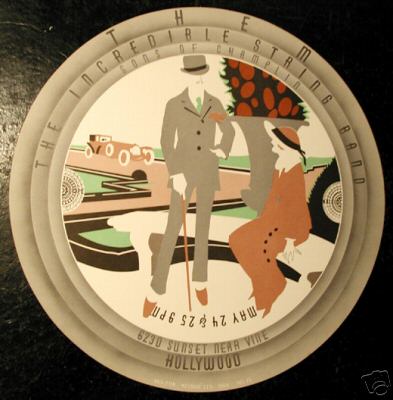
(The poster for the April 8-11 shows at the Kaleidoscope in Hollywood. h/t Ross for the scans)

The Kaleidoscope was a psychedelic rock venue run by the management of the band Canned Heat. It was only open for about 6 months in 1968. It had some memorable posters and some memorable bands, but it was one of many unsuccessful efforts to create a viable Fillmore type venue in Los Angeles.

The Venue
The well-known 1968 iteration of the Kaleidoscope was housed in a built in 1938 by one Earl Carroll, and named the Earl Carroll Theater. The theater, at 6230 Sunset Boulevard (at Argyle near Vine) in Hollywood, featured two concentrically rotating stages at the center of the venue.  Right on the Sunset Strip in Hollywood, its purpose was to display naked women: at the time, it was illegal to have naked women in motion, but not stationary women on a moving stage. By the 1950s,  the venue was a TV studio (Queen For A Day was filmed here), and by the early 1960s it had become The Moulin Rouge. By about 1965 it became The Hullabaloo (the TV show of the same name was broadcast from there). The Hullabaloo (also known as Dave Hull's Hullabaloo) was an industry showcase, so bands played every night.  Many of these bands played for free, and even headliners just got scale.  There was also an after hours set from 1-4:00 am, played by many aspiring bands (for some great photos of the incarnations of the Earl Carroll theater, see here).

Skip Taylor, the manager of Canned Heat, had been interested in running his own venue for some time. In early 1967, he attempted to book shows at a building on 1228 Vine Street, but they were stopped by an injunction and the project was put on hold. The circular poster became more famous than the abortive venue.

By Spring 1968, Canned Heat was a popular band with a successful single ("On The Road Again"), so Taylor was in a better position. Taylor, William Morris agent John Hartmann and Gary Essert took over the lease on former Hullabaloo (Taylor and Morris had been agents together at William Morris). It was presumably easier to take a venue that presented music and dancing already than to create a new one. Since Taylor and Hartmann were Canned Heat's manager and booking agent, respectively, the band played the venue often.

The unique design of the Earl Carroll Theater meant that The Kaleidoscope, as a rock venue, had  a unique stage set up that allowed acts to set up prior to performing, and then rotated into place. A new sound system brought the Kaleidoscope up to Fillmore standards. However, the venue only held about 1,000 people, and it was not able to become a profitable venture.  Kaleidoscope shows were advertised by posters, some of them quite interesting, but not every show appears to have featured a poster. Like many LA venues (and contrary to contemporary San Francisco ones), the Kaleidoscope was probably open many nights with only local bands, or other entertainment like films.

The Kaleidoscope 1967
April 14-16, 1967 The Kaleidoscope, Los Angeles  Jefferson Airplane/Grateful Dead/Canned Heat
This original weekend was supposed to be at a building on 1228 Vine Street (at La Mirada near Fountain), but a last second injunction stopped the show. For the weekend the show was moved to the Embassy Ballroom in the Ambassador Hotel, at 3400 Wilshire, which also housed the legendary Coconut Grove Ballroom. The Embassy Ballroom was jokingly referred to as "The Banana Grove." The hotel considered keeping the Ballroom open as a sort of psychedelic outpost, but chose not to.

For 1967, this was quite an inspired booking. Jefferson Airplane had just released Surrealistic Pillow and "Somebody To Love" was climbing the charts, while the Grateful Dead were underground legends who had just released their first album. Canned Heat were unknown to all but a few Los Angeles club goers, but they were an excellent live band.

April 21-23, 1967  The Kaleidoscope at Ciro’s, West Hollywood The Doors/Peanut Butter Conspiracy/UFO
The next weekend's show was moved to Ciro’s, a club at 8433 W. Sunset Boulevard (at Olive, near La Cienaga), in West Hollywood, just outside the Los Angeles City Limits.  I don't think it was a coincidence that the substitute venue was in unincorporated West Hollywood, outside of the Los Angeles city limits.

Ciro's had been a glamorous Hollywood nightspot in the 40s, but struggled to find a niche in the 60s. The Doors were a popular, rising band, but not as huge as they were about to become. Peanut Butter Conspiracy were also popular, although they were on the decline. UFO is unknown to me. There were other rock shows at Ciro's after this, although I don't know how many. Its possible that some of them were promoted by "The International Kaleidoscope," which was the name on the initial poster, but the Kaleidoscope name seems to have been mostly dormant until March 1968.

8433 W. Sunset Blvd is now the site of an equally legendary club, The Comedy Store.

The Kaleidoscope 1968
The Kaleidoscope opened (or re-opened) in Spring 1968 at the former Earl Carroll Theater, at 6230 Sunset Boulevard, in Hollywood proper (Hollywood agreed to be annexed by Los Angeles in 1910 in order to insure an adequate water supply). I have a feeling there were a few Kaleidoscope-promoted shows on the Sunset Strip between April 1967 and March 1968, however.


March 22-23, 1968  Jefferson Airplane/Canned Heat/Fever Tree
Once again, the Jefferson Airplane headlined the opening of The Kaleidoscope. Canned Heat was a much more substantial band, with a hit single and popular album. Buffalo Springfield were initially on the bill but canceled these two nights. Fever Tree replaced them, a band from Houston who would soon have a hit with “San Francisco Girls.”

According to a quote in Paul Grushkin's book The Art Of Rock, a live elephant was positioned near the stage during the Airplane's set.  Let's just say I'm glad this is not a practice that caught on.

March 24, 1968  Benefit for Radio Strike fund for KMPX and KPPC djs
Buffalo Springfield/Jefferson Airplane/Tiny Tim/H.P. Lovecraft/Steppenwolf/Sweetwater/Firesign Theatre/Clear Light/Quicksilver Messenger Service/Peanut Butter Conspiracy/Genesis
This was an afternoon show. The Kaleidoscope used the rotating stage to great effect, apparently managing set changes in 16 seconds.

Disc jockeys on KMPX-fm radio in San Francisco, the first underground rock station in America, had gone on strike. The staff on their sister station KPPC (Pasadena) had joined them. There were a couple of events in San Francisco as well.

The group Genesis was a Los Angeles group, not the English one (whose members were still in school).

March 24, 1968  Buffalo Springfield/Jefferson Airplane/Canned Heat
Evening show

March 28, 1968 Fever Tree

March 29, 1968  The Doors/ Peanut Butter Conspiracy/Bo Diddley/Clear Light
The poster does not include The Doors, but they appeared to have been added. They were so popular that they could have sold out the Kaleidoscope instantly. According to the very thorough Doors site, their appearance was still considered part of the "Grand Opening," and The Doors performance was filmed by an independent filmmaker.

March 30-31 Peanut Butter Conspiracy/Bo Diddley/Clear Light

April 5-7, 1968 Youngbloods/Spirit/Genesis

April 8-11, 1968 Canned Heat/Evergreen Blue Shoes/Travel Agency
This was a Monday to Thursday billing, a sign that the Kaleidoscope intended to be a full time nightclub. Canned Heat were more or less the "house band." Evergreen Blue Shoes and Travel Agency, while not well known, played around Hollywood and both ended up recording albums (the poster is up top).

I suspect the April 11 (Thursday) show was superseded by the KPPC benefit (below).

April 11, 1968 The Doors/Traffic/Canned Heat/Bo Diddley/Kaleidoscope/Holy Modal Rounders/others.  “Super Ball” Benefit for KPPC Strike Fund.
A similar event in San Francisco, for KMPX, also entitled "Super Ball" was held at Winterland on April 3. Traffic was on tour at this time. KMPX and KPPC had made Traffic very popular in California, so the band was very supportive.

Kaleidoscope was a unique band based in Claremont, with great musicians (David Lindley, Chester Crill, Solomon Feldthouse, Stuart Brotman, Paul Lagos) who invented World Music about twenty years before anyone was ready for it. The band had the name before the venue had opened--contrary to what you may read elsewhere, although Kaleidoscope played The Kaleidoscope regularly, they had no specific connection to the venue.


April 12-14, 1968   The Kaleidoscope, Hollywood HP Lovecraft/James Cotton Blues Band/Mint Tattoo
The poster says "First Anniversary." This is accurate (the first show had been April 14, 1967), but I can't help but think that if the Kaleidoscope had ceased altogether after April 1967 they would not be celebrating their Anniversary. This is one of the main reasons I think there were periodic "International Kaleidoscope" productions on Sunset Strip. I do know of a photo showing a Ciro's marquee featuring Canned Heat, The New Age (from San Francisco) and the West Coast Pop Art Experimental Band. The date can be triangulated to May 12-13, 1967, so I wouldn't be suprised to find out there was an ongoing Kaleidoscope connection.

April 16, 1968 A Memorial For Bobby Hutton
A Black Panther Defense Fund rally, featuring (per the newspaper ad), Bobby Seale and Dick Gregory.

April 19-21, 1968 Quicksilver Messenger Service/Kaleidoscope/Flamin Groovies

April 24, 1968 The Doors
The Doors were friendly with Canned Heat--I believe the William Morris agency booked the Doors concert tours, but I'm not certain--and as a result they seemed to have played the Kaleidoscope when they didn't actually have to. This was a Wednesday night between legs of tours, so the Doors were probably just having a fun show at home.

April 26-27, 1968 The Fugs

April 30, 1968 Jefferson Airplane/Canned Heat
I believe Jefferson Airplane shared a booking agent (presumably William Morris or an affiliate) with Canned Heat and The Doors, and that is why they shared so many bills. Touring musicians are generally quite friendly with each other, regardless of music (tales of the road, faulty gear and dodgy promoters transcend genres), but groups only played together regularly if there was some affiliation between management or booking agents.  This was a Tuesday night show, and neither Canned Heat nor the Airplane "needed" to play Kaleidoscope, much less sharing a bill.

May 3-4, 1968 Don Ellis Orchestra
This was part of a Friday-to Sunday 72-hour “Film Orgy” (per a Los Angeles Free Press ad), with 11 pm shows on Friday and Saturday night by Don Ellis.

The Don Ellis Orchestra was a brilliant and forward looking big band, playing weird time signatures with electric instruments and generally ahead of its time. Don Ellis, unlike other jazz musicians, wanted to break out of jazz confines but refused to do so by playing simplistic music. Although his music sounds a bit dated now (he is best known for his French Connection soundtrack), it is brilliant and memorable. Since Ellis's difficult charts (in times like 19/4 or 17/8) required A-list players, his Orchestra was mostly made up of first call session men like Tom Scott or Steve Bohannon. As a result, the group mostly stuck to California, as the band members were in the Ellis Orchestra for fun and made their living in the studio.

May 10-11, 1968 Eric Burdon And The Animals
I was stuck on this date, but Marc figured out that Eric Burdon and The Animals played. This was the new, psychedelic Animals, who were based in Southern California at the time.

May 17-18, 1968 Moby Grape/Hour Glass/Mt. Rushmore
Moby Grape had been in litigation with former manager Matthew Katz, so Katz had put together a band of Seattle musicians and booked them as Moby Grape, as a means of asserting his rights to the name (as well as making some money). Such practices were hardly unknown in the music industry, but the post-Beatles rock market made individual members of groups considerably more important than they had been. While most shows by the false Grape were in the hinterlands where people hadn't seen the original band, they did play a show at The Cheetah in Santa Monica (at 1 Navy Pier) on March 29, 1968. Thus the Kaleidoscope poster says ‘The Real’ Moby Grape, a reference to the March 29 Cheetah show.

Hour Glass was a Los Angeles based blues band featuring Duane and Gregg Allman. The Hour Glass had apparently played the venue quite regularly in its previous incarnation as The Hullabaloo (maybe in the 1:00-4:00 am slot), so they were familiar with it. Mt. Rushmore was a San Francisco band.

May 24-25, 1968 Them/Incredible String Band/Sons of Champlin
Van Morrison had left Them two years previous, but they were still an enjoyable live band. Incredible String Band were a unique Scottish folk duo on their first American tour. The Sons of Champlin, a San Francisco band who had not yet released their first album, were on their first trip to Southern California.

May 31-June 1, 1968 Iron Butterfly/Life/Things To Come

June 7-8, 1968  Kaleidoscope/Don Ellis Band/H.P. Lovecraft
H.P. Lovecraft were a Chicago band who would ultimately move to San Francisco.

June 14-15, 1968 Love/Rhinoceros/Taj Mahal
The show was reviewed by Pete Johnson of the Los Angeles Times. He describes a line around the block for Love. He says the band played well on simpler songs but had trouble with more complex material. Love rarely played live, and almost never outside of California, because Arthur Lee didn't like to fly, so its not surprising they were sloppy. Johnson also spoke well of Rhinoceros and Taj Mahal's performances.


Billboard (May 25, 1968) has Oakland's Loading Zone this weekend. However, our latest (as yet unposted) research shows that the Zone was on a National tour and played La Cave in Cleveland that weekend. Thus I am uncertain who actually played this weekend.

A contemporary ad in the LA Free Press (above--h/t Marc), probably from about June 18, lists the summer schedule for The Kaleidoscope:
  • Tuesdays: Rhinoceros
  • Wednesdays: Don Ellis Orchestra
  • Thursdays: Illinois Speed Press
  • Fridays and Saturdays: Dance Concerts
  • Sundays: Kaleidoflics
I'm not certain how closely this was adhered to. “Kaleidoflics” was essentially a 24-hour film festival of classic movies. I suspect that the plan was for the Kaleidoscope to be open six nights a week while school was out, essentially from mid-June until Labor Day.

Rhinoceros was a "supergroup" put together by Elektra, with sports-team like auditions. They were actually a pretty good band, although they had difficulty overcoming the hype.

The Illinois Speed Press were an excellent band from Chicago featuring guitarists Paul Cotton and Kal David, recently signed by Columbia and relocated to Los Angeles (just as were their pals, the Chicago Transit Authority). As a newly arrived band, it would make sense that a Thursday night residency would get them known around town. I don't know how many Thursday nights they actually played. The excellent ISP performance list shows some conflicts.

June 21-22, 1968  The Byrds/Crazy World Of Arthur Brown/Frumious Bandersnatch
The Byrds at this time featured their Sweetheart Of The Rodeo lineup. The album had been recorded but not yet released. The Byrds consisted of Roger McGuinn, Gram Parsons, Chris Hillman, Kevin Kelley and non-member Doug Dillard (on banjo).

Frumious Bandersnatch were from San Francisco.

June 25, 1968 Rhinoceros


June 28-29, 1968 Muddy Waters/Sons of Champlin or
June 28-29, 1968 Electric Flag/Smokestack Lightning/Illinois Speed Press
Sons road manager Charlie Kelly clearly recalls his first road trip, which was bracketed by two weekends at the Kaleidoscope. He recalls opening for Muddy Waters, then going to play a few shows in San Diego (at the Hippodrome), then returning for a long weekend with Canned Heat. The weekend of June 28-29 is only a guess. The poster (above) advertises something quite different (Electric Flag etc).

There are a couple of ways to resolve these scenarios. One is simply that the Kaleidoscope was open several nights a week anyway, and while Muddy Waters and the Sons didn't play June 28-29, but they did play around that time, such as July 2-3. This causes some problems with the Sons touring schedule, but I won't go into that here. A more likely scenario to me was that Electric Flag canceled. Mike Blomfield's last performance with the band was June 7, and though he was replaced by Hoshal Wright, the appeal of the Flag was dimmed without Bloomfield, and that lineup played few shows. I think Muddy Waters replaced Electric Flag, and the Sons were added to the booking (this wouldn't rule out either Smokestack Lightning or ISP or both playing as well).

July 2-3, 1968 Peanut Butter Conspiracy
This was a Tuesday and Wednesday. Peanut Butter Conspiracy's presence does not exclude the possibility of Kaleidoscope and/or Don Ellis playing on their respective nights, but it does suggest that the LA Free Press ad may have been more aspirational than accurate. It does indicate that for the Summer, at least, the Kaleidoscope was probably open six nights a week.

July 4-5, 1968 Canned Heat/Sly and The Family Stone
San Francisco's Sly And The Family Stone had been together for about 18 months.  After playing many club shows and releasing a mostly ignored first album, their January 1968 single "Dance To The Music" let the world know that psychedelic soul was on the march. Everyone who saw Sly And The Family Stone during this period was absolutely knocked out by them. 

July 6, 1968 The Doors/Spirit
Spirit, then a rising underground band in Los Angeles, were listed on the poster along with a variety of other (possibly whimsical) entertainments. The Doors headlined the Saturday night show. They had headlined the huge Hollywood Bowl the night before, so their presence at the relatively small Kaleidoscope could not have been advertised.

Marc reports that Chad Stuart (of Chad & Jeremy) played as well, as the contract was for sale on eBay.

July 9-11, 1968 Canned Heat/Sly and The Family Stone/Sons of Champlin
According to Sons road manager Charlie Kelly, Canned Heat played only one song (“Refried Boogie”) for all six sets throughout the entire second weekend.  They were recording a live album (ultimately released as Living The Blues).

July 12-13, 1968 Big Brother and The Holding Company/Rhinoceros
A photo exists of The Kaleidoscope, and this bill is visible on the marquee. It is the only photo I know of the Kaleidoscope incarnation of the building.

July 17, 1968 Don Ellis Orchestra
Billboard (July 13, 1968) says that Don Ellis will play Wednesdays at the Kaleidoscope for an “indefinite” engagement. This seems to confirm the LA Free Press ad. Of course, the peculiar nature of the Don Ellis Orchestra favored set residencies in Hollywood, unlike an ambitious band such as the Illinois Speed Press.


July 19-20, 1968 Love/Rhinoceros
This was probably the last performance by the original configuration of Love.

July 26-27, 1968  The Hook/Sweetwater/Fraternity Of Man
All three of these groups were local bands. I am missing performers for most of the next several weekends. The presence of these three good but not famous bands suggests that The Kaleidoscope was having trouble competing financially for headliners.

August 8, 1968 Canned Heat
Canned Heat kicked off a four-day around the clock film weekend festival, advertised in the Free Press. August 8 was a Thursday, so this seems to be another sign that the Kaleidoscope was having trouble booking headline acts.

August 16-17, 1968 Muddy Waters/Sons of Champlin/Genesis
The Sons of Champlin did not play this show. I do not know if this was because the Sons plans changed, or the show was canceled outright.

Around this time, according to the biography of Canned Heat drummer Fito de la Parra (Living The Blues, published 2000), the band showed up for a gig at The Kaleidoscope to find the theater taken over by well-dressed gentlemen who appeared to be members of the organized crime community, and different entertainment was being provided. It seems that managers Taylor and Hartmann had borrowed money to start the Kaleidoscope from these characters, and their failure to make payments lead them to take over the theater. Skip Taylor apparently told Parra "Don't ask; it's better for you if you don't know" (p.100). Parra ads "that was the end of the dream of duplicating Bill Graham's success with The Fillmore."

August 23-25, 1968 Moby Grape/Group Therapy/Genesis/McCoys
I have yet to confirm whether Moby Grape played these shows, but Marc Skobac confirmed that they were advertised in the LA Free Press, so I think they happened.The McCoys were from Indiana, and trying to live down their pop hit "Hang On Sloopy." They made a try at being a psychedelic blues band. Apparently they were pretty good live, but it was hard to live down their past history. The McCoys ended up becoming the "And" in Johnny Winter And.

August 30-31, 1968 Staple Singers/Genesis
Marc Skobac confirmed that this was the last Kaleidoscope show to be advertised in the Free Press, followed by a Sunday, September 1 showing of the movie Manchurian Candidate. The musical Hair started sometime in September. Its my belief that the creditors of the Kaleidoscope (whatever their affiliations) found a better paying tenant and called their note.

The former Kaleidoscope was re-invented yet again, this time as The Aquarius Theater. A touring production of Hair, the first rock musical, ran for several nights a week for an extended period, starting sometime in September of 1968. Sometime in late 1969 or 1970, a stage version of The Who's Tommy also ran for extended periods. The Aquarius was still used for occasional rock shows, when Hair wasn't playing, or between musicals.

Appendix: Final Notes

Canned Heat Live At The Kaleidoscope 1969
For a variety of reasons, manager Skip Taylor sold a live tape of Canned Heat at the Kaleidoscope, probably recorded in July 1968, to a record company in 1969 and claimed that it was recorded at The Topanga Corral in 1966. The subterfuge about the date was required because in 1966 Canned Heat was not under contract. Since the tape featured Canned Heat's unique take on blues covers, the premise was at least plausible. Subsequent reissues recognized that the album was recorded at the Kaleidoscope, but the date is often listed confusingly and mistakenly as 1969.

The Kaleidoscope, Main Street, Manayunk, PA
Just as their was a band and a venue called Kaleidoscope in Los Angeles that were created without reference to each other, there were at least two other psychedelic venues called The Kaleidoscope.The first psychedelic venue in Philadelphia was a converted movie theater in suburban Manayunk, and it was dubbed The Kaleidoscope. I don't know much about it. The venue opened in early 1967, or perhaps late 1966 (which puts it in the same time frame as a Philadelphia venue called The Trauma, but that's another subject entirely)with day-glo painted walls and black lights. The promoter was one David Carroll, and the venue apparently opened with Philadelphia's own underground stars, The Mandrake Memorial, supported by the Ultimate Spinach, from Massachusetts.  I do not believe this Kaleidoscope was open for long.


The Kaleidoscope, 519 W. Zane Street, Louisville, KY
Louisville, Kentucky was pretty far outside of the rock and roll touring mainstream in the 1960s, but there does appear to have been a psychedelic venue called The Kaleidoscope in Louisville. Based on some obscure but interesting posters, the venue at 519 W. Zane Street was at least open in the Summer of 1968, and Blue Cheer (June 13) and Iron Butterfly (July 30) played there. I know nothing else about the venue or the promoters.

Aquarius Theater Rock Performances 1969
March 28-29, 1969 Jethro Tull/Zephyr/Goose Creek Symphony

March 31, 1969 LA Free Clinic Benefit
Mothers of Invention/Chicago Transit Authority/Illinois Speed Press/Red Beans & Rice/Captain Beefheart/Linda Ronstadt/Jethro Tull/Buddy Miles Express/Southwind/Dillard & Clark

May 26, 1969 Incredible String Band

July 7, 1969 Love/Lonnie Mack
Marc discovered a July, 1969 Billboard article promoting a series of Monday night Showcase concerts sponsored by Elektra Records. Hair was still running, but the theater could be rented on Monday nights. While the theater was too small to turn a profit, by the same token its smaller size and Hollywood location made it a good venue for a high profile record company event. Probably a lot of the people attending these shows were guests of Elektra Records.

This night featured a new lineup of Love, who still had a solid Southern California fan base. Lonnie Mack, although newly signed to Elektra, also had a well deserved reputation as a guitarist.

July 14, 1969 Dillard & Clark/Flying Burrito Brothers/Bread
The Flying Burrito Brothers were actually on A&M, while Dillard & Clark and the newly-formed Bread were on Elektra.

July 21-22, 1969 The Doors
The Doors were the biggest group on Elektra, and one of the biggest bands in the country. They had just resurfaced after Jim Morrison's "indecency" bust in Miami, and their album Soft Parade had just been released four days earlier. The Doors played two shows at the Aquarius on Monday, July 21. They also performed without an audience on Tuesday, July 22, in a kind of "rehearsal" show.  Some of the performances from both nights were issued on various live releases, and both Monday shows plus the rehearsal were ultimately issued in 2001.

I assume most, if not all, of the tickets for July 21 were distributed by Elektra to important people in the industry or friends of the band. The Doors had made their mark at the Whisky A Go Go, just down the road, so a return to Hollywood would have been a big deal indeed. The Doors immediately set out on a tour of major concerts, including the Cow Palace and two major Rock Festivals (Eugene and Seattle).

September 8, 1969 Incredible String Band

Thursday, September 17, 2009

The Trip, West Hollywood, CA 1965-1966


The Trip in West Hollywood opened up in April September 1965 at 8572 West Sunset Boulevard (at Londonderry Place). It was on the site of The Crescendo, a jazz club that had closed because its owner (Gene Norman) wanted to focus on record production [update: between The Crescendo and The Trip, it was called The Tiger Tail--see below]. The Trip was owned by Elmer Valentine and his partners, who also owned the nearby Whisky A Go Go (8901 Sunset at Clark). The Whisky had opened on January 11, 1964, and instantly became a sensation. Los Angeles was ready for rock music, and the chance innovation of having mini-skirted dancers elevated over the floor immediately created the “Go-Go” sensation. The Whisky A-Go-Go was Celebrity Central overnight, and Johnny Rivers, who played The Whisky much of 1964, was an immediate star.

Valentine and his partners, however, seemed to recognize that there was more than one rock audience, and took immediate steps to expand their empire. In April of 1965, they opened up a “branch” of The Whisky A-Go-Go in San Francisco, and they also opened up The Trip. The SF Whisky was modeled on the Hollywood Whisky, but was largely a failure. The Trip was a much more intriguing venture, and while it too lasted only 13 months under Valentine’s management (and briefly afterwards), it had an important effect on the Whisky and thus Los Angeles rock history.

The Whisky A-Go-Go aimed at a rock audience in its mid to late 20s, which is why people like Steve McQueen and Jayne Mansfield were regulars. Johnny Rivers played a very danceable mixture of rock and R&B, and had a big hit with a version of Chuck Berry’s “Memphis.” There was a younger audience, however, who found The Whisky a bit too adult, and that was the target audience of The Trip. Since The Trip served drinks, only those over 21 could get in, but it was a shrewd call nonetheless.

Thanks to a friend’s kindness, I was given access to research into ads for The Trip in the weekly Los Angeles Free Press in 1965-66. Although The Trip was opened in April, Freep ads did not appear for The Trip until the Fall of 1965, and even then they did not always advertise. While their may be a variety of reasons for the failure to advertise certain weeks, it is my current hypothesis that The Trip only advertised shows in the Free Press when they had headliners.

The Trip, like the Whisky, was open 7 nights a week, and its basic business model was to encourage people to come in the club to dance or watch others dance, and thus get thirsty and buy drinks. The Whisky generally featured Johnny Rivers for most of 1964, and well into 1965.  The Whisky also featured local bands who played several sets a night, but they were the sort of bands who would not have had a real following, much less a record, so advertising them as a coming attraction wasn’t worthwhile. Its my supposition that The Trip followed the Whisky model initially, booking local bands without a following, but switched over to promoting more high profile bands who either had records on the radio or at least some sort of fan base. In 1965, this was distinctly different than the Whisky, but by early 1966 The Whisky had moved over to The Trip’s approach of booking popular bands with records, rather than simply having local rock and roll combos.

What follows is a list of bands that were advertised at The Trip in the Los Angeles Free Press. Keep in mind that The Trip was open every night, and probably almost every night at least one (and possibly more) bands played who were not advertised. These would have been local bands—some of who may have gone onto become quite well known—whose job would have been to keep the crowd dancing. In some cases, some of the acts may not have played certain nights, if they had another gig or ended their engagement early. In any case, this is the best information I have for who played The Trip in 1965 and 1966.

September 26-30, 1965: Barry McGuire/The Grass Roots
Barry McGuire, formerly of the New Christy Minstrels, hit #1 on the Billboard singles charts this very week with the PF Sloan composed “Eve Of Destruction.” Although somewhat trivialized now, this Dylan/Byrds knockoff was an early sign that Folk-Rock was going to be very popular. The 'Top Ten' list above is from the Oakland Tribune on September 18, 1965, and Barry McGuire trails only Bob Dylan in the charts, ahead of The Beatles "Help."

The Grass Roots had had a hit with “Where Were You When I Needed You,” another PF Sloan composition. The story of The Grass Roots deserves a post (or a website) of its own. The short version, however, is that Sloan and his partner, Steve Barri, recorded and released “Where Were You When I Needed You” under the name The Grass Roots, and it became a “turntable hit” (maning airplay without sales). They needed a group to promote the record, so they found a San Mateo, CA group called The Bedouins and made them The Grass Roots. Bedouins lead singer Bill Fulton re-recorded the vocal to the single, and the re-release was a hit. The Grass Roots started to play around California, playing the same covers they had played as The Bedouins plus their new hit.

The Grass Roots also backed Barry McGuire for his set, something the band did for a lot of Sloan/Barri acts.  At this time, The Bedouins would have just become The Grass Roots, and it is no coincidence that the shrewd Sloan and Barri would have put their new act in a hip Hollywood club with their current number one artist. Barry McGuire never had another significant hit; The Grass Roots had numerous hits, but their history is too dizzyingly complex to explain here, and involves none of the band members who would have played this gig.As the review above shows (for a McGuire/Grass Roots show at the Hungry I in San Francisco, from the Oakland Tribune of February 18, 1966), electric guitars were still viewed very suspiciously, and there was a definite "generation gap" in popular music that The Trip looked to capitalize upon.

October 1, 1965: The Byrds/Barry McGuire/Grass Roots
The Byrds, huge stars because of “Mr Tambourine Man” and “Turn Turn Turn”, were playing on  Friday, October 1 to publicize their forthcoming run at The Trip.

October 2-3, 1965: Barry McGuire/The Grass Roots

October 4-17, 1965: The Byrds/Grass Roots/Skip Battyn Trio
The Byrds began a lengthy run at The Trip. The Byrds played The Trip long before they played The Whisky, a clear indicator of how The Trip and The Whisky were aimed at different audiences, and how The Whisky eventually adopted The Trip’s booking policy.

Skip Battyn, formerly of Skip And Flip, ended up joining The Byrds in 1969 (spelling his name Battin).

October ? 1965: The Leaves/The Grass Roots
The Leaves were a popular group on the Sunset Strip. They had a hit with “Hey Joe,” which was performed by a lot of groups at that time (probably The Byrds did it first). The Leaves logo was a marijuana leaf, a fact completely lost on all but a few stoners.

The Grass Roots played The Trip for most or all of October. The clip above is from Mike Connolly's column in the Pasadena Star-News of October 29, 1965

November 11-17, 1965: The Miracles/Billy Preston
Smokey Robinson was not yet distinct from The Miracles. Billy Preston had toured with Ray Charles for a few years, and was just breaking out on his own.

November 18-27, 1965: Marvin Gaye

December 1-9, 1965: Lovin Spoonful
The Lovin Spoonful were huge, behind their hit “Do You Believe In Magic.” Their hit in December was “You Didn’t Have To Be So Nice.” The economics of Hollywood clubs was that all performers, even hit bands like The Spoonful, simply got union scale.

December 10-?, 1965: Billy Preston and The Soul Brothers

December ?, 1965: The Leaves/The Mothers
Bruno reports (in the Comments) that a flyer exists with the Leaves and The Mothers. It says "Happy Xmas Beat," so the shows must be around Christmas time.

January 5-16, 1966:The Byrds/Paul Butterfield Blues Band
The Butterfield Blues Band were a profoundly important band, not just multi-racial but the first rock band that was instrumentally spectacular. Mike Bloomfield and Elvin Bishop built the template for every dual guitar band that would follow, including the Grateful Dead, The Allman Brothers and numerous others. Their ground breaking debut album had been released in December.

January17-30, 1966:Wilson Pickett/Paul Butterfield Blues Band/Modern Folk Quartet
After a month at The Trip, The Butterfield Blues Band would move on to play three weeks at The Whisky (February 4-20), yet another sign that The Trip’s bookings were a blueprint for The Whisky.

The Modern Folk Quartet recorded two albums in 1963 and 1964, and their folk music was oriented towards group harmonies. Although not considered a major band these days, they were a well-connected group. Members included Chip Douglas (later in The Turtles and producer of The Monkees) and Henry Diltz (now more famous as a photographer), along with Cyrus Faryar and Stan White. Their manager was Herb Cohen, most famous as the manager of The Mothers

January 31, February 1-2, 1966: The Mothers
The Mothers were a well-known—indeed, notorious—band on the Sunset Strip. They had already played The Whisky. The Mothers would not be signed until March of 1966, when their nervous record company (MGM) would insist they add “Of Invention” to their name. The basic lineup of The Mothers was Frank Zappa, Ray Collins (vocals), Roy Estrada (bass, vocals) and Jimmy Carl Black (drums, and the Indian of the group), but Zappa was still looking for a second guitarist. Henry Vestine had probably just quit, and would soon go on to Canned Heat.

Esteemed Zappa gigolist Charles Ulrich reports that Jim Guercio was The Mothers guitarist briefly for an engagement at The Trip. Guercio would go on to become a successful producer of Chicago Transit Authority and many other groups.These gigs would fit the timeline. Given that these dates were on a Monday, Tuesday and Wednesday, my guess is that The Mothers actually had a somewhat more extended engagement, and only these days were listed in the ad, as I think that Zappa would not have rehearsed a new band member for a three day gig. This supposition is borne out somewhat by the note that singer Tim Buckley met Jimmy Carl Black at The Trip on February 5, 1966 (a Friday), and Black in turn introduced him to Mothers manager Herb Cohen.

February 3-6, 1966: Sam the Sham & The Pharaohs/Rising Sons
The Rising Sons were a popular local band, featuring singer Taj Mahal, newly arrived from Cambridge, MA, and slide guitarist Ry Cooder. The teenage Cooder had only recently “gone electric,” having previously been an acoustic folkie.

February 17-27, 1966: Temptations/The Rising Sons

February-March 1966: Tim Buckley
The exact dates are uncertain. Mothers manager Herb Cohen had become Tim Buckley's manager, too.

March 10-20, 1966: Martha and the Vandellas/The Rising Sons

March 24-31, April 1-2,1966: Donovan with The Jagged Edge/Modern Folk Quartet
There were all ages matinees on March 26 & 27 (Saturday and Sunday). The all-ages matinees on weekends were also being used at The Whisky. Many rock fans were underage, and no drinks were served at these events.

Donovan had had a hit in 1965 with the Dylanesque “Try And Catch The Wind.” Management problems intervened, however, and he hardly performed or recorded for several months. By mid-1966, however, these problems were resolved, and his huge run of hits began in Summer 1966. These gigs were probably intended to re-introduce Donovan to the Los Angeles music industry. I assume The Jagged Edge were his backing group.

The Donovan song “The Trip”, from his massive hit 1966 album Sunshine Superman, is apparently about The Trip in West Hollywood, or at least by being thought of as such, served to immortalize the venue after it was gone.

April 2, 1966: Byrds
            All ages matinee at 4:00 pm (on Saturday), a preview of the next week.

April 4-10, 1966: The Byrds/Modern Folk Quartet
The Byrds play a final week at The Trip. They have just released “Eight Miles High”, and are bigger than ever.

A flyer has the Grass Roots instead of the Modern Folk Quartet.

April 14-24, 1966: The Four Tops

May 3-5, 1966:Velvet Underground & Nico/The Mothers/(Modern Folk Quartet)
This event was the most famous, most notorious and last of The Trip’s brief history. The Velvet Underground, a remarkable group for many reasons, were under artist Andy Warhol’s umbrella. Although Warhol only provided financial support for the Velvets, and had no direct influence on their music, his sponsorship and connections allowed them to become not only a unique band but part of a groundbreaking multimedia extravaganza. The Velvet Underground-plus-light show-plus-dancers-plus movies spectacle was billed as “Andy Warhol’s Exploding Plastic Inevitable.” Although the Velvet Underground had not released any records, they were already an underground sensation, and the band was booked at The Trip for three weeks (from May 3-18).

However, The Mothers were booked as the opening act, and there was apparently hostility between Frank Zappa and the Velvet Underground from the beginning. Zappa made fun of the Velvets on stage, and with the packed crowd of celebrities in attendance, this began a Zappa/Lou Reed “feud” (possibly exaggerated by rock critics) that would last decades. After the first night, however, crowds were somewhat thin. Given the hostilities, an unknown band playing The Whisky were considered as a replacement for The Mothers. However, The Doors never get the opportunity, because after three days, the Los Angeles County Sheriff’s Department shut down The Trip, either for pornographic exhibitions or for drugs (Richie Unterberger’s 2009 VU Chronology White Light/White Heat has the best and most extensive discussion of this subject).

To add to the historical confusion, the LA Free Press ad lists The Modern Folk Quartet as the opening act, rather than The Mothers. Unterberger reports both a picture of the marquee with the Velvets and The MFQ (and no Mothers), and a quote from a member of the MFQ who says they opened for The Velvets and The Mothers didn’t play. The entire ending of The Trip is shrouded in confusion, a story that only adds to the legend of this short-lived venue. According to The LA Free Press, The Trip officially closed on May 13, although it does not appear any shows took place between May 6 and May 13.

Whatever the problems with the Sheriff’s Department (West Hollywood was part of unincorporated Los Angeles County, not the City), Elmer Valentine and his partners may have been overextended, with clubs in San Francisco  and Atlanta and plans for more. However, the lessons of The Trip were already benefiting The Whisky. While the Whisky A-Go-Go was still a place for hip Hollywood to see and be seen, now instead of just a nameless string of dance combos, The Whisky featured the newest and coolest bands around, usually with new albums and hit singles as well. The Trip had served its purpose, and its ethos became an important part of the Whisky’s status as the coolest place to play in Los Angeles.

The Byrds were advertised for May 11-22, but it appears those shows were canceled. The Trip reopened under new management, and a few more shows were advertised, although I know nothing about the new owners or what the club was like in its final incarnation.

June 2-12, 1966: The Miracles
June16-26, 1966: The Knickerbockers
The Lovin' Spoonful were advertised but probably replaced by The Knickerbockers.


June 30-July 10, 1966: Jackie Wilson
July ?, 1966: Bo Diddley
July 14-24, 1966: The Impressions
August ?-14, 1966- The Temptations
August 18-28, 1966: Martha and the Vandellas

Update: correspondent and scholar Bruce Long sent some detailed notes and clippings, which are worth posting in their entirety

You wrote that The Trip opened in April 1965. All contemporary material I have seen indicates it opened at the end of September 1965, with Barry McGuire and The Grass Roots performing at the opening. You have the date correct in your list of performances.

Early in 1965, The Crescendo became The Crescendo Tiger's Tail (sometimes called the Tiger Tail), owned by Carl Greenhouse. This is from Billboard, April 14, 1965:


I was 18 at the time and went there at least twice, where I saw Duane Eddy, The Turtles, and The Beau Jives. The waitresses wore low-cut tiger outfits, clearly inspired by the bunny outfits at the Playboy Club next door. Here's another item mentioning Greenhouse as the owner of the Tiger Tail, from Cash Box, Sept. 11, 1965.


The Tiger Tail lasted about six months before closing for remodeling and re-opening as The Trip, with expanded ownership. From Billboard, Oct. 23, 1965:

The youthful transformation of Sunset Strip was due in part to an ordinance by the L.A. Country Board of Supervisors, allowing businesses in unincorporated areas of the county to obtain "youth dance permits" for under-21 dancing in clubs. (Clubs with alcohol could allow 18-20 year-olds in, and clubs without alcohol could have a 15+ age limit.) In November 1966 the ordinance was repealed and existing licenses were revoked. Ciro's had become It's Boss (15+) when youth dancing was allowed, and went back to being Ciro's when it was repealed. Per the LA Times, the repeal, which appears motivated by attempts to discourage young people congregating on the strip. My own visits to the strip in 1965-66 would never have happened if I were unable to get into the clubs.

I went to The Trip about 20 times between September 1965 and March 1966 before going into the Army. But except for a Marvin Gaye performance I skipped the R&B/Motown acts because they were shows; I went to clubs mainly because I wanted to dance, not just be an audience member. The bands I saw most at The Trip were The Grass Roots (16 times), The Leaves (10 times), The Muthers (original spelling of Frank Zappa's band, 4 times), and The Byrds (3 times).

The Trip was absolutely my favorite club during the first four months it was open. And a key reason was because various Gazzarri Dancers from the Hollywood A Go-Go TV show could sometimes be found there. Jackpot! As I later learned from their on-line recollections, the TV show taped on Saturday at the KHJ-TV studio. After the taping a bunch of the dancers would go out to dinner together and then on to The Trip. They weren't really at The Trip to "perform", they were there to hang out and blow off steam on the dance floor, dancing the way they wanted to dance. In June Fairchild's autobiography, she mentions The Trip a half-dozen times, including, "hottest club in town" and "Everyone loved it when we showed up!" Amen to that! I remember seeing June there on several occasions and even danced with her once. Here's what June looked like on Hollywood A Go-Go around that time. Sometimes June and Mimi would do their Statue dance at The Trip, which they had originated and performed on the TV show. It was highly entertaining to watch live. One night Mimi broke her ankle while dancing there; I wasn't there that night. The TV show ceased production at the end of January 1966 and I don't think I saw any Gazzarri dancers there after that. The club just didn't seem the same without them livening up the place.


Sunday, July 12, 2009

The Bank, Torrance CA 1968 Show List

I have done extensive research into rock concert dates in Southern California in the 1960s, but so far only my Whisky A-Go-Go list (attempting to document every show at the Whisky from 1966 to 1969) has seen the light of day. The profusion of entertainment options in Los Angeles creates the paradoxical result that many go unnoticed. As a result, some interesting 60s venues seem to have been all but forgotten, and research can be very difficult. I am posting my current research in its sketchy, incomplete form in the hopes that others will have more to add. I am very interested in any information anyone might have regarding the backers of this venue, the history of the building, its general successes and problems, and of course any corrections, insights and additions to the show list.

The Bank, at 19840 South Hamilton in Torrance, California, about 20 miles Southwest of Los Angeles, is one of the least remembered and most obscure venues in Southern California. Although it was only open for about six months in the second half of 1968, numerous fine bands played there, mostly from San Francisco, suggesting some sort of connections with San Francisco rock promoters or band managers. The posters for the shows, pleasant but unimpressive, still circulate, which has been just about my only source for information about shows at The Bank. A few listings in local newspapers (such as The Pasadena Star-News) confirm some of the poster dates, but I have found no concert reviews, musician’s recollections or groupie memoirs that recall the venue, and all I have is a list of dates.

Update: thanks to Kim's research and a Commenter, we now have some concrete information on The Bank.  It seems that two brothers inherited something like one million dollars, and chose to spend some of it on opening a venue with bands they liked. The posters were done by one Robert Wilson. Wilson and his girlfiend Sheryl got to see almost every show as a result. Sheryl is our principal source, and while she recalls the venue fondly, she doesn't remember the name of the brothers. Most shows at The Bank were thinly attended, except for Canned Heat, perhaps accounting for the lack of memories surrounding the venue. The soundman was a local teenager named Les Schatz, except when groups like The Grateful Dead had their own crew.

Torrance, California is an industrial suburb of Los Angeles, about 20 miles South of LA. Torrance has some beachfront, but the nearby coastal towns of Redondo Beach and Palos Verdes are better known. Torrance extends several miles inland, and The Bank was on the inland edge of town, close to the intersection of the Harbor (I-110) and San Diego (I-405) Freeways. The site of The Bank had previously been a venue called The Blue Law Ballroom, but other than a few rock shows listed below, I know nothing about that venue either, particularly whether it had a long tradition of musical presentations, or was simply a first attempt to make a Fillmore-style venue at the site. According to Google Maps, there is a building on the site (19840 S. Hamilton Ave, Torrance, CA 90502), but I do not know if it is a new building.

What follows is my list of known rock shows at The Blue Law and The Bank. The sources most dates are posters, except where indicated. I have included a few interesting notes about the chronology and history of some bands that played the venue, but I take for granted that anyone reading this post does not need a primer on the likes of Pink Floyd or Canned Heat. Some posters advertise additional theater or film attractions as part of the bills, but I have not mentioned them here, as they are outside my scope and I have even less of a context for them.

THE BLUE LAW

December 12-13-14, 1967 The Blue Law, Torrance, CA: Country Joe and The Fish/The Sunshine/Inner Spirit
Inner Spirit was an early name for Spirit (Randy California’s band).

This is the first date I have for The Blue Law. I have no idea if music had been presented before, or what the site may have been used for previously. Oddly, these shows are a Tuesday, Wednesday and Thursday, hinting that the venue was trying to open more than just weekends. Unlike the Fillmore and Avalon in San Francisco, Southern California venues like The Cheetah and The Kaleidoscope tried to stay most nights of the week, even if bands weren’t always presented.

December 15, 1967 The Blue Law, Torrance, CA: Love/Canned Heat/Hour Glass
The Hour Glass was a transplanted Florida blues band featuring Duane and Gregg Allman, currently living in Los Angeles.

This gig is discussed at length in drummer Michael Stuart-Ware’s book about his time in the band Love (Behind The Scenes On The Pegasus Carousel, Helter Skelter Books, 2003). Ware’s description suggests the venue is somewhat small. I have found no other account of the venue, as either The Blue Law or The Bank. Ware recalls

The building was like a rec center, located in the heart of a typical suburban Los Angeles community. The stage had no private rear entrance or dressing rooms, and the groups that were scheduled to perform simply walked through the front door, past the people that had come to see them play, and right up the stage steps (p. 152).
He adds that “the place was jam-packed, but room capacity was only seven or eight hundred, tops.” The context suggests that Love did not play the venue the next night.

May 17-18-19, 1968 The Blue Law, Torrance, CA Blue Law Survival Benefit
Strawberry Alarm Clock/Quicksilver Messenger Service/P, G & E/Sweetwater/Love Exchange/Hour Glass/Things To Come/Albert King/Spirit/Genesis/Touch/Mothers of Invention/H.P. Lovecraft/Triangle/East Side Kids/Copper Leaf/Fair Befall
The flyer suggests this is a benefit for the club itself. Since The Bank would open on the site later, its clear that the club is near the end of the line. The exact reason and date for the demise of The Blue Law is completely unknown to me. However, the fact that some established bands were willing to play a benefit for the club suggests that The Blue Law was an established venue.

Obviously these groups were spread out over the entire weekend. The band Genesis was a local band (featuring former members of Sons of Adam), not the English group.

May 19, 1968 The Blue Law, Torrance, CA: Quicksilver Messenger Service/The Mothers of Invention/Iron Butterfly/LA Smog and Refinery
The flyer says “Rock For McCarthy” and advertises “2pm to 1am Sunday.” This sort of fits in with the above flyer, although not exactly. The flyer says “Blue Law Ballroom”

THE BANK
The first indication of a show at The Bank is a poster for the weekend of August 9-11, 1968.  Given that established bands played there, however, I would be surprised if the arrangement where bands walked through the front door onto the stage was not modified. By 1968, touring bands had more equipment and casual arrangements could be more problematic.

Based on the posters, the pattern at The Bank seemed to feature multiple acts on Friday and Saturday night, often including a substantial headliner, and Sunday shows (often in the afternoon) featuring local groups.

August 9-10-11.1968 The Bank, Torrance, CA: PG&E/Illinois Speed Press/Sons of Champlin/Freedom Highway
Sons Of Champlin and Freedom Highway were both associated with West-Pole Management in San Francisco, who also managed Quicksilver Messenger Service. Numerous West-Pole groups played The Bank in its brief tenure.

P, G & E was a Los Angeles blues rock band (formerly The Bluesberries), and Illinois Speed Press had recently been signed by Columbia and relocated from Chicago to LA. Guitarist Paul Cotton, later famous in Poco, was the main singer and writer for the ISP.

August 16-17, 1968 The Bank, Torrance, CA: The Fugs/Mt. Rushmore
Mt. Rushmore (who had two albums on Dot Records) were another San Francisco group managed by West-Pole.

August 18, 1968 The Bank, Torrance, CA: Gravity (afternoon show)

August 23-24, 1968 The Bank, Torrance, CA: Pink Floyd/Black Pearl
August 25, 1968 The Bank, Torrance, CA : Black Pearl (afternoon show)
Black Pearl was an obscure San Francisco band, featuring former members of New England’s Barbarians.

August 30,31, 1968 The Bank, Torrance, CA: United States of America/Taj Mahal
The United States of America were a very forward looking band featuring experimental composer and UCLA ethnomusicologist Joseph Byrd and singer Dorothy Moskowitz. They released one obscure album that has grown in stature over the decades, and made one brief tour before they split up. This was probably one of their last shows.

September 1, 1968 The Bank, Torrance, CA jam/guest bands (afternoon)

September 6-7, 1968 The Bank, Torrance, CA: Moby Grape/Fair BeFall
September 8, 1968 The Bank, Torrance, CA: Fair BeFall/Gravity (afternoon show)

September 13-14, 1968 The Bank, Torrance, CA: Lee Michaels/All Men Joy
All Men Joy were a San Francisco band, and did not feature Duane and Gregg Allman. Lee Michaels was also based in the Bay Area at the time.

September 15, 1968 The Bank, Torrance, CA: All Men Joy/Gravity

September 20, 1968 The Bank, Torrance, CA: Quicksilver Messenger Service/Sons of Champlin/Love Exchange
September 21, 1968 The Bank, Torrance, CA: Quicksilver Messenger Service/Sons of Champlin/Ace Of Cups
Quicksilver, The Sons of Champlin and the all-women band Ace Of Cups were all San Francisco West-Pole bands.

September 22, 1968 The Bank, Torrance, CA: jam

September 27-28, 1968 The Bank, Torrance, CA: John Mayall/Chicago Transit Authority/Mug-Wumps
John Mayall’s group was a quartet featuring guitarist Mick Taylor.

The Chicago Transit Authority, like the Illinois Speed Press, had been signed by Columbia and relocated to Los Angeles. They had not yet released their first album.

September 29, 1968 The Bank, Torrance, CA: John Mayall/Maze/Flash Gordon (afternoon show)

October 4, 1968 The Bank, Torrance, CA: Country Joe and The Fish/A.B. Skhy Blues Band
The A.B. Skhy Blues Band, featuring the fine organist Howard Wales, had recently relocated from Milwaukee (where they were known as The New Blues) to San Francisco.

October 5, 1968 The Bank, Torrance, CA: The Hook/A.B. Skhy Blues Band
October 6, 1968 The Bank, Torrance, CA: Shakey Jake and The All Stars
The poster for the October 4/5/6 weekend says at the bottom “Next week-Canned Heat and Spirit, ” but a later ad in the LA Free Press does not have Canned Heat and Spirit, suggesting the bill was changed.

October 11-12, 1968 The Bank, Torrance, CA: Charlie Musselwhite/Shakey Jake and His All-Stars/Pollution
Harmonica player and singer Charlie Musselwhite, who had moved from Chicago to San Francisco in 1967, was yet another Bay Area band that played The Bank. Ron Polte, the head of West-Pole and Quicksilver’s manager, was a former Union organizer in Chicago, so he had many connections to all the Chicago>San Francisco transplants (Musselwhite, Mike Bloomfield, Nick Gravenites, Harvey Mandel, etc), even if he did not manage those artists. The constant stream of San Francisco bands at The Bank managed by West-Pole or socially connected to Ron Polte suggests a close association between him and The Bank’s owners or managers.

October 13, 1968 The Bank, Torrance, CA jam plus films

October 18, 1968 The Bank, Torrance, CA: Grateful Dead/Cleveland Wrecking Company
Cleveland Wrecking Company were a well regarded San Francisco-area band. They were a 7-piece band (founded at College of San Mateo) that played jazz rock. They mainly played dances, but they also played a few Fillmore-type gigs as well. Although they played original material, they never recorded and apparently never had plans to do so.

October 19, 1968 The Bank, Torrance, CA: Big Mama Thornton/Cleveland Wrecking Company
October 20, 1968 The Bank, Torrance, CA
Free Clinic Benefit (bands not named)

October 25-26, 1968 The Bank, Torrance, CA: Sweetwater/Black Pearl
October 27, 1968 The Bank, Torrance, CA
films/jam KPFK broadcasting live

November 1, 1968 The Bank, Torrance, CA: Three Dog Night/Alice Cooper
In a slight deviation from the norm at The Bank, there are two local headliners on Friday night, with a different lineup on Saturday and Sunday.

Three Dog Night had recorded their first album for ABC Records, and probably released their first single (“Nobody”), but their album had not yet come out. They were still playing local gigs around Southern California to establish themselves.

Alice Cooper—at the time, the name of the band, not lead singer Vince Furnier—had only changed their name from The Nazz in March 1968. By November, they were affiliated with Frank Zappa, but their debut album on Zappa’s Straight Records would not be released until the next year. Sheryl recalls that the Alice Cooper group lined up at the entrance to The Bank and shook hands with each arriving patron, as if they were on the receiving line at a wedding.

November 2-3, 1968 The Bank, Torrance, CA: Alice Cooper/Mint Tattoo/Pollution
Mint Tattoo were also a San Francisco-based group, although the principal members were actually from Sacramento. Guitarist/vocalist Bruce Stephens and bassist/organist Ralph Burns Kellogg went on to join Blue Cheer in 1969, and both recorded in a number of obscure but interesting settings over the next few decades. Kellogg (1946-2003) was a successful engineer and producer in Los Angeles in the 1980s under the name Ethan James, for groups like The Minutemen and Black Flag.

November 8-9, 1968 The Bank, Torrance, CA: Ten Years After/The Collectors/Floating Bridge
This bill was a unique instance at The Bank where none of the acts were California-based. Ten Years After were on the second of their 28 (count ‘em) American tours, the Collectors were from a suburb of Vancouver (Chilliwack, BC) and The Floating Bridge were a highly regarded band from Seattle.

November 15, 1968 The Bank, Torrance, CA: Canned Heat/Linn County/Flamin Groovies
Sheryl recalls Canned Heat playing the club at some point, and that it was the best attended show in the history of The Bank, so they definitely played some weekend.


Linn County were from Cedar Rapids, Iowa, but they too had relocated to San Francisco in 1968. They released three albums on Mercury. The Flamin’ Groovies were a San Francisco band as well, but their neo-British Invasion stylings were never popular in the Bay Area itself.

November 16, 1968 The Bank, Torrance, CA: Harvey Mandel/Linn County/Flamin Groovies
Harvey Mandel, an exceptional guitarist, was one of the white Chicagoans who played authentic blues, like Mike Blomfield and Paul Butterfield. He had relocated to San Francisco as well. Besides recording for Mercury, he would later work with Canned Heat and John Mayall.

November 17, 1968 The Bank, Torrance, CA: jam (afternoon)

November 22, 1968 The Bank, Torrance, CA: Bo Diddley/Fur
November 23, 1968 The Bank, Torrance, CA: Bo Diddley/Notes From The Underground
Notes From The Underground were a Berkeley Folk-Rock group. They released an album on Vanguard.

November 30, 1968 The Bank, Torrance, CA: Spirit/Harvey Mandel
This gig was mentioned in the entertainment listings of the November 30 Pasadena Star News. As the 30th was a Saturday, its reasonable to assume that the same bill played the night before.

December 6, 1968 The Bank, Torrance, CA: Love/Three Dog Night/Fair BeFall
December 7, 1968 The Bank, Torrance, CA: Love/Three Dog Night/Middle Earth
A handwritten Three Dog Night tour diary shows 3DN playing both nights (for $500 each night), varying a bit from the poster.

December 8, 1968 The Bank, Torrance, CA: The Turtles/’KPFK Live’
I don’t believe this indicates that The Turtles were broadcast live on KPFK (although it would be great if they had been, as the Turtles were reputedly a fine live band).

December 13-14, 1968 The Bank, Torrance, CA: Grateful Dead/Magic Sam/Turnquist Remedy
The bare outlines of the story of The Bank in Torrance end here. A clue to the club’s fate comes from the poster for the show. Half of it is taken up with an entreaty:
The Police can only close us
with YOUR fear.
Please help us, the Music,
and yourself.
Bring friends to The Bank.
Come clean, be safe be happy
This plea suggests that police pressure had led to enough drug busts that it affected attendance, a common fate of rock ballrooms in the 1960s. The poster advertises a movie on Sunday afternoon, December 15 (The Return of Flash Gordon), but I have to assume the venue closed after these shows.

Unlike many Grateful Dead shows, there were no known tapers at the December Grateful Dead shows. Uniquely, however, there was a tapir (really). 

Thanks to Kim, Sheryl, and all the Commenters who helped out. Anyone with further information or recovered memories (real or imagined) is encouraged to Comment or contact me.